
Find the Winner of the Circular Game - Solution & Explanation
Problem Statement
There are n friends that are playing a game. The friends are sitting in a circle and are numbered from 1 to n in clockwise order. More formally, moving clockwise from the ith friend brings you to the (i+1)th friend for 1 <= i < n, and moving clockwise from the nth friend brings you to the 1st friend.
The rules of the game are as follows:
- Start at the
1stfriend. - Count the next
kfriends in the clockwise direction including the friend you started at. The counting wraps around the circle and may count some friends more than once. - The last friend you counted leaves the circle and loses the game.
- If there is still more than one friend in the circle, go back to step
2starting from the friend immediately clockwise of the friend who just lost and repeat. - Else, the last friend in the circle wins the game.
Given the number of friends, n, and an integer k, return the winner of the game.
Example 1:
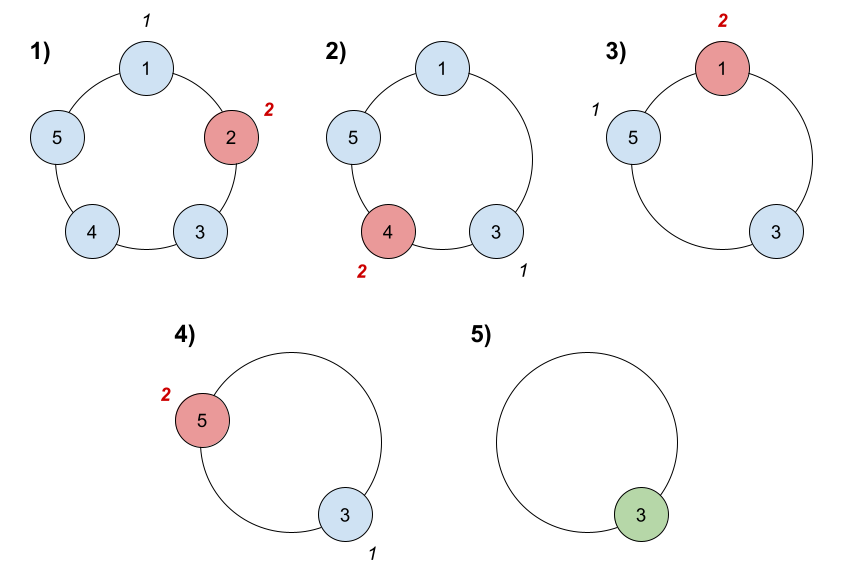
Input: n = 5, k = 2
Output: 3
Explanation: Here are the steps of the game:
1) Start at friend 1.
2) Count 2 friends clockwise, which are friends 1 and 2.
3) Friend 2 leaves the circle. Next start is friend 3.
4) Count 2 friends clockwise, which are friends 3 and 4.
5) Friend 4 leaves the circle. Next start is friend 5.
6) Count 2 friends clockwise, which are friends 5 and 1.
7) Friend 1 leaves the circle. Next start is friend 3.
8) Count 2 friends clockwise, which are friends 3 and 5.
9) Friend 5 leaves the circle. Only friend 3 is left, so they are the winner.
Example 2:
Input: n = 6, k = 5
Output: 1
Explanation: The friends leave in this order: 5, 4, 6, 2, 3. The winner is friend 1.
Constraints:
1 <= k <= n <= 500
Follow up:
Could you solve this problem in linear time with constant space?
Approach Overview
Problem Overview: You have n friends standing in a circle. Starting from the first friend, every k-th friend is eliminated until only one person remains. The task is to return the label of the final survivor. This is a classic variation of the Josephus problem often solved with simulation or a direct mathematical recurrence.
Approach 1: Simulating the Process with a List (O(n*k) time, O(n) space)
This approach directly models the game. Store players 1..n in a list or queue and repeatedly remove the k-th player while moving around the circle. Maintain an index that advances by k - 1 positions each round using modulo arithmetic to wrap around the list. After removing a player, the next count continues from the same index because the circle shrinks. The process continues until only one element remains in the list. This solution is intuitive and mirrors the real game mechanics, making it useful for understanding the elimination process. However, list deletions and repeated traversal lead to O(n*k) time in the worst case.
The implementation often uses a dynamic array or queue structure from the array family. Each iteration performs an index calculation and removal, which shifts remaining elements. For large inputs, this repeated removal becomes the main bottleneck.
Approach 2: Mathematical Solution using Josephus Problem (O(n) time, O(1) space)
The circular elimination follows a well-known recurrence called the Josephus formula. Instead of simulating removals, compute the survivor position incrementally. If f(n, k) represents the winner among n players, the recurrence is:
f(n, k) = (f(n - 1, k) + k) % n
Start with the base case f(1, k) = 0 (0-indexed). Iterate from 2 to n, updating the survivor index each step. The final answer is converted to 1-indexed by adding 1. This approach eliminates the need for explicit simulation and avoids repeated deletions. The logic can also be written using recursion, though the iterative form avoids stack overhead.
This mathematical insight reduces the problem to a simple loop and constant memory usage. The algorithm runs in O(n) time and O(1) space, which is optimal for this problem.
Recommended for interviews: Start with the simulation idea because it shows you understand the circular elimination process. Then derive or mention the Josephus recurrence to reach the O(n) solution. Interviewers typically expect the mathematical approach since it demonstrates deeper algorithmic reasoning beyond straightforward simulation.
Approach 1: Approach 1: Simulating the Process with a List
This approach simulates the game using a list (or array) to represent the friends. We start from the first friend and iteratively remove the k-th friend (considering the wrap around for the circle) until only one friend remains. The advantage of this method is its simplicity and straightforwardness, although it might not be the most efficient solution.
Steps:
- Initialize a list of friends.
- Start from the first friend.
- In each iteration, compute the index of the friend to be eliminated.
- Remove the friend from the list.
- Continue the process until only one friend is left.
This C code defines a function `findTheWinner` that constructs an array `friends` representing the circle and uses a loop to simulate the elimination process. The `index` keeps track of the current position, and friends are removed by shifting elements.
Complexity
Time Complexity: O(n^2), as each friend removal involves an O(n) operation in the worst case.
Space Complexity: O(n), due to the additional array used to represent friends.
Approach 2: Approach 2: Mathematical Solution using Josephus Problem
The problem can be reduced to a well-known mathematical problem called the Josephus Problem. Instead of simulating each elimination, we derive the position of the winner directly using a mathematical formula.
The formula for the winner's position in the Josephus problem (0-indexed) is given by:
f(n) = (f(n-1) + k) % n for n > 1, and f(1) = 0 as the base case.
To get the result in 1-indexing that our problem requires, we add 1 to the result.
This C implementation uses the iterative formula for the Josephus Problem to find the winner efficiently without simulating each elimination.
Complexity
Time Complexity: O(n), iterating once for each friend.
Space Complexity: O(1), using a constant amount of space.
Approach 3: Default Approach
Code
Python
Java
C++
Go
TypeScript
Rust
JavaScript
Approach 4: Simulation
Code
TypeScript
JavaScript
Complexity Comparison
| Approach | Complexity |
|---|---|
| Approach 1: Simulating the Process with a List | Time Complexity: O(n^2), as each friend removal involves an O(n) operation in the worst case. |
| Approach 2: Mathematical Solution using Josephus Problem | Time Complexity: O(n), iterating once for each friend. |
| Default Approach | — |
| Simulation | — |
Detailed Complexity Analysis
| Approach | Time | Space | When to Use |
|---|---|---|---|
| Simulating the Process with a List | O(n*k) | O(n) | When you want a straightforward implementation that mirrors the game process |
| Mathematical Josephus Solution | O(n) | O(1) | Best for interviews and large inputs where simulation would be slower |
Video Solution
Find the Winner of the Circular Game - Leetcode 1823 - Python • NeetCodeIO • 19,361 views views
Watch 9 more video solutions →Frequently Asked Questions
Is Find the Winner of the Circular Game easy or hard?
How to solve Find the Winner of the Circular Game in O(n)?
Find the Winner of the Circular Game Python or Java solution?
What is the best approach for Find the Winner of the Circular Game?
What data structure is used in Find the Winner of the Circular Game?
What is the time complexity of Find the Winner of the Circular Game?
Is Find the Winner of the Circular Game asked at Google, Amazon, or Meta?
Ready to solve this problem?
Practice Find the Winner of the Circular Game with our built-in code editor and test cases.
Practice on FleetCodeProblem Info
Table of Contents
Practice this problem
Open in Editor