
Find the Maximum Sum of Node Values - Solution & Explanation
Problem Statement
There exists an undirected tree with n nodes numbered 0 to n - 1. You are given a 0-indexed 2D integer array edges of length n - 1, where edges[i] = [ui, vi] indicates that there is an edge between nodes ui and vi in the tree. You are also given a positive integer k, and a 0-indexed array of non-negative integers nums of length n, where nums[i] represents the value of the node numbered i.
Alice wants the sum of values of tree nodes to be maximum, for which Alice can perform the following operation any number of times (including zero) on the tree:
- Choose any edge
[u, v]connecting the nodesuandv, and update their values as follows:nums[u] = nums[u] XOR knums[v] = nums[v] XOR k
Return the maximum possible sum of the values Alice can achieve by performing the operation any number of times.
Example 1:
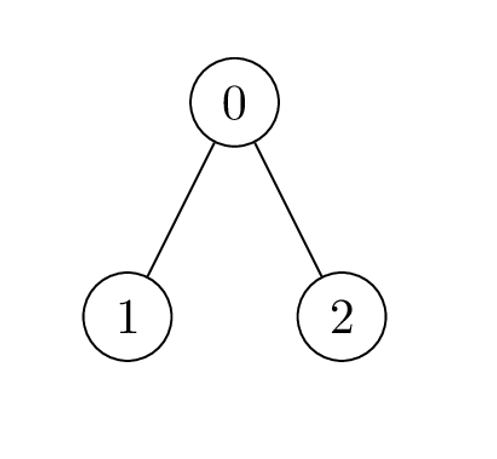
Input: nums = [1,2,1], k = 3, edges = [[0,1],[0,2]]
Output: 6
Explanation: Alice can achieve the maximum sum of 6 using a single operation:
- Choose the edge [0,2]. nums[0] and nums[2] become: 1 XOR 3 = 2, and the array nums becomes: [1,2,1] -> [2,2,2].
The total sum of values is 2 + 2 + 2 = 6.
It can be shown that 6 is the maximum achievable sum of values.
Example 2:
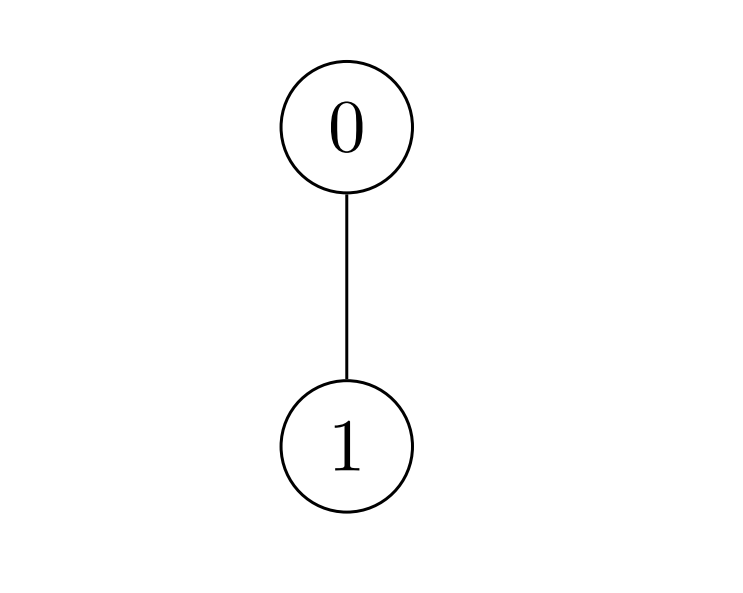
Input: nums = [2,3], k = 7, edges = [[0,1]]
Output: 9
Explanation: Alice can achieve the maximum sum of 9 using a single operation:
- Choose the edge [0,1]. nums[0] becomes: 2 XOR 7 = 5 and nums[1] become: 3 XOR 7 = 4, and the array nums becomes: [2,3] -> [5,4].
The total sum of values is 5 + 4 = 9.
It can be shown that 9 is the maximum achievable sum of values.
Example 3:
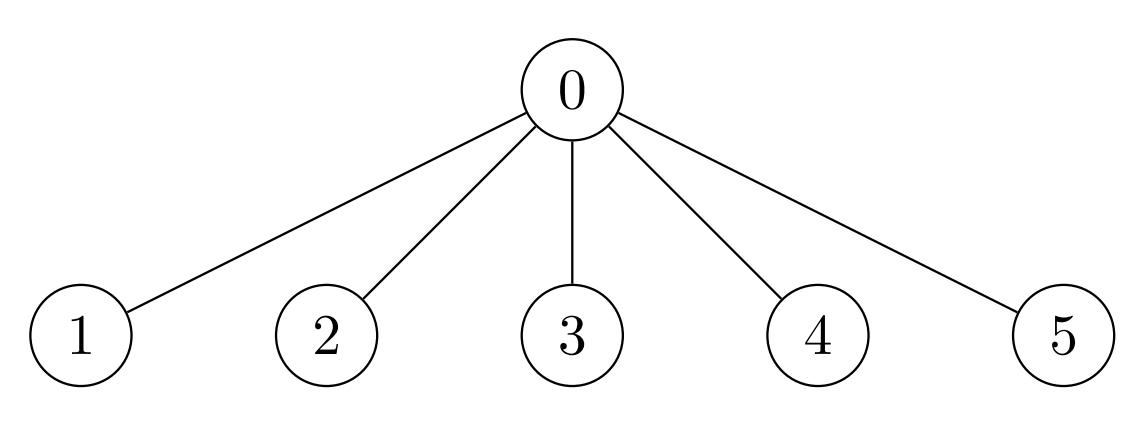
Input: nums = [7,7,7,7,7,7], k = 3, edges = [[0,1],[0,2],[0,3],[0,4],[0,5]]
Output: 42
Explanation: The maximum achievable sum is 42 which can be achieved by Alice performing no operations.
Constraints:
2 <= n == nums.length <= 2 * 1041 <= k <= 1090 <= nums[i] <= 109edges.length == n - 1edges[i].length == 20 <= edges[i][0], edges[i][1] <= n - 1- The input is generated such that
edgesrepresent a valid tree.
Approach Overview
Problem Overview: You are given a tree where each node has a value. An operation selects an edge and XORs both endpoint values with k. Perform any number of operations to maximize the total sum of node values. The key constraint is that every operation affects two nodes simultaneously.
Approach 1: Brute Force Edge Operation Simulation (Exponential Time)
The most direct way is to try every possible combination of XOR operations on edges. Each operation flips two node values using value ^ k, so different sequences of operations produce different states. A brute-force solution explores these states recursively or via bitmask simulation and computes the resulting sum for each configuration. The state space grows exponentially because each edge can be toggled multiple times. This leads to roughly O(2^n) time in the worst case with O(n) space for recursion or state tracking. It demonstrates the operation behavior but becomes infeasible for large trees.
Approach 2: Greedy Gain Selection with Parity Constraint (O(n) time)
The key observation: applying the XOR operation on edges effectively toggles node values in pairs. That means the number of nodes whose value changes must always be even. For each node, compute the gain if XOR is applied: gain = (nums[i] ^ k) - nums[i]. This transforms the problem into choosing a subset of nodes to flip such that the total gain is maximized while the number of chosen nodes remains even.
Iterate through the array and add all positive gains because they increase the total sum. Track the count of chosen nodes and also keep the smallest absolute gain difference. If the count of positive gains is even, the result is simply the base sum plus all positive gains. If the count is odd, adjust by either removing the smallest positive gain or including the least harmful negative gain. This greedy evaluation works because each node decision is independent except for the global even-parity constraint.
The algorithm runs in O(n) time and O(1) extra space while scanning the array once. Although the input includes a tree, the structure does not affect the final decision because any pair of nodes can effectively be toggled through edge operations. The reasoning combines bit manipulation (using XOR) with a parity-style dynamic programming insight.
Recommended for interviews: The greedy parity approach is what interviewers expect. It shows you recognized the hidden constraint that operations affect nodes in pairs and converted the tree problem into a gain-selection problem. Mentioning the brute-force idea first demonstrates understanding of the operation mechanics, while deriving the O(n) greedy solution shows strong problem-solving skills.
Approach 1: Brute Force Approach
This approach involves checking all possible operations on each edge and calculating the resulting sum by applying the XOR operation. We must continuously update and evaluate for every operation on each pair of nodes linked by an edge to see if the resulting sum after the operation is beneficial.
This naive strategy will consider 2^n operations (since each edge can have 2 XOR states per pair), making it inefficient for larger datasets. Ideal for understanding XOR effects but not recommended for large n.
This C function calculates the maximum possible sum by performing ARC XOR operations optimally on each edge. The initial sum is calculated, then for each edge, the potential new sum after the operation is checked and updated if beneficial.
Complexity
Time Complexity: O(n), where n is the number of nodes. Each iteration is constant time.
Space Complexity: O(1), since additional space used is constant.
Approach 2: Optimized Evaluation
Instead of brute checking each edge operation individually, observe that XOR operation symmetry allows flipping of node values to be optimal only when advantageous. Analyze and preprocess which nodes when XOR'd with k will increase their value and prioritize these changes globally without redundant individual edge checks.
This idea is crucially about observing which nodes independently contribute more value when toggled and using the tree structure to apply XOR operations optimally.
This C code efficiently determines the maximum sum by comparing the original sum to the sum if every node were XOR'd independently with k. This leverages XOR symmetry to quickly evaluate if any operation is beneficial globally.
Complexity
Time Complexity: O(n), as it processes each node individually once.
Space Complexity: O(1), using a fixed amount of extra space.
Approach 3: Dynamic Programming
For any number x, its value remains unchanged after being XORed with k an even number of times. Therefore, for any path in a tree, if we perform the operation on all edges in the path, the values of all nodes on the path except the start and end nodes will not change.
Additionally, no matter how many operations are performed, there will always be an even number of elements XORed with k, and the remaining elements will remain unchanged.
Thus, the problem is transformed into: for the array nums, select an even number of elements to XOR with k to maximize the sum.
We can use dynamic programming to solve this problem. Let f_0 represent the maximum sum when an even number of elements have been XORed with k, and f_1 represent the maximum sum when an odd number of elements have been XORed with k. The state transition equations are:
$
\begin{aligned}
f_0 &= max(f_0 + x, f_1 + (x \oplus k)) \
f_1 &= max(f_1 + x, f_0 + (x \oplus k))
\end{aligned}
where x represents the current element's value.
We traverse the array nums and update f_0 and f_1 according to the above state transition equations. Finally, we return f_0.
The time complexity is O(n), where n is the length of the array nums. The space complexity is O(1)$.
Complexity Comparison
| Approach | Complexity |
|---|---|
| Brute Force Approach | Time Complexity: O(n), where n is the number of nodes. Each iteration is constant time. |
| Optimized Evaluation | Time Complexity: O(n), as it processes each node individually once. |
| Dynamic Programming | — |
Detailed Complexity Analysis
| Approach | Time | Space | When to Use |
|---|---|---|---|
| Brute Force Edge Simulation | O(2^n) | O(n) | Conceptual understanding of how edge XOR operations affect node states |
| Greedy Gain Selection with Parity Constraint | O(n) | O(1) | Optimal solution for large inputs; handles the even-toggle constraint efficiently |
Video Solution
Find the Maximum Sum of Node Values - Leetcode 3068 - Python • NeetCodeIO • 17,589 views views
Watch 9 more video solutions →Frequently Asked Questions
Is Find the Maximum Sum of Node Values easy or hard?
Find the Maximum Sum of Node Values Python/Java solution
How to solve Find the Maximum Sum of Node Values in O(n)?
What is the best approach for Find the Maximum Sum of Node Values?
Is Find the Maximum Sum of Node Values asked at Google/Amazon/Meta?
What data structure is used in Find the Maximum Sum of Node Values?
What is the time complexity of Find the Maximum Sum of Node Values?
Ready to solve this problem?
Practice Find the Maximum Sum of Node Values with our built-in code editor and test cases.
Practice on FleetCode