
Find Distance in a Binary Tree - Solution & Explanation
Problem Statement
Given the root of a binary tree and two integers p and q, return the distance between the nodes of value p and value q in the tree.
The distance between two nodes is the number of edges on the path from one to the other.
Example 1:
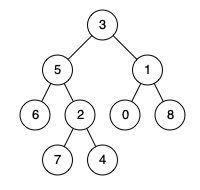
Input: root = [3,5,1,6,2,0,8,null,null,7,4], p = 5, q = 0
Output: 3
Explanation: There are 3 edges between 5 and 0: 5-3-1-0.
Example 2:
Input: root = [3,5,1,6,2,0,8,null,null,7,4], p = 5, q = 7
Output: 2
Explanation: There are 2 edges between 5 and 7: 5-2-7.
Example 3:
Input: root = [3,5,1,6,2,0,8,null,null,7,4], p = 5, q = 5
Output: 0
Explanation: The distance between a node and itself is 0.
Constraints:
- The number of nodes in the tree is in the range
[1, 104]. 0 <= Node.val <= 109- All
Node.valare unique. pandqare values in the tree.
Approach Overview
Problem Overview: Given the root of a binary tree and two node values p and q, compute the number of edges in the shortest path between them. The distance is the count of edges you must traverse to move from node p to node q.
Approach 1: Path to Root Comparison (O(n) time, O(n) space)
One straightforward strategy stores the path from the root to each target node. Use a Depth-First Search to build two arrays: the path to p and the path to q. Iterate from the beginning of both paths until the nodes diverge. The last common node is the Lowest Common Ancestor (LCA). The distance becomes (len(path_p) - i) + (len(path_q) - i), where i is the divergence index. This approach is easy to reason about and useful when you want explicit root-to-node paths.
Approach 2: Convert Tree to Graph + BFS (O(n) time, O(n) space)
A binary tree does not normally allow upward traversal. Build a parent map using a DFS traversal and store each node's parent in a hash table. After that, treat the tree like an undirected graph. Start a Breadth-First Search from node p. At every step, explore the left child, right child, and parent while tracking visited nodes. BFS guarantees the first time you reach q is through the shortest path. The BFS level count directly represents the distance in edges.
Approach 3: Lowest Common Ancestor + Depth Search (O(n) time, O(h) space)
The most common interview solution finds the Lowest Common Ancestor of nodes p and q in a binary tree. First run a DFS to locate the LCA. Once the LCA is known, run another DFS from the LCA to compute the depth to p and the depth to q. The total distance is the sum of those two depths. This works because every path between two nodes must pass through their LCA. The recursion stack only stores nodes along the current branch, so space depends on tree height h.
Recommended for interviews: The LCA + depth search approach is the one interviewers expect. It shows you understand tree structure and avoids unnecessary parent maps or extra arrays. The BFS-with-parent-map solution is also valid and often easier to implement quickly. Mentioning the path-comparison method first demonstrates your reasoning from brute force to optimal design.
Solution
Try this approach in the editor →Detailed Complexity Analysis
| Approach | Time | Space | When to Use |
|---|---|---|---|
| Path to Root Comparison | O(n) | O(n) | When you want explicit root-to-node paths or a simple conceptual solution |
| Parent Map + BFS | O(n) | O(n) | When treating the tree as an undirected graph simplifies traversal |
| Lowest Common Ancestor + DFS | O(n) | O(h) | Best general solution for interviews and typical binary tree problems |
Video Solution
FIND DISTANCE IN BINARY TREE | LEETCODE 1740 | PYTHON GRAPH BFS SOLUTION • Cracking FAANG • 2,070 views views
Watch 5 more video solutions →Frequently Asked Questions
Is Find Distance in a Binary Tree easy or hard?
Find Distance in a Binary Tree Python/Java solution
How to solve Find Distance in a Binary Tree in O(n)?
What is the best approach for Find Distance in a Binary Tree?
Is Find Distance in a Binary Tree asked at Google/Amazon/Meta?
What data structure is used in Find Distance in a Binary Tree?
What is the time complexity of Find Distance in a Binary Tree?
Ready to solve this problem?
Practice Find Distance in a Binary Tree with our built-in code editor and test cases.
Practice on FleetCodeTable of Contents
Practice this problem
Open in Editor