
Delete Leaves With a Given Value - Solution & Explanation
Problem Statement
Given a binary tree root and an integer target, delete all the leaf nodes with value target.
Note that once you delete a leaf node with value target, if its parent node becomes a leaf node and has the value target, it should also be deleted (you need to continue doing that until you cannot).
Example 1:
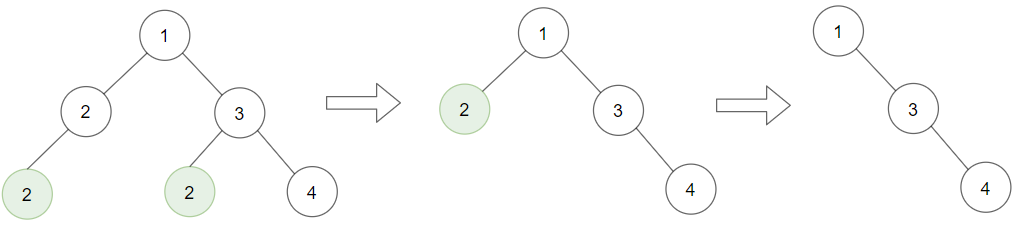
Input: root = [1,2,3,2,null,2,4], target = 2
Output: [1,null,3,null,4]
Explanation: Leaf nodes in green with value (target = 2) are removed (Picture in left).
After removing, new nodes become leaf nodes with value (target = 2) (Picture in center).
Example 2:
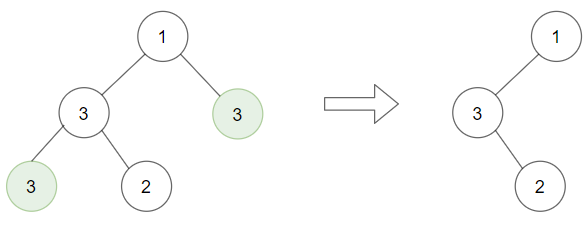
Input: root = [1,3,3,3,2], target = 3
Output: [1,3,null,null,2]
Example 3:
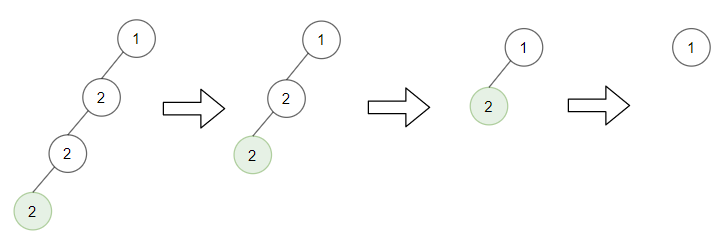
Input: root = [1,2,null,2,null,2], target = 2
Output: [1]
Explanation: Leaf nodes in green with value (target = 2) are removed at each step.
Constraints:
- The number of nodes in the tree is in the range
[1, 3000]. 1 <= Node.val, target <= 1000
Approach Overview
Problem Overview: Given the root of a binary tree and a target value, remove every leaf node whose value equals the target. After deleting a leaf, its parent might become a new leaf that also matches the target, so the process continues until no such leaves remain.
Approach 1: Recursive Depth-First Search (Post-Order DFS) (Time: O(n), Space: O(h))
The cleanest solution uses depth-first search with a post-order traversal. Traverse to the left and right children first, then evaluate the current node. After recursion returns, check whether both children are null and the node value equals the target. If so, return null to the parent, effectively deleting the node.
The key insight: a node can only become a removable leaf after its children are processed. Post-order traversal guarantees that children are handled before their parent. Each node is visited once, so the total work is linear. The recursion stack grows proportional to the tree height h, which is O(log n) for balanced trees and O(n) in the worst case.
This approach works naturally with recursive tree processing and is commonly used in tree and binary tree problems where parent decisions depend on child results.
Approach 2: Iterative Post-Order Traversal (Time: O(n), Space: O(n))
An iterative solution simulates post-order traversal using an explicit stack. Push nodes while traversing down the tree and track whether the node has already visited its children. When both children have been processed, evaluate whether the node is now a leaf with the target value.
If the node should be deleted, update its parent pointer in the stack structure to remove the reference. This approach mirrors the recursive logic but manages traversal state manually. The main advantage is avoiding recursion limits in languages or environments where stack depth could be large.
Because every node is pushed and processed once, the traversal still runs in O(n) time. The explicit stack can hold up to O(n) nodes in skewed trees.
Recommended for interviews: Recursive DFS with post-order traversal. It expresses the core idea directly: process children first, then decide whether the current node becomes a removable leaf. Showing the recursive version demonstrates strong understanding of tree recursion. The iterative version is useful when interviewers specifically ask for a non-recursive traversal or stack-based implementation.
Approach 1: Recursive Depth-First Search (DFS)
This approach involves using a recursive DFS to navigate through the binary tree. We start from the root and check the leaf nodes. If a leaf node matches the target value, we remove it by returning null; otherwise, return the node itself. This should also be applied recursively to handle cases where removing a leaf creates another leaf node which must also be removed.
In this solution, we recursively dive into the left and right subtrees to remove the leaf nodes with the target value. After modifying both subtrees, we check if the current node has become a leaf with the target value and delete it if so.
Complexity
Time Complexity: O(n), where n is the number of nodes in the tree, since we visit each node exactly once.
Space Complexity: O(h), where h is the height of the tree, due to the recursion stack.
Approach 2: Iterative Post-Order Traversal
This approach uses an iterative post-order traversal to visit the nodes of the binary tree. By using a stack, we can simulate the recursive process, ensuring we evaluate and remove leaf nodes correctly by visiting left, right, and then parent nodes.
This JavaScript solution uses an iterative approach to simulate the post-order traversal. By attaching a dummy node to facilitate handling the root node, each node and its corresponding direction (left/right) are pushed onto a stack. As nodes are processed, if a node matches the target and is a leaf, it is removed by setting its parent's pointer to null.
Code
JavaScript
C#
Complexity
Time Complexity: O(n), each node is visited once.
Space Complexity: O(h), where h is the height of the tree, required for the stack.
Approach 3: Default Approach
Code
Python
Java
C++
Go
TypeScript
Complexity Comparison
| Approach | Complexity |
|---|---|
| Recursive Depth-First Search (DFS) | Time Complexity: O(n), where n is the number of nodes in the tree, since we visit each node exactly once. |
| Iterative Post-Order Traversal | Time Complexity: O(n), each node is visited once. |
| Default Approach | — |
Detailed Complexity Analysis
| Approach | Time | Space | When to Use |
|---|---|---|---|
| Recursive Depth-First Search (Post-Order) | O(n) | O(h) | Best general solution. Simple logic when using recursion on binary trees. |
| Iterative Post-Order Traversal | O(n) | O(n) | Useful when recursion depth could be large or when an interviewer asks for an iterative traversal. |
Video Solution
Delete Leaves With a Given Value - Leetcode 1325 - Python • NeetCodeIO • 10,931 views views
Watch 9 more video solutions →Frequently Asked Questions
Is Delete Leaves With a Given Value easy or hard?
Delete Leaves With a Given Value Python/Java solution
How to solve Delete Leaves With a Given Value in O(n)?
What is the best approach for Delete Leaves With a Given Value?
Is Delete Leaves With a Given Value asked at Google/Amazon/Meta?
What data structure is used in Delete Leaves With a Given Value?
What is the time complexity of Delete Leaves With a Given Value?
Ready to solve this problem?
Practice Delete Leaves With a Given Value with our built-in code editor and test cases.
Practice on FleetCodeProblem Info
Table of Contents
Practice this problem
Open in Editor