
Construct Quad Tree - Solution & Explanation
Problem Statement
Given a n * n matrix grid of 0's and 1's only. We want to represent grid with a Quad-Tree.
Return the root of the Quad-Tree representing grid.
A Quad-Tree is a tree data structure in which each internal node has exactly four children. Besides, each node has two attributes:
val: True if the node represents a grid of 1's or False if the node represents a grid of 0's. Notice that you can assign thevalto True or False whenisLeafis False, and both are accepted in the answer.isLeaf: True if the node is a leaf node on the tree or False if the node has four children.
class Node {
    public boolean val;
    public boolean isLeaf;
    public Node topLeft;
    public Node topRight;
    public Node bottomLeft;
    public Node bottomRight;
}
We can construct a Quad-Tree from a two-dimensional area using the following steps:
- If the current grid has the same value (i.e all
1'sor all0's) setisLeafTrue and setvalto the value of the grid and set the four children to Null and stop. - If the current grid has different values, set
isLeafto False and setvalto any value and divide the current grid into four sub-grids as shown in the photo. - Recurse for each of the children with the proper sub-grid.

If you want to know more about the Quad-Tree, you can refer to the wiki.
Quad-Tree format:
You don't need to read this section for solving the problem. This is only if you want to understand the output format here. The output represents the serialized format of a Quad-Tree using level order traversal, where null signifies a path terminator where no node exists below.
It is very similar to the serialization of the binary tree. The only difference is that the node is represented as a list [isLeaf, val].
If the value of isLeaf or val is True we represent it as 1 in the list [isLeaf, val] and if the value of isLeaf or val is False we represent it as 0.
Example 1:

Input: grid = [[0,1],[1,0]]
Output: [[0,1],[1,0],[1,1],[1,1],[1,0]]
Explanation: The explanation of this example is shown below:
Notice that 0 represents False and 1 represents True in the photo representing the Quad-Tree.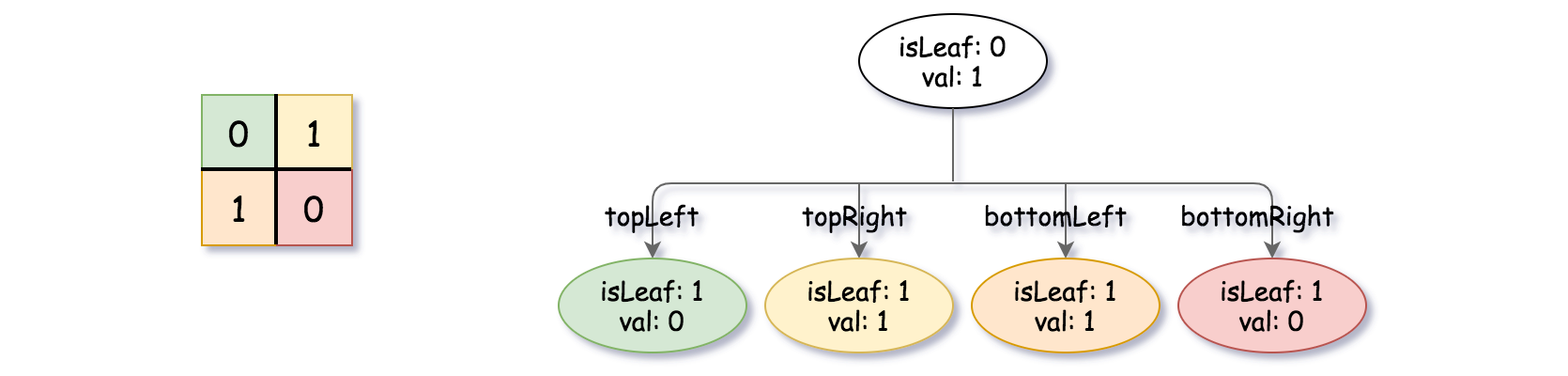
Example 2:
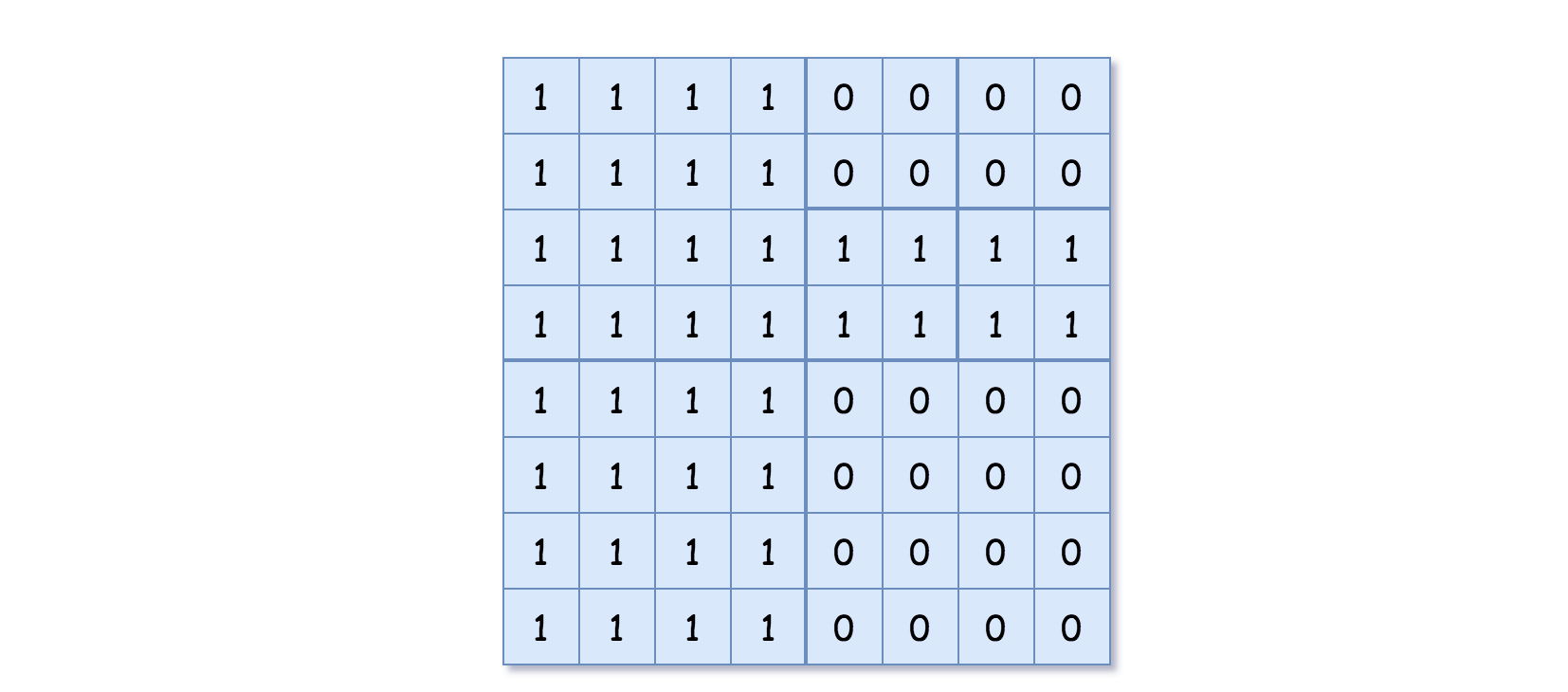
Input: grid = [[1,1,1,1,0,0,0,0],[1,1,1,1,0,0,0,0],[1,1,1,1,1,1,1,1],[1,1,1,1,1,1,1,1],[1,1,1,1,0,0,0,0],[1,1,1,1,0,0,0,0],[1,1,1,1,0,0,0,0],[1,1,1,1,0,0,0,0]]
Output: [[0,1],[1,1],[0,1],[1,1],[1,0],null,null,null,null,[1,0],[1,0],[1,1],[1,1]]
Explanation: All values in the grid are not the same. We divide the grid into four sub-grids.
The topLeft, bottomLeft and bottomRight each has the same value.
The topRight have different values so we divide it into 4 sub-grids where each has the same value.
Explanation is shown in the photo below: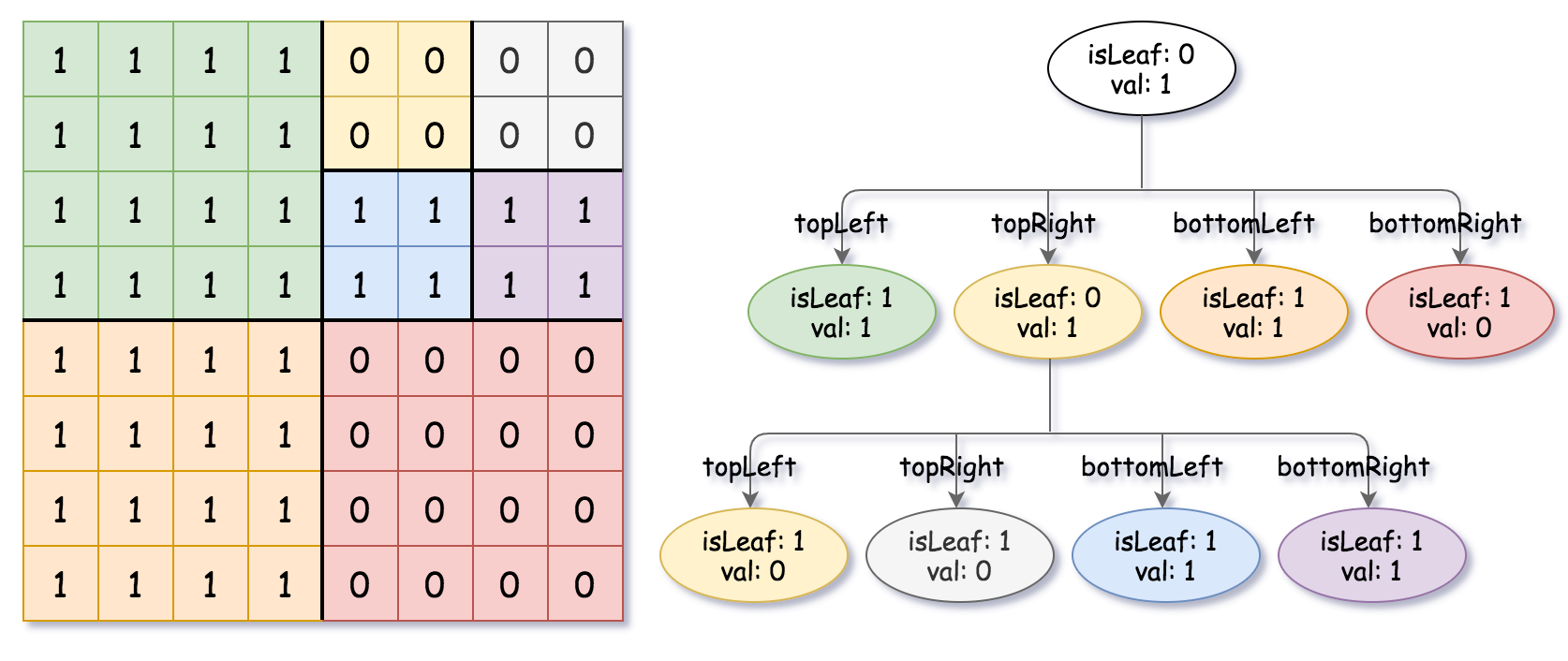
Constraints:
n == grid.length == grid[i].lengthn == 2xwhere0 <= x <= 6
Approach Overview
Problem Overview: Given an n x n binary matrix, build a quad tree representation. Each node represents a square region. If every value in the region is the same (all 0s or all 1s), create a leaf node. Otherwise split the region into four equal quadrants and repeat the process.
Approach 1: Recursive Division (Divide and Conquer) (Time: O(n^2 log n), Space: O(log n))
This approach directly models how a quad tree works. Start with the full matrix. Check whether all values inside the current region are identical. If they are, return a leaf node with that value. If not, split the region into four equal quadrants: top-left, top-right, bottom-left, and bottom-right. Recursively construct nodes for each quadrant and attach them as children.
The key insight is that a quad tree compresses uniform regions. Large areas with identical values become a single node instead of many cells. The recursion naturally follows the structure of divide and conquer. Each recursive call works on a smaller square until the region becomes uniform or reaches size 1.
Uniformity checking requires scanning the current submatrix. In the worst case (a checkerboard-like matrix), every level scans many cells again, leading to O(n^2 log n) total time. The recursion depth is log n, which determines the auxiliary stack space.
This approach is the most common solution used in interviews and editorials. It clearly demonstrates understanding of quad tree construction and recursive decomposition of a matrix.
Approach 2: Iterative Construction Using Queue (Time: O(n^2 log n), Space: O(n^2))
An iterative version simulates the recursion with a queue. Each queue entry stores the boundaries of a matrix region along with the node that represents it. Dequeue a region, check whether all values are identical, and mark the node as a leaf if so. If the region contains mixed values, split it into four subregions and enqueue them while creating child nodes.
This approach replaces the recursive call stack with an explicit queue, which some engineers prefer when recursion depth might be large. The logic is similar: repeatedly subdivide until each node represents a uniform region.
The complexity remains O(n^2 log n) because each region may still require scanning its cells. However, space usage can grow to O(n^2) in the worst case when many subregions are waiting in the queue. The approach still relies on the same structural properties of a tree built over the original array grid.
Recommended for interviews: The recursive divide and conquer solution is what interviewers expect. It mirrors the definition of a quad tree and produces concise code. Showing the recursive approach first demonstrates strong understanding of tree construction, while discussing the iterative queue version shows you can translate recursion into explicit data structure management.
Approach 1: Recursive Division Approach
This approach involves recursively dividing the grid into four quadrants until each subdivision is either uniform (composed of the same elements) or a minimum size is reached. The base case of the recursion is when the grid section being considered is uniform, guiding us to create a leaf node. Otherwise, you recursively create non-leaf nodes and divide the grid further.
This solution defines a tree node class and a function to recursively construct the Quad-Tree. The function checks if a block in the grid is uniform and creates nodes accordingly, returning the root of the constructed tree.
Complexity
Time Complexity: O(n^2 * log(n)), where n is the length of the grid. Each division checks floor(n^2) cells for uniformity.
Space Complexity: O(log(n)), due to the recursion stack depth.
Approach 2: Iterative Approach Using Queue
This approach involves using a queue data structure for constructing the Quad-Tree iteratively. Initially, you enqueue the entire grid with its coordinates. By dequeuing elements and checking uniformity, you either create a leaf node or enqueue its four sub-regions for further processing.
The C++ solution utilizes an iterative technique by gradually processing nodes via a queue. Each iteration checks for uniform grids, constructing either leaf or non-leaf nodes, and breaks down non-uniform areas for further examination.
Code
C++
JavaScript
Complexity
Time Complexity: O(n^2), as each entry in the grid must be visited to verify uniformity.
Space Complexity: O(n^2) in the worst case, since there's a possibility of storing every grid block in separate nodes.
Approach 3: Default Approach
Try this approach in the editor →Complexity Comparison
| Approach | Complexity |
|---|---|
| Recursive Division Approach | Time Complexity: O(n^2 * log(n)), where n is the length of the grid. Each division checks floor(n^2) cells for uniformity. |
| Iterative Approach Using Queue | Time Complexity: O(n^2), as each entry in the grid must be visited to verify uniformity. |
| Default Approach | — |
Detailed Complexity Analysis
| Approach | Time | Space | When to Use |
|---|---|---|---|
| Recursive Division (Divide and Conquer) | O(n^2 log n) | O(log n) | Standard interview solution. Clean recursive structure that directly models quad tree construction. |
| Iterative Approach Using Queue | O(n^2 log n) | O(n^2) | Useful when avoiding recursion or when implementing tree construction iteratively. |
Video Solution
Construct Quad Tree - Leetcode 427 - Python • NeetCodeIO • 48,614 views views
Watch 9 more video solutions →Frequently Asked Questions
Is Construct Quad Tree easy or hard?
Construct Quad Tree Python/Java solution
How to solve Construct Quad Tree in O(n)?
What is the best approach for Construct Quad Tree?
Is Construct Quad Tree asked at Google/Amazon/Meta?
What data structure is used in Construct Quad Tree?
What is the time complexity of Construct Quad Tree?
Ready to solve this problem?
Practice Construct Quad Tree with our built-in code editor and test cases.
Practice on FleetCode