Given an array of integers preorder, which represents the preorder traversal of a BST (i.e., binary search tree), construct the tree and return its root.
It is guaranteed that there is always possible to find a binary search tree with the given requirements for the given test cases.
A binary search tree is a binary tree where for every node, any descendant of Node.left has a value strictly less than Node.val, and any descendant of Node.right has a value strictly greater than Node.val.
A preorder traversal of a binary tree displays the value of the node first, then traverses Node.left, then traverses Node.right.
Example 1:
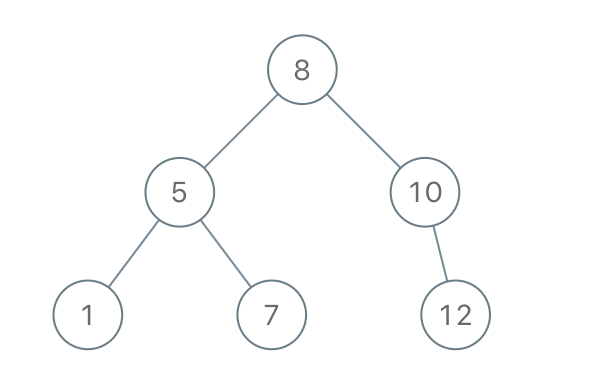
Input: preorder = [8,5,1,7,10,12]
Output: [8,5,10,1,7,null,12]
Example 2:
Input: preorder = [1,3]
Output: [1,null,3]
Constraints:
1 <= preorder.length <= 1001 <= preorder[i] <= 1000preorder are unique.Problem Overview: Given an array representing the preorder traversal of a Binary Search Tree, reconstruct the original BST and return its root. The preorder order guarantees that every node appears before its left and right subtree, while BST rules ensure left < root < right.
Approach 1: Recursive Insertion (Time: O(n^2), Space: O(h))
This approach builds the tree the same way values would be inserted into a normal BST. Iterate through the preorder array and insert each value into the tree using a recursive BST insert routine. For every insertion, traverse left or right depending on the value comparison until you find the correct position. The logic is simple and mirrors standard BST operations, which makes it easy to implement during interviews. The drawback is performance: if the preorder array is sorted, the BST becomes skewed and each insertion scans most of the tree, resulting in O(n^2) time.
Approach 2: Stack-based Iterative Construction (Time: O(n), Space: O(n))
This optimized method uses a stack to track the path of nodes whose right child hasn't been assigned yet. Start by creating the root from the first preorder value and push it onto the stack. For each next value, check the top of the stack. If the value is smaller, it becomes the left child of the top node. If the value is larger, pop nodes until you find the correct parent where the value should be attached as the right child. The stack maintains a decreasing sequence of ancestors, similar to a monotonic stack. Each element is pushed and popped at most once, giving O(n) time complexity.
The key insight comes from preorder traversal properties: nodes appear in root-left-right order, so once you encounter a value greater than a node, you've finished that node's left subtree and are moving to the right subtree. The stack efficiently tracks this transition.
Recommended for interviews: Interviewers typically expect the O(n) stack solution because it demonstrates understanding of preorder traversal constraints and Binary Search Tree structure. The recursive insertion approach still helps show baseline reasoning and correctness before optimizing.
In this approach, you will construct the binary search tree (BST) by recursively inserting nodes. The property of the BST is used where, for each node, nodes in the left subtree are less, and nodes in the right subtree are greater.
Start with the first element from the preorder sequence, which will be the root. Recursively insert subsequent elements using the BST insertion logic, and this will ensure that the tree constructed respects both the structure of a BST and adheres to the given preorder traversal.
This C solution recursively inserts each element of the preorder array into the BST using standard recursive insertion. Starting with the first element as the root, it iteratively adds each subsequent element by comparing values and guiding the insertion either to the left or the right subtree appropriately.
Time Complexity: O(n^2) in the worst case due to skewed trees where each insertion is O(n).
Space Complexity: O(n) due to the recursion stack and additional space for the BST nodes.
This approach uses a stack to iteratively construct the BST from the preorder traversal, which helps in achieving better average performance. Begin with the root node from the first preorder element, and iterate over the rest of the array with a technique to adjust parents as potential ancestors using a stack. Primary benefit is an average O(n log n) time complexity due to more constant-time parent-backtracking via stack use.
This C implementation uses an auxiliary stack structure to iteratively build the BST. By iterating over the preorder list, it appends each node either as a left child (when smaller) or as a right child using the stack to backtrack dynamically to suitable parent nodes.
Time Complexity: O(n), processing each node in a single pass with constant-time stack operations.
Space Complexity: O(n) due to the usage of an explicit stack for nodes.
We design a function dfs(i, j) to construct a binary search tree from the nodes preorder[i] to preorder[j]. The answer is dfs(0, n - 1).
In dfs(i, j), we first construct the root node, which is preorder[i]. Then, we use binary search to find the first node greater than preorder[i] and get its index mid. We set dfs(i + 1, mid - 1) as the left subtree of the root node and dfs(mid, j) as the right subtree of the root node.
Finally, we return the root node.
The time complexity is O(n times log n), and the space complexity is O(n). Here, n is the length of the array preorder.
| Approach | Complexity |
|---|---|
| Approach 1: Recursive Insertion | Time Complexity: O(n^2) in the worst case due to skewed trees where each insertion is O(n). |
| Approach 2: Stack-based Iterative Construction | Time Complexity: O(n), processing each node in a single pass with constant-time stack operations. |
| DFS + Binary Search | — |
| Approach | Time | Space | When to Use |
|---|---|---|---|
| Recursive Insertion | O(n^2) worst case | O(h) | Simple implementation when demonstrating BST insertion logic |
| Stack-based Iterative Construction | O(n) | O(n) | Optimal solution for large inputs and interview expectations |
Construct binary search tree from preorder traversal | Leetcode #1008 • Techdose • 60,648 views views
Watch 9 more video solutions →Practice Construct Binary Search Tree from Preorder Traversal with our built-in code editor and test cases.
Practice on FleetCode