
Closest Leaf in a Binary Tree - Solution & Explanation
Problem Statement
Given the root of a binary tree where every node has a unique value and a target integer k, return the value of the nearest leaf node to the target k in the tree.
Nearest to a leaf means the least number of edges traveled on the binary tree to reach any leaf of the tree. Also, a node is called a leaf if it has no children.
Example 1:
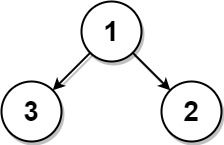
Input: root = [1,3,2], k = 1
Output: 2
Explanation: Either 2 or 3 is the nearest leaf node to the target of 1.
Example 2:

Input: root = [1], k = 1
Output: 1
Explanation: The nearest leaf node is the root node itself.
Example 3:
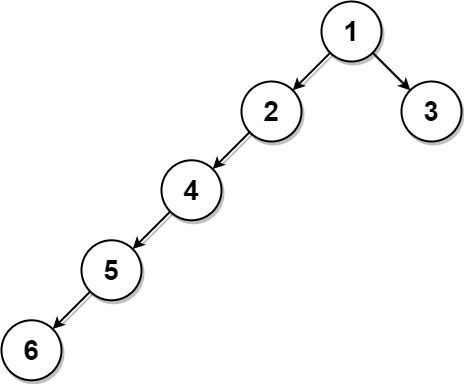
Input: root = [1,2,3,4,null,null,null,5,null,6], k = 2
Output: 3
Explanation: The leaf node with value 3 (and not the leaf node with value 6) is nearest to the node with value 2.
Constraints:
- The number of nodes in the tree is in the range
[1, 1000]. 1 <= Node.val <= 1000- All the values of the tree are unique.
- There exist some node in the tree where
Node.val == k.
Approach Overview
Problem Overview: You are given a binary tree and a target node value k. The goal is to return the value of the leaf node that is closest to that target. Distance is measured by the number of edges. The challenge is that the closest leaf may not be in the target’s subtree—it could be reached by moving up to a parent and then down another branch.
Approach 1: Brute Force DFS from Every Node (O(n^2) time, O(h) space)
A straightforward idea is to treat every node as a possible starting point and compute the distance to all leaf nodes using Depth-First Search. First locate the node with value k. Then repeatedly traverse possible paths while measuring distance until a leaf is reached. Because a binary tree normally doesn't store parent pointers, each traversal may require searching portions of the tree again to move upward or across branches. In the worst case you end up exploring most nodes multiple times, leading to O(n^2) time. This approach is mainly useful for reasoning about the problem but rarely acceptable in interviews.
Approach 2: Convert Tree to Graph + BFS (O(n) time, O(n) space)
The key insight: once you allow movement to a parent, the binary tree behaves like an undirected graph. Build an adjacency list where each node connects to its left child, right child, and parent. You can construct this graph with a single DFS traversal of the Binary Tree. After building the graph, start a Breadth-First Search from the node with value k. BFS guarantees the first leaf node you encounter is the closest one because nodes are visited in increasing distance order. A leaf is simply a node with no children in the original tree. This approach processes each node at most once, resulting in O(n) time and O(n) space for the adjacency structure and queue.
Approach 3: DFS Parent Mapping + BFS from Target (O(n) time, O(n) space)
A common optimization avoids building a full adjacency list. Instead, perform a DFS to record only the parent of each node in a hash map while also locating the node with value k. During the BFS phase, each node can expand to three neighbors: left, right, and parent[node]. Maintain a visited set to prevent cycling back up the tree. As soon as BFS reaches a node with no children, that node is the closest leaf. This method still runs in O(n) time and uses O(n) space but reduces graph construction overhead and is the most common implementation in interview solutions.
Recommended for interviews: The DFS parent mapping combined with BFS is the expected solution. It demonstrates understanding of tree traversal, graph modeling, and shortest-path reasoning. Starting with the brute-force idea shows intuition about searching for leaves, but the optimized O(n) BFS approach proves you recognize that the tree effectively becomes an undirected graph when upward movement is allowed.
Solution
First, we use depth-first search to construct an undirected graph g, where g[node] represents the set of nodes adjacent to the node node. Then we start a breadth-first search from node k until we find a leaf node, which is the answer.
The time complexity is O(n), and the space complexity is O(n). Where n is the number of nodes in the binary tree.
Detailed Complexity Analysis
| Approach | Time | Space | When to Use |
|---|---|---|---|
| Brute Force DFS Exploration | O(n^2) | O(h) | Conceptual baseline or very small trees |
| Tree to Graph Conversion + BFS | O(n) | O(n) | General solution when modeling the tree as an undirected graph |
| DFS Parent Map + BFS | O(n) | O(n) | Most common interview approach with minimal graph construction |
Video Solution
花花酱 LeetCode 742. Closest Leaf in a Binary Tree - 刷题找工作 EP131 • Hua Hua • 4,758 views views
Watch 5 more video solutions →Frequently Asked Questions
Is Closest Leaf in a Binary Tree easy or hard?
Closest Leaf in a Binary Tree Python/Java solution
How to solve Closest Leaf in a Binary Tree in O(n)?
What is the best approach for Closest Leaf in a Binary Tree?
Is Closest Leaf in a Binary Tree asked at Google/Amazon/Meta?
What data structure is used in Closest Leaf in a Binary Tree?
What is the time complexity of Closest Leaf in a Binary Tree?
Ready to solve this problem?
Practice Closest Leaf in a Binary Tree with our built-in code editor and test cases.
Practice on FleetCode