
Clone Graph - Solution & Explanation
Problem Statement
Given a reference of a node in a connected undirected graph.
Return a deep copy (clone) of the graph.
Each node in the graph contains a value (int) and a list (List[Node]) of its neighbors.
class Node {
    public int val;
    public List<Node> neighbors;
}
Test case format:
For simplicity, each node's value is the same as the node's index (1-indexed). For example, the first node with val == 1, the second node with val == 2, and so on. The graph is represented in the test case using an adjacency list.
An adjacency list is a collection of unordered lists used to represent a finite graph. Each list describes the set of neighbors of a node in the graph.
The given node will always be the first node with val = 1. You must return the copy of the given node as a reference to the cloned graph.
Example 1:
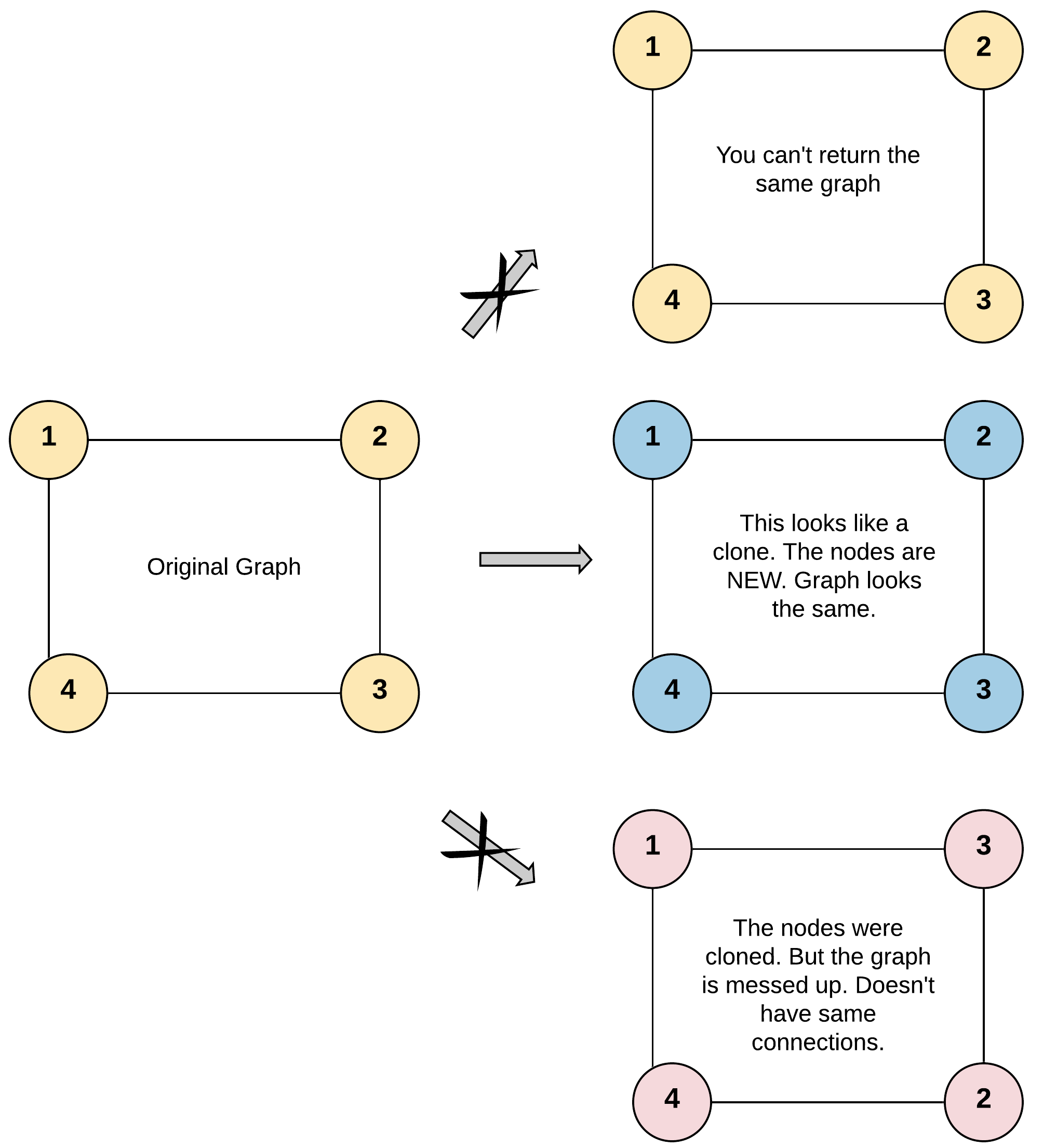
Input: adjList = [[2,4],[1,3],[2,4],[1,3]]
Output: [[2,4],[1,3],[2,4],[1,3]]
Explanation: There are 4 nodes in the graph.
1st node (val = 1)'s neighbors are 2nd node (val = 2) and 4th node (val = 4).
2nd node (val = 2)'s neighbors are 1st node (val = 1) and 3rd node (val = 3).
3rd node (val = 3)'s neighbors are 2nd node (val = 2) and 4th node (val = 4).
4th node (val = 4)'s neighbors are 1st node (val = 1) and 3rd node (val = 3).
Example 2:
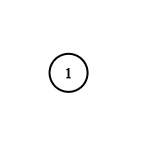
Input: adjList = [[]]
Output: [[]]
Explanation: Note that the input contains one empty list. The graph consists of only one node with val = 1 and it does not have any neighbors.
Example 3:
Input: adjList = []
Output: []
Explanation: This an empty graph, it does not have any nodes.
Constraints:
- The number of nodes in the graph is in the range
[0, 100]. 1 <= Node.val <= 100Node.valis unique for each node.- There are no repeated edges and no self-loops in the graph.
- The Graph is connected and all nodes can be visited starting from the given node.
Approach Overview
Problem Overview: You’re given a reference to a node in a connected undirected graph. Each node contains a value and a list of neighbors. The task is to create a deep copy of the entire graph so that every node and edge is duplicated without sharing references with the original graph.
Approach 1: Depth-First Search (DFS) Graph Cloning (O(V + E) time, O(V) space)
This approach treats cloning as a graph traversal problem. Starting from the given node, perform a recursive Depth-First Search. For each visited node, create a clone and store the mapping from original node to cloned node in a hash map. The hash map prevents duplicate cloning and also helps handle cycles in the graph. When DFS visits a neighbor, check the map: if the neighbor hasn’t been cloned yet, recursively clone it; otherwise reuse the stored clone. Each edge is processed once while building the neighbor list for the copied node. The total complexity is O(V + E) time because every vertex and edge is traversed once, and O(V) space for the recursion stack and hash map.
This method is concise and mirrors the natural recursive structure of graph traversal. It works especially well when implementing graph algorithms recursively and when the graph depth is manageable.
Approach 2: Breadth-First Search (BFS) Graph Cloning (O(V + E) time, O(V) space)
The BFS approach clones the graph level by level using a queue. Start by cloning the initial node and pushing the original node into a queue. Maintain a hash map that maps each original node to its cloned counterpart. While the queue isn’t empty, pop a node, iterate through its neighbors, and check if each neighbor has already been cloned. If not, create the clone, add it to the map, and push the original neighbor into the queue for later processing. Then append the cloned neighbor to the neighbor list of the current cloned node. This guarantees that each node is cloned exactly once while preserving the graph structure.
BFS avoids recursion and uses an explicit queue, which can be safer for very deep graphs where recursion depth might be a concern. Like DFS, it relies on a Hash Table to maintain the original-to-clone mapping and correctly reconstruct edges in the graph. The complexity remains O(V + E) time and O(V) space.
Recommended for interviews: Both DFS and BFS are accepted optimal solutions. Interviewers usually expect a graph traversal with a hash map to track cloned nodes. DFS tends to be slightly shorter to write and demonstrates comfort with recursive graph traversal, while BFS shows iterative control using a queue. Explaining why the hash map is required (to avoid cloning nodes multiple times and to handle cycles) is often the key signal that you fully understand the problem.
Approach 1: Depth-First Search (DFS) for Graph Cloning
The Depth-First Search (DFS) approach is one of the most intuitive ways to solve the graph cloning problem. Here, we will recursively explore each node starting from the root (Node 1) and keep a map to store already cloned nodes, ensuring each node is cloned once.
For each node, we:
- Check if the node is already cloned; if so, return the cloned instance to avoid cycles.
- Create a new copy of the node.
- Iteratively clone all its neighbors and add the clone references to the new node's neighbor list.
- Return the cloned node.
The above C program defines a structure Node for graph nodes and uses a recursive function cloneGraphUtil to perform a DFS for cloning. We use an array of pointers cloneMap indexed by node values to track cloned nodes.
Complexity
Time Complexity: O(V+E), where V is the number of vertices and E is the number of edges. This is because we visit each node and edge once.
Space Complexity: O(V), for the recursion stack and the clone map.
Approach 2: Breadth-First Search (BFS) for Graph Cloning
An alternative approach is to use Breadth-First Search (BFS), which is iterative in nature. Here, we utilize a queue to help explore each node level by level, preventing deep recursion and managing each node's clone in a breadth-wise manner.
In this BFS approach:
- We initialize a queue with the starting node.
- Use a map to store cloned nodes and a visited state.
- Iteratively process nodes from the queue—cloning nodes, establishing clone-linking relationships, and enqueuing unvisited nodes.
- Once the queue is empty, cloning and linking are complete.
This C++ BFS-based solution utilizes a queue to explore nodes level by level. We maintain a map visited to keep track of the original to clone node mapping. Each node and its neighbors are iteratively visited, cloned, and linked.
Code
C++
Java
Python
C#
JavaScript
Complexity
Time Complexity: O(V+E).
Space Complexity: O(V).
Approach 3: Hash Table + DFS
We use a hash table g to record the correspondence between each node in the original graph and its copy, and then perform depth-first search.
We define the function dfs(node), which returns the copy of the node. The process of dfs(node) is as follows:
- If
nodeisnull, then the return value ofdfs(node)isnull. - If
nodeis ing, then the return value ofdfs(node)isg[node]. - Otherwise, we create a new node
clonedand set the value ofg[node]tocloned. Then, we traverse all the neighbor nodesnxtofnodeand adddfs(nxt)to the neighbor list ofcloned. - Finally, return
cloned.
In the main function, we return dfs(node).
The time complexity is O(n), and the space complexity is O(n). Here, n is the number of nodes.
Code
Python
Java
C++
Go
TypeScript
JavaScript
C#
Complexity Comparison
| Approach | Complexity |
|---|---|
| Depth-First Search (DFS) for Graph Cloning | Time Complexity: O(V+E), where V is the number of vertices and E is the number of edges. This is because we visit each node and edge once. Space Complexity: O(V), for the recursion stack and the clone map. |
| Breadth-First Search (BFS) for Graph Cloning | Time Complexity: O(V+E). Space Complexity: O(V). |
| Hash Table + DFS | — |
Detailed Complexity Analysis
| Approach | Time | Space | When to Use |
|---|---|---|---|
| Depth-First Search (DFS) with Hash Map | O(V + E) | O(V) | Preferred when recursion is acceptable and you want a concise graph traversal solution |
| Breadth-First Search (BFS) with Queue | O(V + E) | O(V) | Useful when avoiding recursion or when implementing iterative graph traversal |
Video Solution
Clone Graph - Depth First Search - Leetcode 133 • NeetCode • 355,261 views views
Watch 9 more video solutions →Frequently Asked Questions
Is Clone Graph easy or hard?
How to solve Clone Graph in O(n)?
What is the best approach for Clone Graph?
What data structure is used in Clone Graph?
What is the time complexity of Clone Graph?
Clone Graph Python or Java solution approach?
Is Clone Graph asked at Google, Amazon, or Meta?
Ready to solve this problem?
Practice Clone Graph with our built-in code editor and test cases.
Practice on FleetCode