
Cat and Mouse - Solution & Explanation
Problem Statement
A game on an undirected graph is played by two players, Mouse and Cat, who alternate turns.
The graph is given as follows: graph[a] is a list of all nodes b such that ab is an edge of the graph.
The mouse starts at node 1 and goes first, the cat starts at node 2 and goes second, and there is a hole at node 0.
During each player's turn, they must travel along one edge of the graph that meets where they are. For example, if the Mouse is at node 1, it must travel to any node in graph[1].
Additionally, it is not allowed for the Cat to travel to the Hole (node 0).
Then, the game can end in three ways:
- If ever the Cat occupies the same node as the Mouse, the Cat wins.
- If ever the Mouse reaches the Hole, the Mouse wins.
- If ever a position is repeated (i.e., the players are in the same position as a previous turn, and it is the same player's turn to move), the game is a draw.
Given a graph, and assuming both players play optimally, return
1if the mouse wins the game,2if the cat wins the game, or0if the game is a draw.
Example 1:
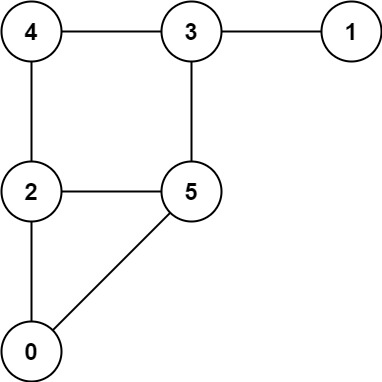
Input: graph = [[2,5],[3],[0,4,5],[1,4,5],[2,3],[0,2,3]]
Output: 0
Example 2:
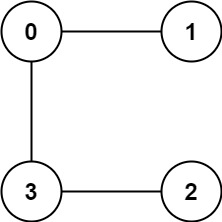
Input: graph = [[1,3],[0],[3],[0,2]]
Output: 1
Constraints:
3 <= graph.length <= 501 <= graph[i].length < graph.length0 <= graph[i][j] < graph.lengthgraph[i][j] != igraph[i]is unique.- The mouse and the cat can always move.
Approach Overview
Problem Overview: You’re given an undirected graph where a mouse starts at node 1 and a cat starts at node 2. Players move alternately along edges; the mouse wants to reach node 0 while the cat wants to catch the mouse. If the game repeats indefinitely, it’s a draw. The task is to determine the final outcome assuming both players play optimally.
Approach 1: Minimax with Memoization (Time: O(n^3), Space: O(n^2))
Model the game as a recursive minimax decision process. Each state is defined by (mouse_position, cat_position, turn). The mouse tries to minimize loss by reaching node 0, while the cat tries to move onto the mouse’s node. Use memoization to cache computed states and avoid exponential recursion. During recursion, iterate over all neighbors of the current player’s node and evaluate the opponent’s best response. A visited-depth or move-limit guard (commonly 2 * n * n) prevents infinite loops and marks repeated states as draws.
Approach 2: Dynamic Programming on Game States (Time: O(n^3), Space: O(n^2))
Instead of pure recursion, explicitly define DP states dp[mouse][cat][turn]. Each entry stores the outcome: mouse win, cat win, or draw. Initialize base states: mouse at node 0 means mouse wins, and mouse == cat means cat wins. Then propagate results through transitions similar to minimax evaluation. This approach structures the recursion into a table-driven solution and makes reasoning about state transitions easier. It relies heavily on dynamic programming principles and careful state evaluation.
Approach 3: Breadth-First Search with Memoization (Time: O(n^3), Space: O(n^2))
Represent the game as a directed state graph where nodes are (mouse, cat, turn). Instead of evaluating from the start, begin with terminal states and run reverse BFS to propagate results backward. If a move leads to a guaranteed win for the current player, mark that state immediately. Otherwise track the number of remaining moves that avoid losing. Once all safe moves disappear, the state becomes a forced loss. This approach converts recursive reasoning into a graph traversal using graph state transitions.
Approach 4: BFS with Coloring Method (Time: O(n^3), Space: O(n^2))
This is the canonical editorial approach. Each state is colored as mouse win, cat win, or draw. Start by coloring obvious terminal states and place them in a queue. Using reverse edges, update predecessor states: if a player can move into a winning state, that predecessor becomes winning as well. Maintain a degree count for each state to detect forced losses when all moves lead to opponent wins. The propagation behaves like a topological sort over the game state graph and guarantees convergence.
Recommended for interviews: The BFS coloring method is typically expected because it cleanly models the problem as a game-state graph and avoids recursion pitfalls. Showing the minimax + memoization version first demonstrates understanding of game theory, while the BFS propagation shows stronger algorithmic maturity and is easier to reason about for large graphs.
Approach 1: Dynamic Programming Approach
This approach uses dynamic programming with a 3D array to store the results for each game state. We use the state (mouse and cat positions, and the current turn) to determine the game's outcome. This helps us avoid redundant computations and efficiently reach a solution through recursive calls. Each possible state is evaluated based on whether the mouse or cat can win from that point, or if it's a draw.
- Initialize a 3D list 'state' to hold game outcomes for various states.
- Define constants MOUSE, CAT, and DRAW to represent outcomes.
- Pre-fill base cases: Mouse at 0 wins, Cat at Mouse's position wins.
- Use recursive DP to explore each possible move for the Mouse and Cat.
- Check if the resulting state could lead to a win/draw.
- Recursively solve smaller subproblems until reaching base cases, and store results to avoid recomputation.
Code
Python
Complexity
Time Complexity: O(N^3), where N is the number of graph nodes, since we try each node for mouse, cat, and turns.
Space Complexity: O(N^2), owing to storage in the DP table.
Approach 2: Breadth-First Search with Memoization
This approach uses a breadth-first search (BFS) combined with memoization to handle game states. We use a queue to systematically explore potential moves for both the mouse and cat, updating states based on the outcomes of previous states. This approach effectively captures the transitions and dependencies among various game states, systematically moving towards an outcome.
- Initiate a queue to process states and initial degrees for mouse and cat moves.
- Set base cases for winning conditions directly and put them to queue.
- Implement a BFS where the queue constantly checks for resolvable states by tracing dependency backward using the degree of each state.
- Optimally determine results based on configurations derived from the current state's effect on previous states.
Code
Python
Complexity
Time Complexity: O(N^3), as each state must be iterated for mouse, cat and move number combinations.
Space Complexity: O(N^2), due to storing states in the DP table with a queue usage.
Approach 3: Approach 1: Minimax with Memoization
This approach is based on a recursive minimax algorithm with memoization to optimize overlapping subproblems. We represent the game state as a triplet (mouse_position, cat_position, turn), and use memoization to store results of states that have been computed before.
Each state evaluates its possible next states recursively, calculating whether it's a guaranteed win, loss, or draw from that position.
This Python solution uses a recursive function with memoization (via lru_cache) to decide the outcome at each state. The base states evaluate whether the mouse wins (reaches 0), the cat wins (occupies the same node as the mouse), or if the number of turns suggests a draw. Depending on whether it's the mouse's or cat's turn, the function iterates over possible moves, recursively determining and memorizing possible outcomes. The solution makes use of depth-first exploration to optimize using previously computed states.
Complexity
Time Complexity: O(n^3) - In the worst case, each state (mouse position, cat position, turn) is visited once for every player due to memoization.
Space Complexity: O(n^2) - Space used by the memoization cache, capturing every unique state evaluated.
Approach 4: Approach 2: BFS with Coloring Method
This approach uses a breadth-first search (BFS) method in which we 'color' the nodes based on current positions and outcomes as we traverse the graph. This approach focuses on evaluating the nodes with terminal states quickly and propagating results efficiently to neighbors. The 'coloring' means marking nodes with direct results like wins or losses and progressively marking draws as paths are evaluated.
In this JavaScript solution, a color array tracks the win/draw state of every mouse, cat position at both even and odd turns. outDegree tracks remaining unexplored branch counts for optimization, simplifying the process of detecting draws. This BFS-based solution suits JavaScript well due to the language’s strength in managing asynchronous operations through event loops, thus efficiently simulating game states without recursion depth concerns.
Code
JavaScript
C#
Complexity
Time Complexity: O(n^3) - BFS explores states by all node combinations leading to exhaustive evaluations, ensuring each is processed to fixed evaluation.
Space Complexity: O(n^2) - Each node stores multiple state outcomes efficiently within a moderate space allocation.
Approach 5: Topological Sorting
According to the problem description, the state of the game is determined by the position of the mouse, the position of the cat, and the player who is moving. The outcome can be directly determined in the following situations:
- When the positions of the cat and the mouse are the same, the cat wins. This is a winning state for the cat and a losing state for the mouse.
- When the mouse is at the hole, the mouse wins. This is a winning state for the mouse and a losing state for the cat.
To determine the result of the initial state, we need to traverse all states starting from the boundary states. Each state includes the position of the mouse, the position of the cat, and the player who is moving. Based on the current state, we can determine all possible states from the previous round. The player who moved in the previous round is the opposite of the player who is moving in the current state, and the positions of the players in the previous round are different from their positions in the current state.
We use the tuple (m, c, t) to represent the current state and (pm, pc, pt) to represent a possible state from the previous round. The possible states from the previous round are:
- If the player moving in the current round is the mouse, then the player moving in the previous round is the cat. The position of the mouse in the previous round is the same as the current position of the mouse, and the position of the cat in the previous round is any adjacent node of the current position of the cat.
- If the player moving in the current round is the cat, then the player moving in the previous round is the mouse. The position of the cat in the previous round is the same as the current position of the cat, and the position of the mouse in the previous round is any adjacent node of the current position of the mouse.
Initially, all states except the boundary states are unknown. Starting from the boundary states, for each state, we determine all possible states from the previous round and update the results. The update logic is as follows:
- If the player moving in the previous round is the same as the winner in the current round, then the player moving in the previous round can reach the current state and win. We directly update the state of the previous round to the winner of the current round.
- If the player moving in the previous round is different from the winner in the current round, and all states that the player moving in the previous round can reach are losing states for that player, then we update the state of the previous round to the winner of the current round.
For the second update logic, we need to record the degree of each state. Initially, the degree of each state represents the number of nodes the player moving in that state can move to, which is the number of adjacent nodes of the node where the player is located. If the player is the cat and the node is adjacent to the hole, the degree of that state is reduced by 1.
When all states have been updated, the result of the initial state is the final result.
The time complexity is O(n^3), and the space complexity is O(n^2). Here, n is the number of nodes in the graph.
Complexity Comparison
| Approach | Complexity |
|---|---|
| Dynamic Programming Approach | Time Complexity: O(N^3), where N is the number of graph nodes, since we try each node for mouse, cat, and turns. Space Complexity: O(N^2), owing to storage in the DP table. |
| Breadth-First Search with Memoization | Time Complexity: O(N^3), as each state must be iterated for mouse, cat and move number combinations. Space Complexity: O(N^2), due to storing states in the DP table with a queue usage. |
| Approach 1: Minimax with Memoization | Time Complexity: O(n^3) - In the worst case, each state (mouse position, cat position, turn) is visited once for every player due to memoization. Space Complexity: O(n^2) - Space used by the memoization cache, capturing every unique state evaluated. |
| Approach 2: BFS with Coloring Method | Time Complexity: O(n^3) - BFS explores states by all node combinations leading to exhaustive evaluations, ensuring each is processed to fixed evaluation. Space Complexity: O(n^2) - Each node stores multiple state outcomes efficiently within a moderate space allocation. |
| Topological Sorting | — |
Detailed Complexity Analysis
| Approach | Time | Space | When to Use |
|---|---|---|---|
| Minimax with Memoization | O(n^3) | O(n^2) | When explaining the game-theory reasoning or writing a recursive solution first |
| Dynamic Programming on States | O(n^3) | O(n^2) | When you prefer structured DP tables over recursion |
| BFS with Memoization | O(n^3) | O(n^2) | When modeling the game as a state graph with reverse traversal |
| BFS with Coloring Method | O(n^3) | O(n^2) | Preferred optimal approach used in editorials and interviews |
Video Solution
LeetCode 913. Cat and Mouse • Happy Coding • 8,660 views views
Watch 7 more video solutions →Frequently Asked Questions
Is Cat and Mouse easy or hard?
How to solve Cat and Mouse in O(n^3)?
What is the best approach for Cat and Mouse?
What data structure is used in Cat and Mouse?
What is the time complexity of Cat and Mouse?
Cat and Mouse Python or Java solution approach?
Is Cat and Mouse asked at Google, Amazon, or Meta?
Ready to solve this problem?
Practice Cat and Mouse with our built-in code editor and test cases.
Practice on FleetCodeTable of Contents
Practice this problem
Open in Editor