129. Sum Root to Leaf Numbers
You are given the root of a binary tree containing digits from 0 to 9 only.
Each root-to-leaf path in the tree represents a number.
- For example, the root-to-leaf path
1 -> 2 -> 3represents the number123.
Return the total sum of all root-to-leaf numbers. Test cases are generated so that the answer will fit in a 32-bit integer.
A leaf node is a node with no children.
Example 1:
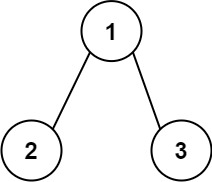
Input: root = [1,2,3] Output: 25 Explanation: The root-to-leaf path1->2represents the number12. The root-to-leaf path1->3represents the number13. Therefore, sum = 12 + 13 =25.
Example 2:
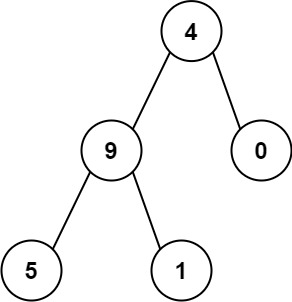
Input: root = [4,9,0,5,1] Output: 1026 Explanation: The root-to-leaf path4->9->5represents the number 495. The root-to-leaf path4->9->1represents the number 491. The root-to-leaf path4->0represents the number 40. Therefore, sum = 495 + 491 + 40 =1026.
Constraints:
- The number of nodes in the tree is in the range
[1, 1000]. 0 <= Node.val <= 9- The depth of the tree will not exceed
10.
 Google
Topics
Loading editor…
1# Definition for a binary tree node.
2# class TreeNode:
3# def __init__(self, val=0, left=None, right=None):
4# self.val = val
5# self.left = left
6# self.right = right
7class Solution:
8 def sumNumbers(self, root: Optional[TreeNode]) -> int:
9
Starter codePython 3Spaces: 4
Loading editor…
1# Definition for a binary tree node.
2# class TreeNode:
3# def __init__(self, val=0, left=None, right=None):
4# self.val = val
5# self.left = left
6# self.right = right
7class Solution:
8 def sumNumbers(self, root: Optional[TreeNode]) -> int:
9
Starter codePython 3Spaces: 4
Examples
Input
[1,2,3]
Input
[4,9,0,5,1]
Your code is saved on this device.Solution