1260. Shift 2D Grid
Given a 2D grid of size m x n and an integer k. You need to shift the grid k times.
In one shift operation:
- Element at
grid[i][j]moves togrid[i][j + 1]. - Element at
grid[i][n - 1]moves togrid[i + 1][0]. - Element at
grid[m - 1][n - 1]moves togrid[0][0].
Return the 2D grid after applying shift operation k times.
Example 1:
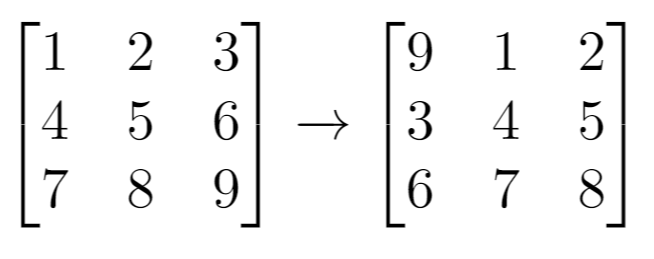
Input: grid = [[1,2,3],[4,5,6],[7,8,9]], k = 1
Output: [[9,1,2],[3,4,5],[6,7,8]]
Example 2:
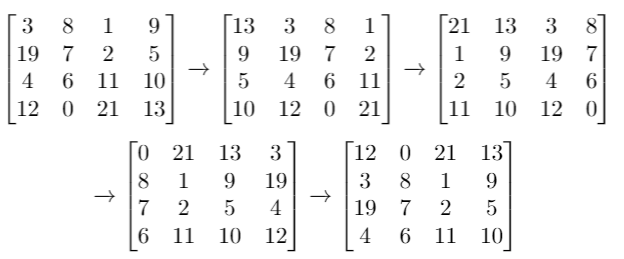
Input: grid = [[3,8,1,9],[19,7,2,5],[4,6,11,10],[12,0,21,13]], k = 4
Output: [[12,0,21,13],[3,8,1,9],[19,7,2,5],[4,6,11,10]]
Example 3:
Input: grid = [[1,2,3],[4,5,6],[7,8,9]], k = 9
Output: [[1,2,3],[4,5,6],[7,8,9]]
Constraints:
m == grid.lengthn == grid[i].length1 <= m <= 501 <= n <= 50-1000 <= grid[i][j] <= 10000 <= k <= 100
Asked at 1 company
Topics
Hints open one at a time
Hint 1
Simulate step by step. move grid[i][j] to grid[i][j+1]. handle last column of the grid.
Hint 2
Put the matrix row by row to a vector. take k % vector.length and move last k of the vector to the beginning. put the vector to the matrix back the same way.
Loading editor…
1class Solution:
2 def shiftGrid(self, grid: List[List[int]], k: int) -> List[List[int]]:
3
Starter codePython 3Spaces: 4
Loading editor…
1class Solution:
2 def shiftGrid(self, grid: List[List[int]], k: int) -> List[List[int]]:
3
Starter codePython 3Spaces: 4
Examples
Input
[[1,2,3],[4,5,6],[7,8,9]]
1
Input
[[3,8,1,9],[19,7,2,5],[4,6,11,10],[12,0,21,13]]
4
Input
[[1,2,3],[4,5,6],[7,8,9]]
9
Your code is saved on this device.Solution