2445. Number of Nodes With Value One
There is an undirected connected tree with n nodes labeled from 1 to n and n - 1 edges. You are given the integer n. The parent node of a node with a label v is the node with the label floor (v / 2). The root of the tree is the node with the label 1.
- For example, if
n = 7, then the node with the label3has the node with the labelfloor(3 / 2) = 1as its parent, and the node with the label7has the node with the labelfloor(7 / 2) = 3as its parent.
You are also given an integer array queries. Initially, every node has a value 0 on it. For each query queries[i], you should flip all values in the subtree of the node with the label queries[i].
Return the total number of nodes with the value 1 after processing all the queries.
Note that:
- Flipping the value of a node means that the node with the value
0becomes1and vice versa. floor(x)is equivalent to roundingxdown to the nearest integer.
Example 1:
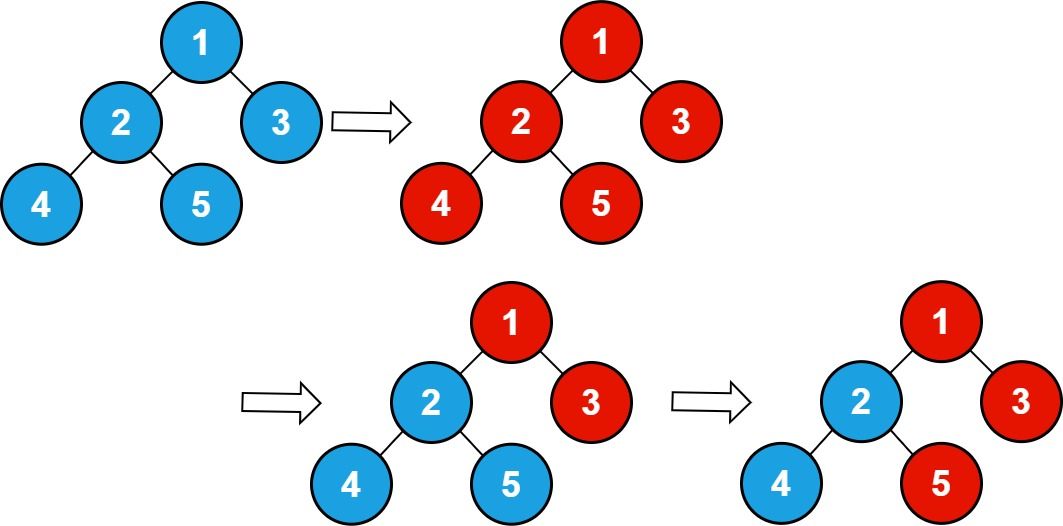
Input: n = 5 , queries = [1,2,5]
Output: 3
Explanation: The diagram above shows the tree structure and its status after performing the queries. The blue node represents the value 0, and the red node represents the value 1.
After processing the queries, there are three red nodes (nodes with value 1): 1, 3, and 5.
Example 2:

Input: n = 3, queries = [2,3,3]
Output: 1
Explanation: The diagram above shows the tree structure and its status after performing the queries. The blue node represents the value 0, and the red node represents the value 1.
After processing the queries, there are one red node (node with value 1): 2.
Constraints:
1 <= n <= 1051 <= queries.length <= 1051 <= queries[i] <= n
Asked at 1 company
 Infosys
Topics
Hints open one at a time
Hint 1
The relative order of processing queries does not matter.
Hint 2
If we know that for some node v, its parent was updated some number of times, then we know that node v was also updated that number of times.
Hint 3
Iterate on nodes from highest to lowest and count the number of times the query was performed on that node and the number of times this node was updated from its parent (direct or indirect). The parity of that number is the answer.
Loading editor…
1class Solution:
2 def solve(self):
3 pass
4
Starter codePython 3Spaces: 4
Loading editor…
1class Solution:
2 def solve(self):
3 pass
4
Starter codePython 3Spaces: 4
Examples
Input
5
[1,2,5]
Input
3
[2,3,3]
Your code is saved on this device.Solution