1261. Find Elements in a Contaminated Binary Tree
Given a binary tree with the following rules:
root.val == 0- If
treeNode.val == xandtreeNode.left != null, thentreeNode.left.val == 2 * x + 1 - If
treeNode.val == xandtreeNode.right != null, thentreeNode.right.val == 2 * x + 2
Now the binary tree is contaminated, which means all treeNode.val have been changed to -1.
Implement the FindElements class:
FindElements(TreeNode* root)Initializes the object with a contaminated binary tree and recovers it.bool find(int target)Returnstrueif thetargetvalue exists in the recovered binary tree.
Example 1:
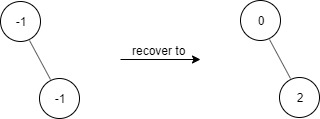
Input
["FindElements","find","find"]
[[[-1,null,-1]],[1],[2]]
Output
[null,false,true]
Explanation
FindElements findElements = new FindElements([-1,null,-1]);
findElements.find(1); // return False
findElements.find(2); // return True
Example 2:
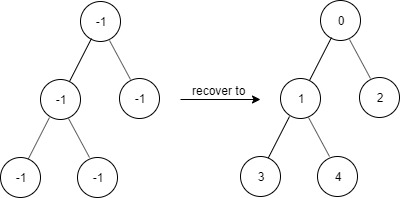
Input
["FindElements","find","find","find"]
[[[-1,-1,-1,-1,-1]],[1],[3],[5]]
Output
[null,true,true,false]
Explanation
FindElements findElements = new FindElements([-1,-1,-1,-1,-1]);
findElements.find(1); // return True
findElements.find(3); // return True
findElements.find(5); // return False
Example 3:
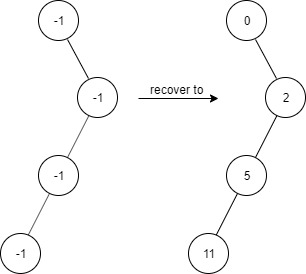
Input
["FindElements","find","find","find","find"]
[[[-1,null,-1,-1,null,-1]],[2],[3],[4],[5]]
Output
[null,true,false,false,true]
Explanation
FindElements findElements = new FindElements([-1,null,-1,-1,null,-1]);
findElements.find(2); // return True
findElements.find(3); // return False
findElements.find(4); // return False
findElements.find(5); // return True
Constraints:
TreeNode.val == -1- The height of the binary tree is less than or equal to
20 - The total number of nodes is between
[1, 104] - Total calls of
find()is between[1, 104] 0 <= target <= 106
 Google
Topics
Hints open one at a time
Hint 1
Use DFS to traverse the binary tree and recover it.
Hint 2
Use a hashset to store TreeNode.val for finding.
Loading editor…
1# Definition for a binary tree node.
2# class TreeNode:
3# def __init__(self, val=0, left=None, right=None):
4# self.val = val
5# self.left = left
6# self.right = right
7class FindElements:
8
9 def __init__(self, root: Optional[TreeNode]):
10
11
12 def find(self, target: int) -> bool:
13
14
15
16# Your FindElements object will be instantiated and called as such:
17# obj = FindElements(root)
18# param_1 = obj.find(target)
Starter codePython 3Spaces: 4
Examples
Input
["FindElements","find","find"]
[[[-1,null,-1]],[1],[2]]
Input
["FindElements","find","find","find"]
[[[-1,-1,-1,-1,-1]],[1],[3],[5]]
Input
["FindElements","find","find","find","find"]
[[[-1,null,-1,-1,null,-1]],[2],[3],[4],[5]]
Your code is saved on this device.Solution