3939. Count Non Adjacent Subsets in a Rooted Tree
Hard51.7% Acceptance
You are given a rooted tree with n nodes labeled from 0 to n - 1, represented by an integer array parent of length n, where:
parent[0] = -1(node 0 is the root).- For each
1 <= i < n,parent[i]is the parent of nodei(0 <= parent[i] < i).
You are also given an integer array nums of length n, where nums[i] is the value of node i, and an integer k.
A non-empty subset of nodes is called valid if:
- The sum of the values of the selected nodes is divisible by
k. - No two selected nodes are adjacent in the tree (no node and its direct parent are both included in the subset).
Return the number of valid subsets modulo 109 + 7.
Example 1:
Input: parent = [-1,0,1], nums = [1,2,3], k = 3
Output: 1
Explanation:
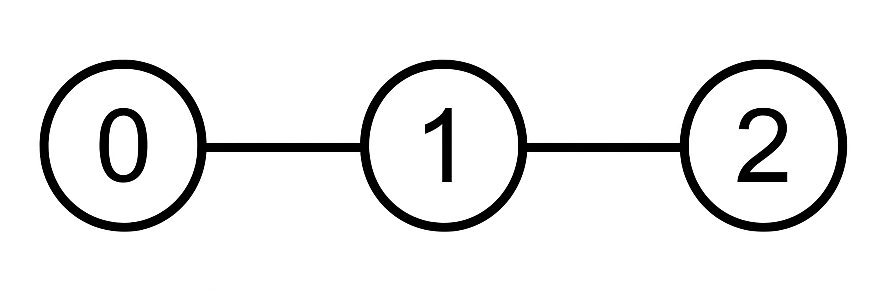
The only valid subset is {2}. It contains node 2 with value 3, which is divisible by 3.
Example 2:
Input: parent = [-1,0,0,0], nums = [2,1,2,1], k = 3
Output: 2
Explanation:
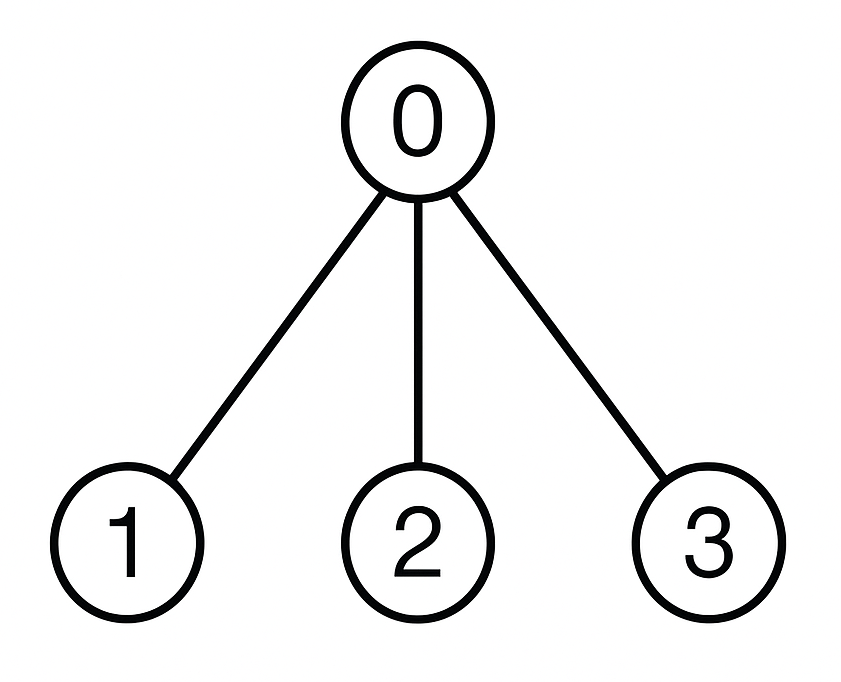
The valid subsets are:
{1, 2}: Nodes 1 and 2 are both children of node 0 and not directly connected to each other. Their values sum to1 + 2 = 3, which is divisible by 3.{2, 3}: Nodes 2 and 3 are also non-adjacent. Their values sum to2 + 1 = 3, which is divisible by 3.
No other subset satisfies both conditions. Therefore, the answer is 2.
Constraints:
n == parent.length == nums.length1 <= n <= 1000parent[0] == -1- For all
1 <= i < n:0 <= parent[i] < i
1 <= nums[i] <= 1091 <= k <= 100parentdescribes a valid rooted tree.
Asked by 1 company
Loading editor...
[-1,0,1]
[1,2,3]
3