
Given an integer numRows, return the first numRows of Pascal's triangle.
In Pascal's triangle, each number is the sum of the two numbers directly above it as shown:
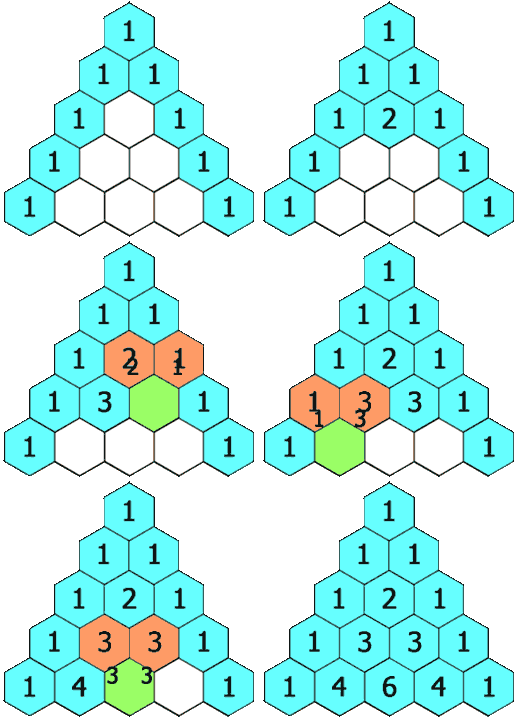
Example 1:
Input: numRows = 5
Output: [[1],[1,1],[1,2,1],[1,3,3,1],[1,4,6,4,1]]
Example 2:
Input: numRows = 1
Output: [[1]]
Constraints:
1 <= numRows <= 30The Pascal's Triangle problem asks you to generate the first numRows of the triangle where each element is the sum of the two numbers directly above it. A common and efficient approach uses dynamic programming with an array (or list of lists). Start by initializing the first row with [1]. For each new row, set the first and last elements to 1, then compute the middle elements using values from the previous row.
This approach builds the triangle row by row, reusing previously computed values. Each element depends only on two elements from the previous row, making it a natural fit for dynamic programming. The overall time complexity grows with the number of elements generated across all rows, while the space complexity depends on storing the triangle structure.
By iterating through rows and constructing each using previously calculated values, the solution remains simple, readable, and efficient for interview settings.
| Approach | Time Complexity | Space Complexity |
|---|---|---|
| Dynamic Programming (Build Row by Row) | O(n²) | O(n²) |
take U forward
This approach involves generating Pascal's Triangle row by row using an iterative method. The first row is initialized with [1], and for each subsequent row, the first and last element are always 1. The intermediate elements are calculated as sums of appropriate elements from the previous row.
Time Complexity: O(numRows^2) due to the nested loop structure.
Space Complexity: O(numRows^2) as we store all elements of the triangle.
1#include <stdio.h>
2#include <stdlib.h>
3
4int** generate(int numRows, int* returnSize, int** returnColumnSizes)
In this C implementation, we allocate a 2D array to hold the triangle's content. We initialize the first and last entries of each row to 1. For each intermediate row entry, we compute its value as the sum of the two appropriate values from the preceding row, incrementally building each row from top to bottom.
This approach constructs Pascal's Triangle using recursion by calculating each value based on the combination formula. The values on the edges are always 1, and other values are calculated as combinatorial numbers derived recursively.
Time Complexity: O(numRows^3) due to recursive calls, not optimal.
Space Complexity: O(numRows^2) for storing the triangle.
1using System;
using System.Collections.Generic;

public class PascalTriangleRecursive {
    public static int Combination(int n, int k) {
        if (k == 0 || k == n) return 1;
        return Combination(n - 1, k - 1) + Combination(n - 1, k);
    }

    public static List<List<int>> Generate(int numRows) {
        List<List<int>> triangle = new List<List<int>>();
        for (int i = 0; i < numRows; i++) {
            List<int> row = new List<int>();
            for (int j = 0; j <= i; j++) {
                row.Add(Combination(i, j));
            }
            triangle.Add(row);
        }
        return triangle;
    }

    public static void Main(string[] args) {
        int numRows = 5;
        List<List<int>> result = Generate(numRows);
        foreach (var row in result) {
            Console.WriteLine(string.Join(" ", row));
        }
    }
}
Watch expert explanations and walkthroughs
Practice problems asked by these companies to ace your technical interviews.
Explore More ProblemsJot down your thoughts, approach, and key learnings
Yes, Pascal's Triangle is a common entry-level interview question at many tech companies, including FAANG. It tests understanding of arrays, iteration, and basic dynamic programming concepts.
A list of lists (or 2D array) works best for representing Pascal's Triangle. Each inner list represents a row, allowing easy access to previous row values when calculating new elements.
The optimal approach is to build the triangle iteratively using dynamic programming. Each element is computed using the two elements above it from the previous row, which avoids recomputation and keeps the logic simple.
Pascal's Triangle follows the principle of overlapping subproblems because each value depends on previously computed values. Dynamic programming fits well since we reuse results from earlier rows instead of recalculating them.
This C# program uses a recursive function to obtain Pascal's Triangle values by calculating each position's combinatorial value. Recursive computation helps build each row of the triangle effectively from the top down.