
Given an integer rowIndex, return the rowIndexth (0-indexed) row of the Pascal's triangle.
In Pascal's triangle, each number is the sum of the two numbers directly above it as shown:
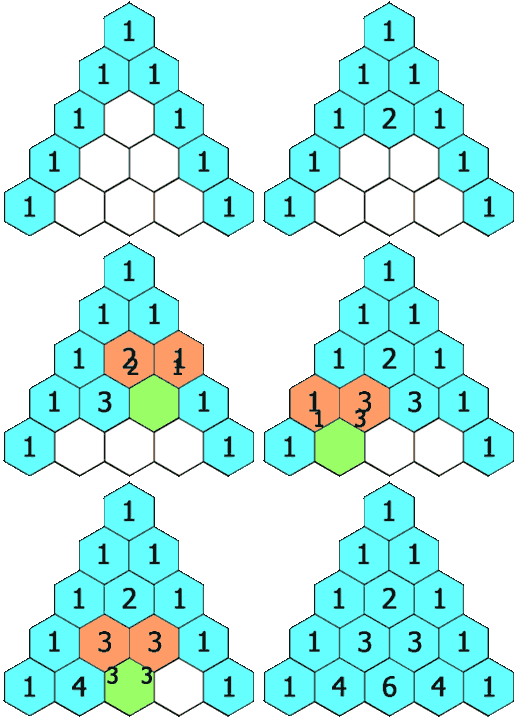
Example 1:
Input: rowIndex = 3
Output: [1,3,3,1]
Example 2:
Input: rowIndex = 0
Output: [1]
Example 3:
Input: rowIndex = 1
Output: [1,1]
Constraints:
0 <= rowIndex <= 33Follow up: Could you optimize your algorithm to use only O(rowIndex) extra space?
In #119 Pascal's Triangle II, the goal is to return the specific row of Pascal’s Triangle for a given index. Each value in the triangle is formed by adding the two numbers directly above it. Instead of generating the entire triangle, an efficient strategy focuses only on constructing the required row.
A common dynamic programming approach uses a single array representing the current row. Start with [1] and iteratively update the array for each row. To avoid overwriting values that are still needed, update the elements from right to left. Each element becomes the sum of the current value and the previous one.
This technique builds the row incrementally while maintaining correctness and minimizing memory usage. The process runs in O(n²) time due to nested updates across rows, while space is optimized to O(n) because only one row is stored at any time.
| Approach | Time Complexity | Space Complexity |
|---|---|---|
| Dynamic Programming (Single Row Update) | O(n^2) | O(n) |
| Combinatorial Calculation | O(n) | O(1) (excluding output) |
take U forward
The iterative approach builds each row of Pascal's Triangle from the topmost row down to the target row, updating values in-place. The key observation is that each element at position j in a row is the sum of the element at position j and j-1 from the previous row. By starting from the end of the row, you can use the same array for updating values without overwriting the necessary data.
Time Complexity: O(n^2) where n is rowIndex as it involves nested iteration to build each row.
Space Complexity: O(n) for storing the result row.
1#include <stdio.h>
2#include <stdlib.h>
3
4int* getRow(int rowIndex, int* returnSize) {
5    *returnSize
This C program achieves the solution using in-place updates for constructing Pascal's Triangle. It manages memory dynamically and prints the resulting row for a given rowIndex.
This approach utilizes the combinatorial formula for a specific row in Pascal's Triangle. Specifically, the k-th element in the n-th row is given by the binomial coefficient: C(n, k) = n! / (k! * (n-k)!). Using this fact, we can derive all the values of the row without constructing the triangle iteratively.
Time Complexity: O(n).
Space Complexity: O(n) for storing the row.
1#
Watch expert explanations and walkthroughs
Practice problems asked by these companies to ace your technical interviews.
Explore More ProblemsJot down your thoughts, approach, and key learnings
Yes, variations of Pascal's Triangle problems appear in technical interviews, including FAANG-style interviews. They are used to test understanding of dynamic programming, array manipulation, and space optimization techniques.
An array or dynamic list is the most suitable data structure. It allows in-place updates while constructing the row step by step. Updating from the end prevents overwriting values that are still needed for calculations.
The optimal approach uses a single array with dynamic programming. By updating values from right to left, you can build the required row without storing the entire triangle. This keeps space usage efficient while maintaining correct calculations.
Yes, the row values can also be computed using binomial coefficients. Each element corresponds to nCk, which can be calculated iteratively to avoid factorial computations. This method can achieve linear time complexity.
In this C solution, a helper function calculates binomial coefficients using combinatorial properties, avoiding overflow by working iteratively.