There is an undirected connected tree with n nodes labeled from 0 to n - 1 and n - 1 edges.
You are given a 0-indexed integer array nums of length n where nums[i] represents the value of the ith node. You are also given a 2D integer array edges of length n - 1 where edges[i] = [ai, bi] indicates that there is an edge between nodes ai and bi in the tree.
Remove two distinct edges of the tree to form three connected components. For a pair of removed edges, the following steps are defined:
[4,5,7], [1,9], and [3,3,3]. The three XOR values are 4 ^ 5 ^ 7 = 6, 1 ^ 9 = 8, and 3 ^ 3 ^ 3 = 3. The largest XOR value is 8 and the smallest XOR value is 3. The score is then 8 - 3 = 5.Return the minimum score of any possible pair of edge removals on the given tree.
Example 1:
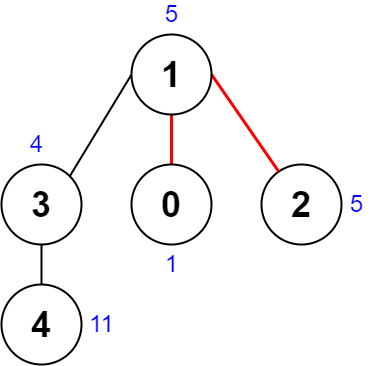
Input: nums = [1,5,5,4,11], edges = [[0,1],[1,2],[1,3],[3,4]]
Output: 9
Explanation: The diagram above shows a way to make a pair of removals.
- The 1st component has nodes [1,3,4] with values [5,4,11]. Its XOR value is 5 ^ 4 ^ 11 = 10.
- The 2nd component has node [0] with value [1]. Its XOR value is 1 = 1.
- The 3rd component has node [2] with value [5]. Its XOR value is 5 = 5.
The score is the difference between the largest and smallest XOR value which is 10 - 1 = 9.
It can be shown that no other pair of removals will obtain a smaller score than 9.
Example 2:
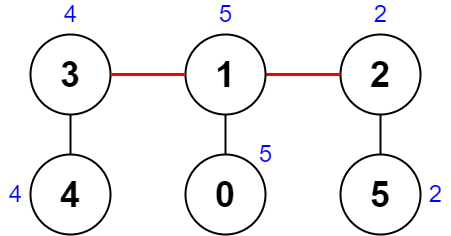
Input: nums = [5,5,2,4,4,2], edges = [[0,1],[1,2],[5,2],[4,3],[1,3]]
Output: 0
Explanation: The diagram above shows a way to make a pair of removals.
- The 1st component has nodes [3,4] with values [4,4]. Its XOR value is 4 ^ 4 = 0.
- The 2nd component has nodes [1,0] with values [5,5]. Its XOR value is 5 ^ 5 = 0.
- The 3rd component has nodes [2,5] with values [2,2]. Its XOR value is 2 ^ 2 = 0.
The score is the difference between the largest and smallest XOR value which is 0 - 0 = 0.
We cannot obtain a smaller score than 0.
Constraints:
n == nums.length3 <= n <= 10001 <= nums[i] <= 108edges.length == n - 1edges[i].length == 20 <= ai, bi < nai != biedges represents a valid tree.Problem Overview: You are given a tree where each node has a value. Remove two edges to split the tree into three components. For each component compute the XOR of node values, then minimize the difference between the maximum and minimum XOR values.
Approach 1: Brute Force with Optimizations (O(n^3) time, O(n) space)
The direct idea is to try every pair of edges to remove. Removing two edges splits the tree into three components, so you compute the XOR of each component and track the score max(x1, x2, x3) - min(x1, x2, x3). A DFS can compute XOR values for a component after temporarily removing edges. Since there are O(n^2) edge pairs and each component computation can take O(n), the total complexity becomes O(n^3). Some implementations reduce repeated work by caching subtree results or precomputing node values, but the approach is still expensive for large trees.
Approach 2: DFS with Subtree XOR Caching (O(n^2) time, O(n) space)
The optimized solution precomputes the XOR of every subtree using a single DFS. While traversing the tree, store each node's subtree XOR and maintain entry/exit times to determine ancestor relationships. The key observation: removing an edge corresponds to isolating a subtree. If you know subtree XOR values, you can derive the XOR of the remaining parts using simple XOR arithmetic.
For every pair of nodes representing removed edges, determine how their subtrees interact. There are three cases: one subtree inside another, the reverse nesting, or completely disjoint subtrees. Using ancestor checks from DFS timestamps, compute the three component XOR values in constant time. This reduces each pair evaluation to O(1), making the total runtime O(n^2) after a single DFS preprocessing step.
This approach relies heavily on Depth-First Search traversal and XOR properties from Bit Manipulation. Precomputing subtree information transforms repeated graph traversals into constant-time calculations.
Recommended for interviews: Interviewers expect the DFS + subtree XOR caching approach. The brute force method shows you understand the problem structure and component splitting. The optimized solution demonstrates stronger tree reasoning: precomputing subtree data, using ancestor checks, and applying XOR algebra to compute component values efficiently.
The key idea is to perform a depth-first search (DFS) to compute the XOR for each subtree rooted at each node. By caching these values, we can efficiently determine the XOR of components after removing two edges.
We can use these cached values to compute the possible component XOR values after removing each pair of edges, and calculate the score of each pair.
This Python solution first builds an adjacency list from the given edges. It then uses DFS from an arbitrary root (node 0) to compute the XOR of every subtree rooted at each node. It utilizes this subtree data to compute possible XOR values when two edges are removed, and tracks the minimum score obtained.
The use of sets and filtering ensures efficient edge selection to deeply examine the implied subtrees created by removing distinct pairs of edges.
Python
JavaScript
Time Complexity: O(n^2), where n is the number of nodes, due to the nested loops for examining edge pairs.
Space Complexity: O(n), mainly consumed by the adjacency list and XOR storage.
This approach leverages a brute-force analysis, with optimizations such as subtree XOR precomputation and efficient edge double-exclusion considerations.
The key is to evaluate every pair of distinct edges, ensuring each removal leads to valid and distinct subcomponent calculations.
The C++ solution optimizes the brute-force method to reduce redundant calculations when determining unique edge removal pairs. This code calculates all subtree XOR combinations and evaluates the score for each distinct pair of potential edge removals.
Adjacency lists and careful nested loop indices ensure complete yet efficient configurations of potential subtree analysis.
Time Complexity: O(n^3) due to nested loops checking each edge in combination with others.
Space Complexity: O(n), using vectors to manage adjacency and subtree XORs.
We denote the XOR sum of the tree as s, i.e., s = nums[0] \oplus nums[1] \oplus ldots \oplus nums[n-1].
Next, we enumerate each node i in [0..n) as the root of the tree, and treat the edge connecting the root node to some child node j as the first edge to be removed. This gives us two connected components. We denote the XOR sum of the connected component containing root node i as s_1, then we perform DFS on the connected component containing root node i to calculate the XOR sum of each subtree, denoting each XOR sum calculated by DFS as s_2. The XOR sums of the three connected components are s \oplus s_1, s_2, and s_1 \oplus s_2. We need to calculate the maximum and minimum values of these three XOR sums, denoted as mx and mn. For each enumerated case, the score is mx - mn. We find the minimum value among all cases as the answer.
The XOR sum of each subtree can be calculated through DFS. We define a function dfs(i, fa), which represents starting DFS from node i, where fa is the parent node of node i. The function returns the XOR sum of the subtree rooted at node i.
The time complexity is O(n^2), and the space complexity is O(n), where n is the number of nodes in the tree.
| Approach | Complexity |
|---|---|
| DFS with Subtree XOR Caching | Time Complexity: O(n^2), where n is the number of nodes, due to the nested loops for examining edge pairs. Space Complexity: O(n), mainly consumed by the adjacency list and XOR storage. |
| Brute Force with Optimizations | Time Complexity: O(n^3) due to nested loops checking each edge in combination with others. Space Complexity: O(n), using vectors to manage adjacency and subtree XORs. |
| DFS + Subtree XOR Sum | — |
| Approach | Time | Space | When to Use |
|---|---|---|---|
| Brute Force with Component DFS | O(n^3) | O(n) | Conceptual baseline or when constraints are very small |
| Brute Force with Cached Subtree XOR | O(n^2) | O(n) | When subtree XOR values are precomputed to avoid repeated DFS |
| DFS with Subtree XOR + Ancestor Checks | O(n^2) | O(n) | Optimal interview solution for tree splitting problems |
Minimum Score After Removals on a Tree | Detailed Explanation | Leetcode 2322 | codestorywithMIK • codestorywithMIK • 9,720 views views
Watch 9 more video solutions →Practice Minimum Score After Removals on a Tree with our built-in code editor and test cases.
Practice on FleetCode