
Uncrossed Lines | Dynamic programming | Leetcode #1035
Uncrossed Lines - Video Solution
Watch 10 video solutions for Uncrossed Lines, a medium level problem involving Array, Dynamic Programming. This walkthrough by Techdose has 21,162 views views. Want to try solving it yourself? Practice on FleetCode or read the detailed text solution.
Problem Statement
You are given two integer arrays nums1 and nums2. We write the integers of nums1 and nums2 (in the order they are given) on two separate horizontal lines.
We may draw connecting lines: a straight line connecting two numbers nums1[i] and nums2[j] such that:
nums1[i] == nums2[j], and- the line we draw does not intersect any other connecting (non-horizontal) line.
Note that a connecting line cannot intersect even at the endpoints (i.e., each number can only belong to one connecting line).
Return the maximum number of connecting lines we can draw in this way.
Example 1:
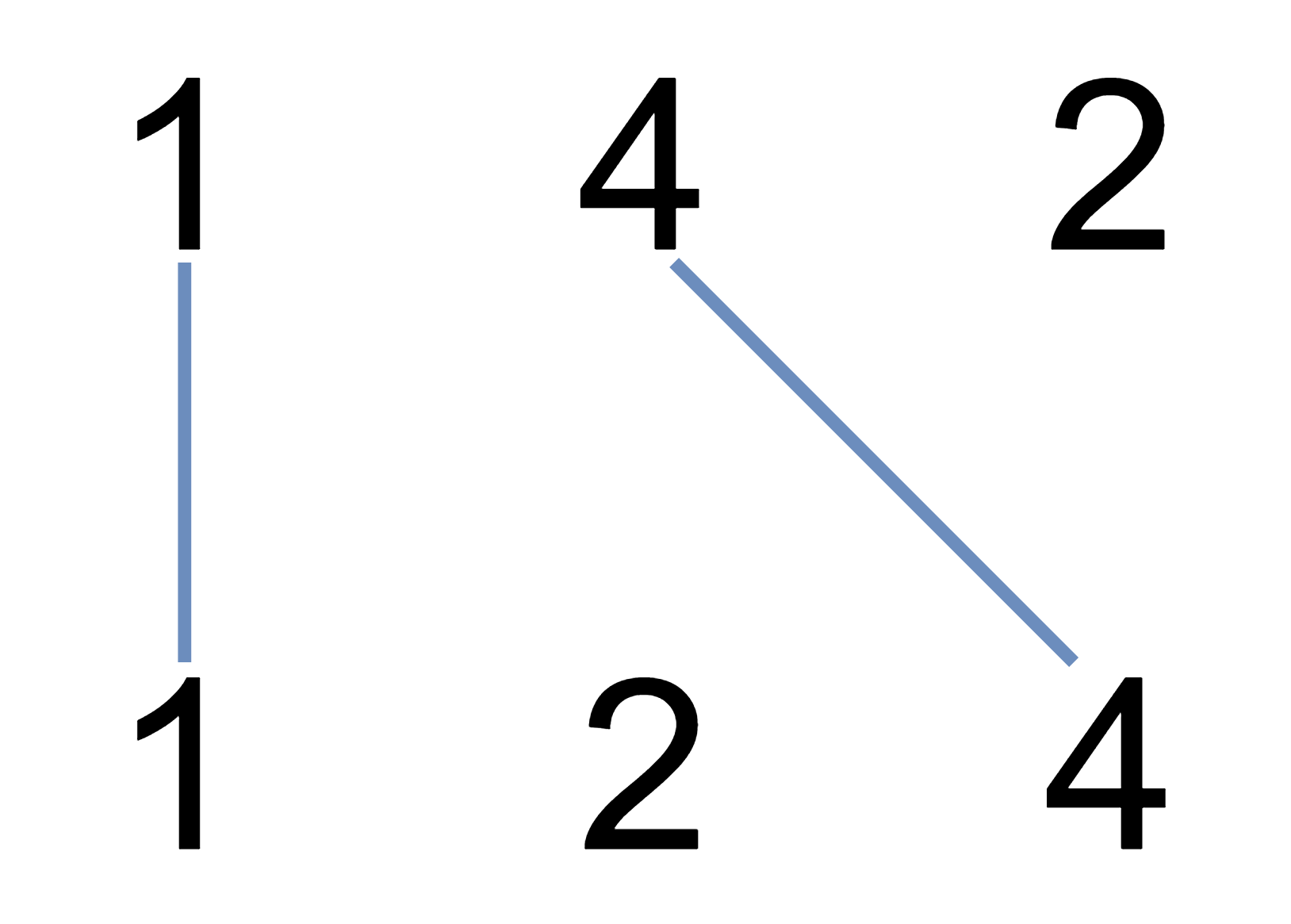
Input: nums1 = [1,4,2], nums2 = [1,2,4]
Output: 2
Explanation: We can draw 2 uncrossed lines as in the diagram.
We cannot draw 3 uncrossed lines, because the line from nums1[1] = 4 to nums2[2] = 4 will intersect the line from nums1[2]=2 to nums2[1]=2.
Example 2:
Input: nums1 = [2,5,1,2,5], nums2 = [10,5,2,1,5,2]
Output: 3
Example 3:
Input: nums1 = [1,3,7,1,7,5], nums2 = [1,9,2,5,1]
Output: 2
Constraints:
1 <= nums1.length, nums2.length <= 5001 <= nums1[i], nums2[j] <= 2000
Approach Overview
Problem Overview: You are given two integer arrays. Draw lines connecting equal numbers between the arrays such that the lines do not cross. The goal is to compute the maximum number of such connections. The key observation: once two elements are matched, their relative order must remain consistent, otherwise the lines would intersect.
This constraint makes the problem identical to the Longest Common Subsequence (LCS) problem. You want the longest sequence of elements that appears in both arrays while preserving order. Every element in that subsequence represents one uncrossed line.
Approach 1: Dynamic Programming (LCS Table) (Time: O(n*m), Space: O(n*m))
Create a 2D DP table where dp[i][j] represents the maximum number of uncrossed lines you can draw using the first i elements of nums1 and the first j elements of nums2. Iterate through both arrays. If nums1[i-1] == nums2[j-1], you can connect them, so dp[i][j] = 1 + dp[i-1][j-1]. Otherwise, skip one element from either array: dp[i][j] = max(dp[i-1][j], dp[i][j-1]). This builds the optimal answer bottom‑up. The approach systematically explores all pair combinations and ensures order is preserved, preventing crossings. The final answer is stored in dp[n][m].
This method is straightforward and commonly used in interview settings because it clearly demonstrates understanding of dynamic programming. The table explicitly shows how partial solutions combine to form the final result.
Approach 2: Space Optimized Dynamic Programming (Time: O(n*m), Space: O(min(n,m)))
The full DP table is not always necessary. Each state only depends on the previous row and the current row. Instead of storing an n x m matrix, maintain two 1D arrays representing the previous and current rows. Iterate through nums1, and for each element update values across nums2. When the elements match, update using the diagonal value from the previous row; otherwise carry forward the maximum from adjacent states.
This optimization reduces memory usage significantly while preserving the same O(n*m) runtime. It is useful when arrays are large and memory limits matter. The logic remains identical to the classic LCS DP, but storage shrinks to linear space.
The problem is categorized under Array and Dynamic Programming because it combines sequential array traversal with optimal substructure reasoning. Once you recognize the LCS pattern, the solution becomes straightforward.
Recommended for interviews: The standard 2D dynamic programming solution is what interviewers typically expect. It clearly models the LCS recurrence and demonstrates strong DP fundamentals. Mentioning the space optimization afterward shows deeper understanding and awareness of memory tradeoffs.
Complexity Analysis
| Approach | Time | Space | When to Use |
|---|---|---|---|
| Dynamic Programming (LCS Table) | O(n*m) | O(n*m) | Best for clarity and interviews. Easy to reason about and implement. |
| Space Optimized Dynamic Programming | O(n*m) | O(min(n,m)) | Use when arrays are large and memory usage must be minimized. |