
Selling Pieces of Wood - Video Solutions
Complete Weekly Contest 298 | Leetcode 2312 Selling Pieces of Wood| Live coding | Easy Peasy DP 🔥🔥
Selling Pieces of Wood - Video Solution
Watch 9 video solutions for Selling Pieces of Wood, a hard level problem involving Array, Dynamic Programming, Memoization. This walkthrough by Coding Decoded has 2,045 views views. Want to try solving it yourself? Practice on FleetCode or read the detailed text solution.
Problem Statement
You are given two integers m and n that represent the height and width of a rectangular piece of wood. You are also given a 2D integer array prices, where prices[i] = [hi, wi, pricei] indicates you can sell a rectangular piece of wood of height hi and width wi for pricei dollars.
To cut a piece of wood, you must make a vertical or horizontal cut across the entire height or width of the piece to split it into two smaller pieces. After cutting a piece of wood into some number of smaller pieces, you can sell pieces according to prices. You may sell multiple pieces of the same shape, and you do not have to sell all the shapes. The grain of the wood makes a difference, so you cannot rotate a piece to swap its height and width.
Return the maximum money you can earn after cutting an m x n piece of wood.
Note that you can cut the piece of wood as many times as you want.
Example 1:
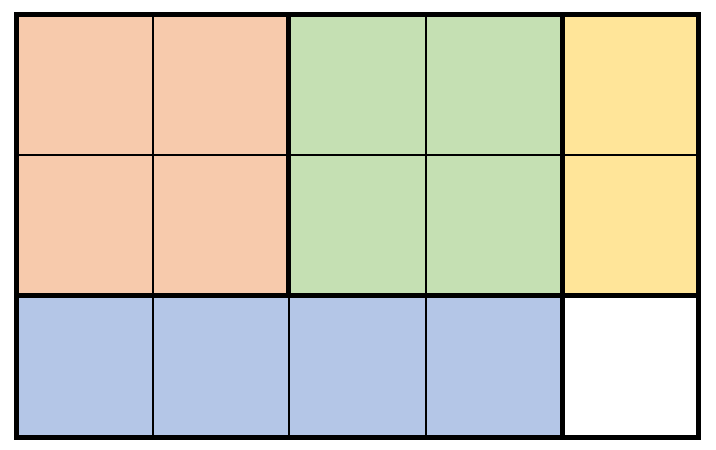
Input: m = 3, n = 5, prices = [[1,4,2],[2,2,7],[2,1,3]]
Output: 19
Explanation: The diagram above shows a possible scenario. It consists of:
- 2 pieces of wood shaped 2 x 2, selling for a price of 2 * 7 = 14.
- 1 piece of wood shaped 2 x 1, selling for a price of 1 * 3 = 3.
- 1 piece of wood shaped 1 x 4, selling for a price of 1 * 2 = 2.
This obtains a total of 14 + 3 + 2 = 19 money earned.
It can be shown that 19 is the maximum amount of money that can be earned.
Example 2:
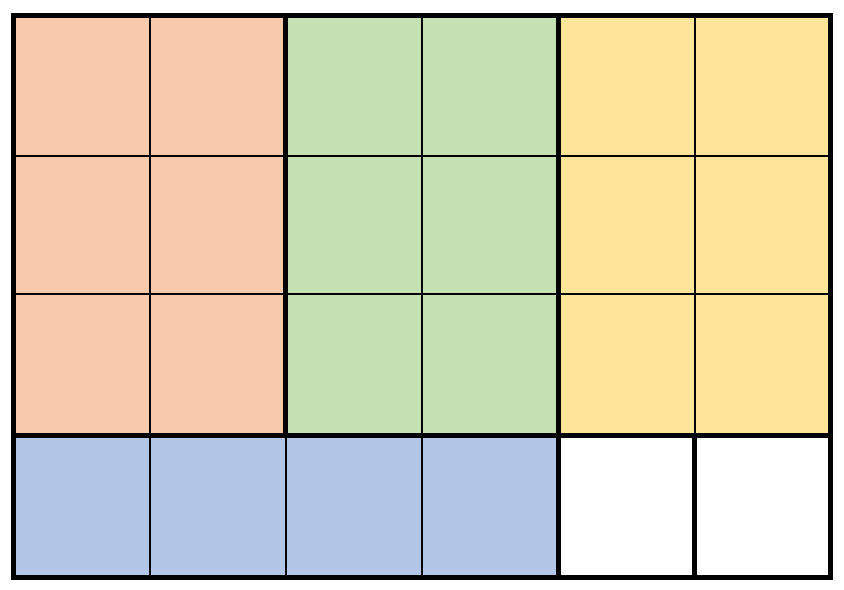
Input: m = 4, n = 6, prices = [[3,2,10],[1,4,2],[4,1,3]]
Output: 32
Explanation: The diagram above shows a possible scenario. It consists of:
- 3 pieces of wood shaped 3 x 2, selling for a price of 3 * 10 = 30.
- 1 piece of wood shaped 1 x 4, selling for a price of 1 * 2 = 2.
This obtains a total of 30 + 2 = 32 money earned.
It can be shown that 32 is the maximum amount of money that can be earned.
Notice that we cannot rotate the 1 x 4 piece of wood to obtain a 4 x 1 piece of wood.
Constraints:
1 <= m, n <= 2001 <= prices.length <= 2 * 104prices[i].length == 31 <= hi <= m1 <= wi <= n1 <= pricei <= 106- All the shapes of wood
(hi, wi)are pairwise distinct.
Approach Overview
Problem Overview: You have an m x n wooden board and a list of prices for smaller rectangles. You can cut the board horizontally or vertically any number of times. The goal is to maximize the total selling price of the pieces you produce.
Approach 1: Recursive Backtracking with Memoization (Time: O(m*n*(m+n)), Space: O(m*n))
This approach treats every rectangle (h, w) as a subproblem. If a direct price exists for that size, you can sell it immediately. Otherwise, try every possible horizontal cut and vertical cut, recursively compute the best value for each resulting piece, and combine the profits. Memoization stores results for previously computed dimensions so the same rectangle size is never recomputed. This converts an exponential brute-force search into a manageable dynamic programming problem. The recursion naturally models the decision tree of splitting wood, while the cache ensures each (h, w) state is evaluated once.
Approach 2: Bottom-Up Dynamic Programming (Time: O(m*n*(m+n)), Space: O(m*n))
Create a 2D DP table where dp[h][w] stores the maximum profit for a rectangle of height h and width w. Initialize the table using the provided price list. Then iterate through all board sizes from smaller rectangles to larger ones. For each state, try all horizontal splits (1..h-1) and vertical splits (1..w-1), updating the value with dp[i][w] + dp[h-i][w] or dp[h][j] + dp[h][w-j]. This works because any optimal solution for a large rectangle must be composed of optimal solutions for smaller rectangles. The approach is a classic 2D partition DP pattern commonly used in cutting and segmentation problems.
Both methods rely heavily on dynamic programming and overlapping subproblems. The recursive variant uses memoization to cache computed states, while the bottom-up version iteratively fills the table. The input price list is typically stored in a lookup structure derived from the array input.
Recommended for interviews: The bottom-up dynamic programming approach. Interviewers expect candidates to recognize this as a 2D DP partition problem similar to rod cutting but extended to rectangles. Explaining the recursive memoized solution first shows you understand the recurrence, while converting it into iterative DP demonstrates stronger optimization and implementation skills.
Complexity Analysis
| Approach | Time | Space | When to Use |
|---|---|---|---|
| Recursive Backtracking with Memoization | O(m*n*(m+n)) | O(m*n) | When deriving the recurrence relation first or explaining the problem during interviews |
| Bottom-Up Dynamic Programming | O(m*n*(m+n)) | O(m*n) | Best practical implementation; avoids recursion overhead and clearly builds optimal solutions |