
Rotating the Box - Leetcode 1861 - Python
Rotating the Box - Video Solution
Watch 10 video solutions for Rotating the Box, a medium level problem involving Array, Two Pointers, Matrix. This walkthrough by NeetCodeIO has 13,770 views views. Want to try solving it yourself? Practice on FleetCode or read the detailed text solution.
Problem Statement
You are given an m x n matrix of characters boxGrid representing a side-view of a box. Each cell of the box is one of the following:
- A stone
'#' - A stationary obstacle
'*' - Empty
'.'
The box is rotated 90 degrees clockwise, causing some of the stones to fall due to gravity. Each stone falls down until it lands on an obstacle, another stone, or the bottom of the box. Gravity does not affect the obstacles' positions, and the inertia from the box's rotation does not affect the stones' horizontal positions.
It is guaranteed that each stone in boxGrid rests on an obstacle, another stone, or the bottom of the box.
Return an n x m matrix representing the box after the rotation described above.
Example 1:
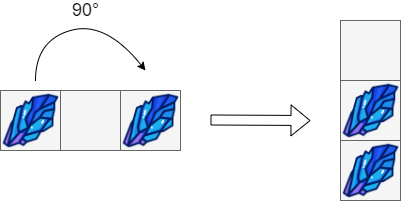
Input: boxGrid = [["#",".","#"]]
Output: [["."],
         ["#"],
         ["#"]]
Example 2:
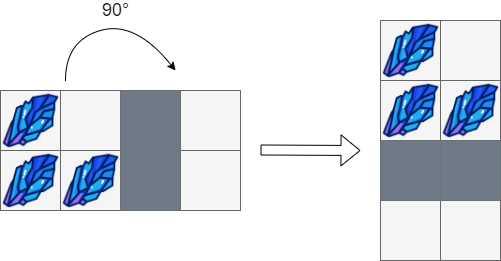
Input: boxGrid = [["#",".","*","."],
              ["#","#","*","."]]
Output: [["#","."],
         ["#","#"],
         ["*","*"],
         [".","."]]
Example 3:
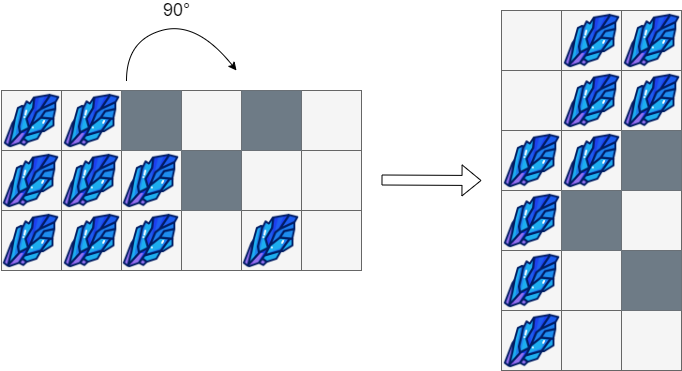
Input: boxGrid = [["#","#","*",".","*","."],
              ["#","#","#","*",".","."],
              ["#","#","#",".","#","."]]
Output: [[".","#","#"],
         [".","#","#"],
         ["#","#","*"],
         ["#","*","."],
         ["#",".","*"],
         ["#",".","."]]
Constraints:
m == boxGrid.lengthn == boxGrid[i].length1 <= m, n <= 500boxGrid[i][j]is either'#','*', or'.'.
Approach Overview
Problem Overview: You receive an m x n box represented as a matrix containing stones (#), obstacles (*), and empty spaces (.). Stones fall to the right due to gravity until blocked by an obstacle or another stone. After gravity settles, the entire box is rotated 90 degrees clockwise. The task is to return the final matrix.
Approach 1: Simulate Gravity and Then Rotate (Time: O(mn), Space: O(mn))
Process each row independently and simulate gravity before rotation. Scan from right to left using a pointer that marks the next position where a stone can settle. When you encounter a stone (#), move it to the pointer position and decrement the pointer. When an obstacle (*) appears, reset the pointer to the cell just left of the obstacle since stones cannot pass through it. After all rows stabilize, construct the rotated matrix by mapping box[r][c] to result[c][m-1-r]. This approach cleanly separates physics (gravity) from geometry (rotation) and is easy to reason about. It relies on sequential traversal of the array and basic matrix transformation.
Approach 2: Transpose and Simulate Gravity Directly (Time: O(mn), Space: O(mn))
Instead of settling stones first, rotate the matrix structure immediately and simulate gravity afterward. Build the rotated matrix using the same coordinate transform rotated[c][m-1-r] = box[r][c]. After rotation, gravity acts downward rather than to the right. Process each column using a two-pointer technique: scan upward while maintaining a pointer where the next falling stone should land. Obstacles reset the pointer just above them, while stones move down to the pointer location. This uses the classic two pointers pattern to compact stones within segments separated by obstacles.
Recommended for interviews: The gravity-first simulation is usually easier to explain and implement during interviews. You demonstrate understanding of constrained movement using pointers and then apply a standard matrix rotation. The transpose-first approach is equally optimal but slightly less intuitive because gravity changes direction after rotation. Showing either solution with clear reasoning and O(mn) complexity is typically what interviewers expect.
Complexity Analysis
| Approach | Time | Space | When to Use |
|---|---|---|---|
| Simulate Gravity Then Rotate | O(mn) | O(mn) | Most intuitive approach. Easy to explain during interviews and separates gravity simulation from rotation. |
| Transpose Then Simulate Gravity | O(mn) | O(mn) | Useful when you prefer working with the final rotated structure and applying gravity vertically with two pointers. |