
Number of Ways to Divide a Long Corridor - Video Solutions
Number of Ways to Divide a Long Corridor | Clear Intuition | Dry Run | Leetcode 2147 | MIK
Number of Ways to Divide a Long Corridor - Video Solution
Watch 10 video solutions for Number of Ways to Divide a Long Corridor, a hard level problem involving Math, String, Dynamic Programming. This walkthrough by codestorywithMIK has 9,877 views views. Want to try solving it yourself? Practice on FleetCode or read the detailed text solution.
Problem Statement
Along a long library corridor, there is a line of seats and decorative plants. You are given a 0-indexed string corridor of length n consisting of letters 'S' and 'P' where each 'S' represents a seat and each 'P' represents a plant.
One room divider has already been installed to the left of index 0, and another to the right of index n - 1. Additional room dividers can be installed. For each position between indices i - 1 and i (1 <= i <= n - 1), at most one divider can be installed.
Divide the corridor into non-overlapping sections, where each section has exactly two seats with any number of plants. There may be multiple ways to perform the division. Two ways are different if there is a position with a room divider installed in the first way but not in the second way.
Return the number of ways to divide the corridor. Since the answer may be very large, return it modulo 109 + 7. If there is no way, return 0.
Example 1:
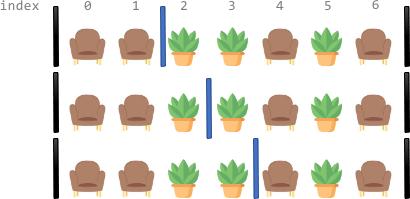
Input: corridor = "SSPPSPS"
Output: 3
Explanation: There are 3 different ways to divide the corridor.
The black bars in the above image indicate the two room dividers already installed.
Note that in each of the ways, each section has exactly two seats.
Example 2:

Input: corridor = "PPSPSP"
Output: 1
Explanation: There is only 1 way to divide the corridor, by not installing any additional dividers.
Installing any would create some section that does not have exactly two seats.
Example 3:
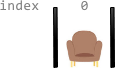
Input: corridor = "S"
Output: 0
Explanation: There is no way to divide the corridor because there will always be a section that does not have exactly two seats.
Constraints:
n == corridor.length1 <= n <= 105corridor[i]is either'S'or'P'.
Approach Overview
Problem Overview: You get a corridor represented by a string containing seats (S) and plants (P). The corridor must be divided using partitions so every section contains exactly two seats. The task is to count how many valid ways you can place these dividers.
Approach 1: Counting Seats and Calculating Divisions (O(n) time, O(1) space)
Scan the corridor and group seats in pairs. Each valid section must contain exactly two seats, so the structure becomes fixed once you locate seat positions. After the first pair is completed, count the number of plants between the second seat of the previous pair and the first seat of the next pair. Every plant position between those pairs becomes a potential divider location, so multiply the number of choices for each gap. This produces a running product of valid partition placements. The approach behaves like lightweight dynamic programming because the total number of arrangements accumulates as you process the string.
Approach 2: Two-Pointer Technique (O(n) time, O(1) space)
Use two pointers to locate seat pairs directly. Move the right pointer until two seats are found, marking the end of a section. Then advance the pointer across plants until the next seat appears. The number of plants skipped determines how many divider positions exist between seat pairs. Multiply this count into the answer and repeat until the corridor ends. This pointer-based traversal avoids extra storage and keeps the logic simple while still processing the string in one pass.
Recommended for interviews: The seat-counting multiplication approach is the most common solution. It demonstrates understanding of pattern observation and linear scanning over a string. Interviewers expect the O(n) solution using combinatorial counting from math. A brute-force attempt that tries every partition quickly becomes exponential and is mainly useful to reason about why counting gaps works.
Complexity Analysis
| Approach | Time | Space | When to Use |
|---|---|---|---|
| Counting Seats and Calculating Divisions | O(n) | O(1) | Best general solution; simple linear scan and multiplication of valid divider positions |
| Two-Pointer Technique | O(n) | O(1) | Useful when explicitly tracking seat boundaries while scanning the corridor |