
Minimum Swaps to Arrange a Binary Grid - Video Solutions
Minimum Swaps to Arrange a Binary Grid | Intuition | Dry Run | Leetcode 1536 | codestorywithMIK
Minimum Swaps to Arrange a Binary Grid - Video Solution
Watch 10 video solutions for Minimum Swaps to Arrange a Binary Grid, a medium level problem involving Array, Greedy, Matrix. This walkthrough by codestorywithMIK has 11,360 views views. Want to try solving it yourself? Practice on FleetCode or read the detailed text solution.
Problem Statement
Given an n x n binary grid, in one step you can choose two adjacent rows of the grid and swap them.
A grid is said to be valid if all the cells above the main diagonal are zeros.
Return the minimum number of steps needed to make the grid valid, or -1 if the grid cannot be valid.
The main diagonal of a grid is the diagonal that starts at cell (1, 1) and ends at cell (n, n).
Example 1:

Input: grid = [[0,0,1],[1,1,0],[1,0,0]]
Output: 3
Example 2:
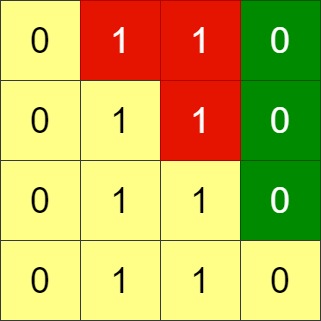
Input: grid = [[0,1,1,0],[0,1,1,0],[0,1,1,0],[0,1,1,0]]
Output: -1
Explanation: All rows are similar, swaps have no effect on the grid.
Example 3:
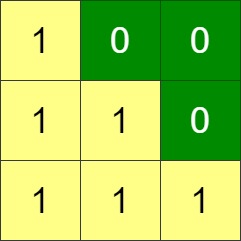
Input: grid = [[1,0,0],[1,1,0],[1,1,1]]
Output: 0
Constraints:
n == grid.length== grid[i].length1 <= n <= 200grid[i][j]is either0or1
Approach Overview
Problem Overview: You are given an n x n binary grid. The goal is to reorder rows using adjacent swaps so that for every row i, the number of trailing zeros is at least n - i - 1. If no ordering satisfies this constraint, return -1. The challenge is minimizing the number of adjacent row swaps required.
Approach 1: Greedy Method to Track Trailing Zeros (O(n2) time, O(n) space)
Start by computing the number of trailing zeros for each row. Store these values in an array. For row i, you need at least n - i - 1 trailing zeros to place that row at position i. Scan downward from i to find the first row that satisfies the requirement. Once found, move that row upward using adjacent swaps, which costs the distance moved. This greedy strategy works because placing the earliest valid row preserves flexibility for later rows. The algorithm mainly uses array traversal and counting, making it a classic combination of array manipulation and greedy decision making. Time complexity is O(n^2) due to repeated scans and swaps, while space complexity is O(n) for storing trailing zero counts.
Approach 2: Advanced Counting from Bottom to Top (O(n2) time, O(n) space)
This variation processes the grid from the bottom toward the top while maintaining counts of rows that already satisfy each trailing-zero requirement. First compute trailing zeros for every row in the matrix. Then iterate over required positions and look for rows that meet the constraint. Instead of repeatedly scanning the full list, you conceptually treat rows as a movable sequence and count how far a valid row must travel upward. The number of swaps equals the difference between the row’s current index and its target index. This method emphasizes counting and positional adjustments rather than explicitly simulating every swap, though the complexity remains O(n^2). It provides a cleaner mental model for understanding why the greedy choice is optimal.
Recommended for interviews: The greedy trailing-zero approach is the expected solution. Interviewers want to see you recognize that each row has a minimum trailing-zero requirement and that selecting the nearest valid row minimizes swaps. Starting with the trailing-zero calculation shows strong problem decomposition, while the greedy placement demonstrates algorithmic intuition. Even though the complexity is O(n^2), it comfortably fits the problem constraints and is considered the optimal practical solution.
Complexity Analysis
| Approach | Time | Space | When to Use |
|---|---|---|---|
| Greedy Tracking of Trailing Zeros | O(n^2) | O(n) | General case. Most intuitive solution and commonly expected in coding interviews. |
| Bottom-to-Top Counting Strategy | O(n^2) | O(n) | Useful when reasoning about row positions and swap distances instead of explicitly simulating swaps. |