1536. Minimum Swaps to Arrange a Binary Grid
Given an n x n binary grid, in one step you can choose two adjacent rows of the grid and swap them.
A grid is said to be valid if all the cells above the main diagonal are zeros.
Return the minimum number of steps needed to make the grid valid, or -1 if the grid cannot be valid.
The main diagonal of a grid is the diagonal that starts at cell (1, 1) and ends at cell (n, n).
Example 1:

Input: grid = [[0,0,1],[1,1,0],[1,0,0]]
Output: 3
Example 2:
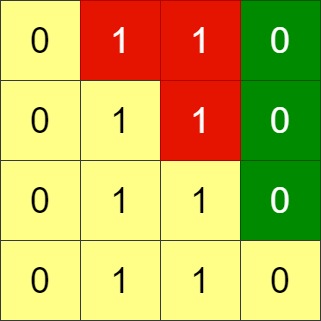
Input: grid = [[0,1,1,0],[0,1,1,0],[0,1,1,0],[0,1,1,0]]
Output: -1
Explanation: All rows are similar, swaps have no effect on the grid.
Example 3:
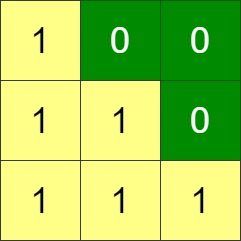
Input: grid = [[1,0,0],[1,1,0],[1,1,1]]
Output: 0
Constraints:
n == grid.length== grid[i].length1 <= n <= 200grid[i][j]is either0or1
Topics
Hints open one at a time
Hint 1
For each row of the grid calculate the most right 1 in the grid in the array maxRight.
Hint 2
To check if there exist answer, sort maxRight and check if maxRight[i] ≤ i for all possible i's.
Hint 3
If there exist an answer, simulate the swaps.
Loading editor…
1class Solution:
2 def minSwaps(self, grid: List[List[int]]) -> int:
3
Starter codePython 3Spaces: 4
Loading editor…
1class Solution:
2 def minSwaps(self, grid: List[List[int]]) -> int:
3
Starter codePython 3Spaces: 4
Examples
Input
[[0,0,1],[1,1,0],[1,0,0]]
Input
[[0,1,1,0],[0,1,1,0],[0,1,1,0],[0,1,1,0]]
Input
[[1,0,0],[1,1,0],[1,1,1]]
Your code is saved on this device.Solution