
Minimum Operations to Make Columns Strictly Increasing - Video Solutions
3402. Minimum Operations to Make Columns Strictly Increasing (Leetcode Easy)
Minimum Operations to Make Columns Strictly Increasing - Video Solution
Watch 6 video solutions for Minimum Operations to Make Columns Strictly Increasing, a easy level problem involving Array, Greedy, Matrix. This walkthrough by Programming Live with Larry has 260 views views. Want to try solving it yourself? Practice on FleetCode or read the detailed text solution.
Problem Statement
You are given a m x n matrix grid consisting of non-negative integers.
In one operation, you can increment the value of any grid[i][j] by 1.
Return the minimum number of operations needed to make all columns of grid strictly increasing.
Example 1:
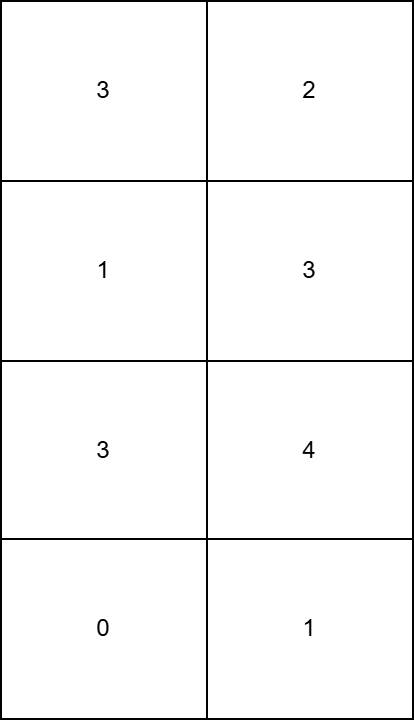
Input: grid = [[3,2],[1,3],[3,4],[0,1]]
Output: 15
Explanation:
- To make the
0thcolumn strictly increasing, we can apply 3 operations ongrid[1][0], 2 operations ongrid[2][0], and 6 operations ongrid[3][0]. - To make the
1stcolumn strictly increasing, we can apply 4 operations ongrid[3][1].
Example 2:
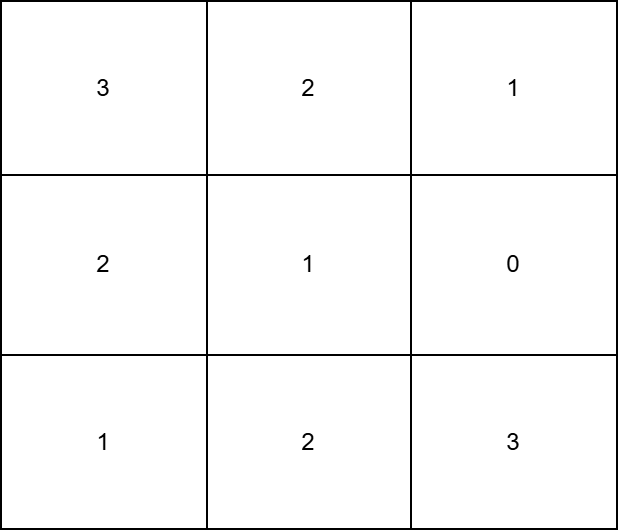
Input: grid = [[3,2,1],[2,1,0],[1,2,3]]
Output: 12
Explanation:
- To make the
0thcolumn strictly increasing, we can apply 2 operations ongrid[1][0], and 4 operations ongrid[2][0]. - To make the
1stcolumn strictly increasing, we can apply 2 operations ongrid[1][1], and 2 operations ongrid[2][1]. - To make the
2ndcolumn strictly increasing, we can apply 2 operations ongrid[1][2].
Constraints:
m == grid.lengthn == grid[i].length1 <= m, n <= 500 <= grid[i][j] < 2500
Approach Overview
Problem Overview: You are given an m x n grid of integers. You can increment any cell by 1 in a single operation. The goal is to make every column strictly increasing from top to bottom while performing the minimum number of operations.
Approach 1: Increment Simulation (Brute Force) (Time: O(m * n * k), Space: O(1))
The straightforward idea is to process each column and repeatedly increment elements until the column becomes strictly increasing. For every cell grid[r][c], compare it with the element above it. If it is not greater, keep incrementing the current cell until it becomes prev + 1. Each increment is counted as a separate operation. This approach works but can perform many unnecessary repeated increments when the difference between values is large.
Because increments are simulated one-by-one, the effective complexity becomes O(m * n * k), where k represents the number of increments applied. While simple to reason about, it is inefficient for large values and mainly useful as a conceptual starting point.
Approach 2: Column-wise Greedy Calculation (Time: O(m * n), Space: O(1))
A more efficient strategy is to compute the required increments directly instead of simulating them. Iterate column by column. For each column, keep track of the previous value (the value in the row above after adjustments). If the current cell is already greater than the previous value, move on. Otherwise, calculate how much it must increase to become prev + 1.
Add the difference (prev + 1 - current) to the operation count and treat the cell's adjusted value as prev + 1. This greedy rule ensures the smallest possible increment that maintains the strictly increasing property. Each cell is processed once, making the algorithm linear in the number of elements.
This approach works because increasing a value more than necessary would only increase future constraints in the column. The optimal move is always the minimal increment that satisfies the order requirement.
Recommended for interviews: The greedy column-wise scan is the expected solution. It demonstrates understanding of arrays, matrix traversal, and a simple greedy optimization. Explaining the brute force idea first and then optimizing it to a direct calculation shows strong problem-solving progression.
Complexity Analysis
| Approach | Time | Space | When to Use |
|---|---|---|---|
| Increment Simulation (Brute Force) | O(m * n * k) | O(1) | Conceptual baseline when first reasoning about the problem |
| Column-wise Greedy Calculation | O(m * n) | O(1) | Optimal solution for interviews and production code |