
Minimum Numbers of Function Calls to Make Target Array - Video Solutions
花花酱 LeetCode 1558. Minimum Numbers of Function Calls to Make Target Array - 刷题找工作 EP351
Minimum Numbers of Function Calls to Make Target Array - Video Solution
Watch 10 video solutions for Minimum Numbers of Function Calls to Make Target Array, a medium level problem involving Array, Greedy, Bit Manipulation. This walkthrough by Hua Hua has 1,308 views views. Want to try solving it yourself? Practice on FleetCode or read the detailed text solution.
Problem Statement
You are given an integer array nums. You have an integer array arr of the same length with all values set to 0 initially. You also have the following modify function:
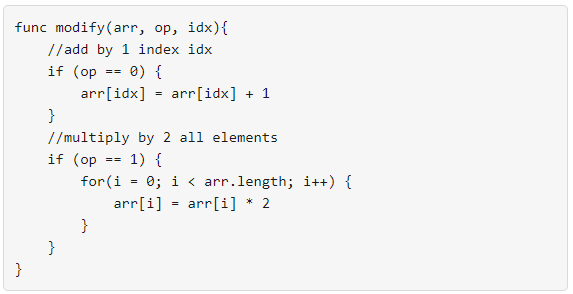
You want to use the modify function to convert arr to nums using the minimum number of calls.
Return the minimum number of function calls to make nums from arr.
The test cases are generated so that the answer fits in a 32-bit signed integer.
Example 1:
Input: nums = [1,5]
Output: 5
Explanation: Increment by 1 (second element): [0, 0] to get [0, 1] (1 operation).
Double all the elements: [0, 1] -> [0, 2] -> [0, 4] (2 operations).
Increment by 1 (both elements)  [0, 4] -> [1, 4] -> [1, 5] (2 operations).
Total of operations: 1 + 2 + 2 = 5.
Example 2:
Input: nums = [2,2]
Output: 3
Explanation: Increment by 1 (both elements) [0, 0] -> [0, 1] -> [1, 1] (2 operations).
Double all the elements: [1, 1] -> [2, 2] (1 operation).
Total of operations: 2 + 1 = 3.
Example 3:
Input: nums = [4,2,5]
Output: 6
Explanation: (initial)[0,0,0] -> [1,0,0] -> [1,0,1] -> [2,0,2] -> [2,1,2] -> [4,2,4] -> [4,2,5](nums).
Constraints:
1 <= nums.length <= 1050 <= nums[i] <= 109
Approach Overview
Problem Overview: You start with an array of zeros and want to build the target array using two operations: increment a single element by 1, or double every element in the array. The task is to compute the minimum number of function calls needed to transform the zero array into the target array.
Approach 1: Greedy Reverse Simulation (O(n log M) time, O(1) space)
Instead of building the array from zeros, think in reverse. Start from the target array and reduce it to all zeros. If an element is odd, the last operation must have been an increment, so subtract 1 from that element. If all elements are even, the last operation must have been a global doubling, so divide every element by 2. This greedy logic works because doubling affects all elements simultaneously while increments affect only one index. Repeating this process until all elements reach zero gives the minimum number of operations.
Approach 2: Bitwise Analysis (O(n log M) time, O(1) space)
The operations map directly to binary representation. Every 1 bit in a number corresponds to an increment operation. Every bit shift to the left corresponds to a doubling operation applied to the entire array. For each element, count the number of set bits using bit manipulation; this gives the total number of increment operations. Then track the maximum bit length among all numbers, which determines how many doubling operations are required. The final answer is the sum of all set bits plus (max_bit_length - 1) doubling operations.
This works because doubling the array is equivalent to a left shift in binary. Increment operations fill in the 1 bits, while doubling operations move values into higher bit positions. Iterating through the array once and analyzing the bits of each number yields the optimal result.
Both approaches rely on understanding how binary representation reflects the allowed operations. The bitwise method is typically simpler and avoids modifying the array, making it the most common interview solution.
Recommended for interviews: Use the Bitwise Analysis approach. Interviewers expect you to recognize that increment operations correspond to set bits and doubling corresponds to binary shifts. The greedy reverse idea shows strong intuition, but the bit manipulation solution demonstrates deeper understanding of binary operations and runs in linear time relative to the array size. Related concepts appear frequently in problems involving array processing, greedy algorithms, and bit manipulation.
Complexity Analysis
| Approach | Time | Space | When to Use |
|---|---|---|---|
| Greedy Reverse Simulation | O(n log M) | O(1) | When reasoning about operations step-by-step or explaining the logic intuitively in interviews |
| Bitwise Analysis | O(n log M) | O(1) | Best general solution; counts set bits and maximum bit length efficiently without modifying the array |