
Maximum Genetic Difference Query - Video Solutions
LeetCode 1938. Maximum Genetic Difference Query
Maximum Genetic Difference Query - Video Solution
Watch 4 video solutions for Maximum Genetic Difference Query, a hard level problem involving Array, Hash Table, Bit Manipulation. This walkthrough by Happy Coding has 1,428 views views. Want to try solving it yourself? Practice on FleetCode or read the detailed text solution.
Problem Statement
There is a rooted tree consisting of n nodes numbered 0 to n - 1. Each node's number denotes its unique genetic value (i.e. the genetic value of node x is x). The genetic difference between two genetic values is defined as the bitwise-XOR of their values. You are given the integer array parents, where parents[i] is the parent for node i. If node x is the root of the tree, then parents[x] == -1.
You are also given the array queries where queries[i] = [nodei, vali]. For each query i, find the maximum genetic difference between vali and pi, where pi is the genetic value of any node that is on the path between nodei and the root (including nodei and the root). More formally, you want to maximize vali XOR pi.
Return an array ans where ans[i] is the answer to the ith query.
Example 1:
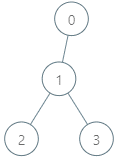
Input: parents = [-1,0,1,1], queries = [[0,2],[3,2],[2,5]]
Output: [2,3,7]
Explanation: The queries are processed as follows:
- [0,2]: The node with the maximum genetic difference is 0, with a difference of 2 XOR 0 = 2.
- [3,2]: The node with the maximum genetic difference is 1, with a difference of 2 XOR 1 = 3.
- [2,5]: The node with the maximum genetic difference is 2, with a difference of 5 XOR 2 = 7.
Example 2:
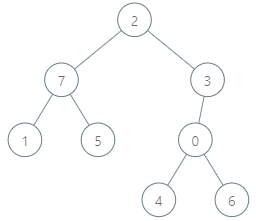
Input: parents = [3,7,-1,2,0,7,0,2], queries = [[4,6],[1,15],[0,5]]
Output: [6,14,7]
Explanation: The queries are processed as follows:
- [4,6]: The node with the maximum genetic difference is 0, with a difference of 6 XOR 0 = 6.
- [1,15]: The node with the maximum genetic difference is 1, with a difference of 15 XOR 1 = 14.
- [0,5]: The node with the maximum genetic difference is 2, with a difference of 5 XOR 2 = 7.
Constraints:
2 <= parents.length <= 1050 <= parents[i] <= parents.length - 1for every nodeithat is not the root.parents[root] == -11 <= queries.length <= 3 * 1040 <= nodei <= parents.length - 10 <= vali <= 2 * 105
Approach Overview
Problem Overview: You are given a rooted tree where each node represents a genetic value equal to its index. For every query [node, val], compute the maximum val XOR x where x is any ancestor of node (including the node itself). The challenge is answering many XOR queries efficiently while traversing the tree.
Approach 1: DFS with Trie (Time: O((n + q) * logV), Space: O(n * logV))
This approach performs a depth-first search over the tree while maintaining a binary Trie of the values on the current root-to-node path. When DFS enters a node, insert the node's value into the Trie. For every query attached to that node, compute the maximum XOR with val by greedily choosing the opposite bit at each level of the Trie (a classic bit manipulation trick). After processing children, remove the node value when backtracking so the Trie always reflects the active ancestor path.
The key insight: at any moment during DFS, the Trie contains exactly the ancestors of the current node. That means each query becomes a standard "maximum XOR with set" operation. Since values are bounded by node indices, the Trie depth is about 18–20 bits, making each insert, delete, and query very fast.
Approach 2: Preprocessing with Persistent Trie (Time: O((n + q) * logV), Space: O(n * logV))
This approach builds a persistent binary Trie for each node representing the set of values from the root to that node. Instead of modifying a single Trie during DFS, every insertion creates a new version that shares most of its structure with the previous one. The version for a node is derived from its parent's version with the node value inserted.
Each query simply uses the persistent Trie version corresponding to the queried node and performs the same maximum XOR lookup. Because nodes share structure between versions, memory growth stays manageable while avoiding insert/remove operations during traversal.
The persistent structure is especially useful when queries are independent of traversal order or when you want immutable versions of the ancestor sets. The lookup process is identical to a standard maximum XOR search in a binary Trie.
Recommended for interviews: DFS with Trie is the approach most interviewers expect. It demonstrates understanding of tree traversal, dynamic data structures, and XOR optimization. The persistent Trie version shows deeper knowledge of functional data structures and is more common in competitive programming or advanced system design discussions.
Complexity Analysis
| Approach | Time | Space | When to Use |
|---|---|---|---|
| DFS with Trie | O((n + q) * logV) | O(n * logV) | Best general solution. Efficient when queries are processed during DFS traversal. |
| Preprocessing with Persistent Trie | O((n + q) * logV) | O(n * logV) | Useful when immutable versions of ancestor sets are needed or queries are processed independently. |