
Longest ZigZag Path in a Binary Tree - Video Solutions
Longest ZigZag Path in a Binary Tree - | Leetcode-1372 | MICROSOFT | Explanation + Live Code
Longest ZigZag Path in a Binary Tree - Video Solution
Watch 10 video solutions for Longest ZigZag Path in a Binary Tree, a medium level problem involving Dynamic Programming, Tree, Depth-First Search. This walkthrough by codestorywithMIK has 14,391 views views. Want to try solving it yourself? Practice on FleetCode or read the detailed text solution.
Problem Statement
You are given the root of a binary tree.
A ZigZag path for a binary tree is defined as follow:
- Choose any node in the binary tree and a direction (right or left).
- If the current direction is right, move to the right child of the current node; otherwise, move to the left child.
- Change the direction from right to left or from left to right.
- Repeat the second and third steps until you can't move in the tree.
Zigzag length is defined as the number of nodes visited - 1. (A single node has a length of 0).
Return the longest ZigZag path contained in that tree.
Example 1:
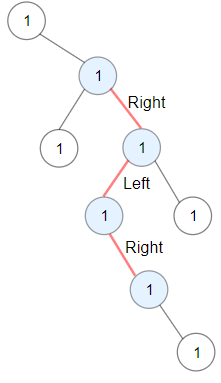
Input: root = [1,null,1,1,1,null,null,1,1,null,1,null,null,null,1]
Output: 3
Explanation: Longest ZigZag path in blue nodes (right -> left -> right).
Example 2:
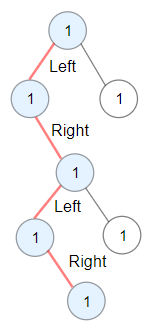
Input: root = [1,1,1,null,1,null,null,1,1,null,1]
Output: 4
Explanation: Longest ZigZag path in blue nodes (left -> right -> left -> right).
Example 3:
Input: root = [1]
Output: 0
Constraints:
- The number of nodes in the tree is in the range
[1, 5 * 104]. 1 <= Node.val <= 100
Approach Overview
Problem Overview: You are given the root of a binary tree and must find the length of the longest ZigZag path. A ZigZag path alternates between left and right child moves at every step. The path can start at any node, and the answer is the maximum number of edges in such an alternating sequence.
Approach 1: Depth-First Search (DFS) Recursive Approach (O(n) time, O(h) space)
This approach uses Depth-First Search to explore every node while tracking the direction of the previous move. For each node, maintain two states: the length of a ZigZag path if the previous move was left and the length if the previous move was right. When moving left, reset the left count and extend the right count, and vice versa. A global variable tracks the maximum length encountered during traversal. Because each node is visited once, the time complexity is O(n), and recursion stack space is O(h), where h is the tree height.
The key insight is that ZigZag paths depend only on the previous direction. By passing the current length and direction during recursion, you avoid recomputing paths from every node. This pattern resembles state transitions commonly seen in Dynamic Programming on trees.
Approach 2: Breadth-First Search (BFS) Iterative Approach (O(n) time, O(n) space)
This method performs a level-order traversal using a queue. Each queue entry stores the current node, the direction of the last move, and the current ZigZag length. When expanding nodes, push children with updated direction and reset the path length when the direction repeats. By iterating through all nodes while tracking direction changes, the algorithm evaluates every possible ZigZag path. The traversal touches each node once, giving O(n) time complexity, while the queue may hold up to O(n) nodes in the worst case.
This iterative version is useful when recursion depth might become large or when you prefer explicit state tracking during traversal. It still relies on standard Binary Tree traversal mechanics.
Recommended for interviews: The DFS recursive approach is typically expected. It demonstrates strong understanding of tree traversal, state propagation, and how to track directional transitions efficiently. Interviewers often look for the insight that two directional states per node are enough to compute the optimal ZigZag path in a single pass.
Complexity Analysis
| Approach | Time | Space | When to Use |
|---|---|---|---|
| DFS Recursive with Direction Tracking | O(n) | O(h) | Best general solution. Clean logic and optimal for interviews. |
| BFS Iterative with Queue State | O(n) | O(n) | Useful when avoiding recursion or when explicit traversal state is preferred. |