
Leetcode 1895. Largest Magic Square
Largest Magic Square - Video Solution
Watch 10 video solutions for Largest Magic Square, a medium level problem involving Array, Matrix, Prefix Sum. This walkthrough by Fraz has 6,374 views views. Want to try solving it yourself? Practice on FleetCode or read the detailed text solution.
Problem Statement
A k x k magic square is a k x k grid filled with integers such that every row sum, every column sum, and both diagonal sums are all equal. The integers in the magic square do not have to be distinct. Every 1 x 1 grid is trivially a magic square.
Given an m x n integer grid, return the size (i.e., the side length k) of the largest magic square that can be found within this grid.
Example 1:
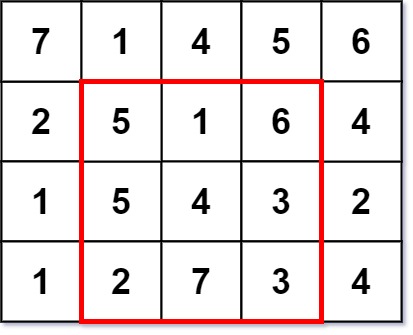
Input: grid = [[7,1,4,5,6],[2,5,1,6,4],[1,5,4,3,2],[1,2,7,3,4]]
Output: 3
Explanation: The largest magic square has a size of 3.
Every row sum, column sum, and diagonal sum of this magic square is equal to 12.
- Row sums: 5+1+6 = 5+4+3 = 2+7+3 = 12
- Column sums: 5+5+2 = 1+4+7 = 6+3+3 = 12
- Diagonal sums: 5+4+3 = 6+4+2 = 12
Example 2:
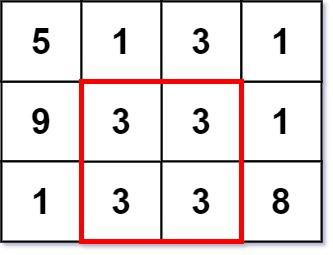
Input: grid = [[5,1,3,1],[9,3,3,1],[1,3,3,8]]
Output: 2
Constraints:
m == grid.lengthn == grid[i].length1 <= m, n <= 501 <= grid[i][j] <= 106
Approach Overview
Problem Overview: Given a grid of integers, find the size of the largest k x k subgrid where every row sum, column sum, and both diagonal sums are equal. Such a subgrid is called a magic square. The task is to scan the matrix and return the maximum possible k.
Approach 1: Brute Force with Prefix Sums (Time: O(m * n * k^2), Space: O(m * n))
Start by computing prefix sums for rows and columns so you can query the sum of any row segment or column segment in constant time. For every possible top-left corner in the matrix, try every possible square size k. For each candidate square, check all k row sums and k column sums using the prefix arrays, and compute the two diagonals directly. If every sum matches the first row's sum, the square is magic. This approach is straightforward and easier to reason about, but verifying all rows and columns for every candidate square introduces an extra k factor.
Prefix sums are the key helper here. A row prefix array lets you compute sum(row, c1..c2) instantly, while a column prefix array provides sum(col, r1..r2). That avoids recomputing sums repeatedly and significantly reduces the naive O(k^3) checks. This technique is common in problems involving repeated range queries on arrays and grids.
Approach 2: Optimized Prefix Sum Verification (Time: O(m * n * min(m,n)), Space: O(m * n))
This approach still relies on prefix sums but reduces unnecessary checks. Precompute row and column prefix sums once. Then iterate over possible square sizes from largest to smallest. For each size k, scan all valid top-left positions. Compute the target sum from the first row of the square. Next verify columns using prefix sums and compute the two diagonals directly. Because you attempt larger squares first, you can return immediately once a valid magic square is found.
The optimization works because prefix sums reduce every row and column verification to O(1). The algorithm effectively checks each candidate square in linear time relative to its size rather than quadratic. Combined with early termination when a valid square appears, this performs well even for larger grids.
Recommended for interviews: The optimized prefix sum approach is what most interviewers expect. The brute force version shows that you understand how to enumerate candidate squares and validate sums. Adding prefix sums and checking larger squares first demonstrates practical optimization skills and familiarity with common grid techniques.
Complexity Analysis
| Approach | Time | Space | When to Use |
|---|---|---|---|
| Brute Force with Prefix Sums | O(m * n * k^2) | O(m * n) | Good for understanding the validation process of magic squares and practicing prefix sum queries |
| Optimized Prefix Sum Verification | O(m * n * min(m,n)) | O(m * n) | Preferred solution for interviews and production due to faster validation and early termination |