
Intersection of Two Linked Lists - Video Solutions
Intersection of Two Linked Lists - Leetcode 160 - Python
Intersection of Two Linked Lists - Video Solution
Watch 10 video solutions for Intersection of Two Linked Lists, a easy level problem involving Hash Table, Linked List, Two Pointers. This walkthrough by NeetCode has 105,351 views views. Want to try solving it yourself? Practice on FleetCode or read the detailed text solution.
Problem Statement
Given the heads of two singly linked-lists headA and headB, return the node at which the two lists intersect. If the two linked lists have no intersection at all, return null.
For example, the following two linked lists begin to intersect at node c1:
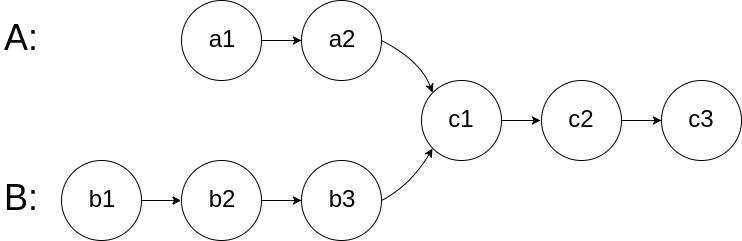
The test cases are generated such that there are no cycles anywhere in the entire linked structure.
Note that the linked lists must retain their original structure after the function returns.
Custom Judge:
The inputs to the judge are given as follows (your program is not given these inputs):
intersectVal- The value of the node where the intersection occurs. This is0if there is no intersected node.listA- The first linked list.listB- The second linked list.skipA- The number of nodes to skip ahead inlistA(starting from the head) to get to the intersected node.skipB- The number of nodes to skip ahead inlistB(starting from the head) to get to the intersected node.
The judge will then create the linked structure based on these inputs and pass the two heads, headA and headB to your program. If you correctly return the intersected node, then your solution will be accepted.
Example 1:

Input: intersectVal = 8, listA = [4,1,8,4,5], listB = [5,6,1,8,4,5], skipA = 2, skipB = 3
Output: Intersected at '8'
Explanation: The intersected node's value is 8 (note that this must not be 0 if the two lists intersect).
From the head of A, it reads as [4,1,8,4,5]. From the head of B, it reads as [5,6,1,8,4,5]. There are 2 nodes before the intersected node in A; There are 3 nodes before the intersected node in B.
- Note that the intersected node's value is not 1 because the nodes with value 1 in A and B (2nd node in A and 3rd node in B) are different node references. In other words, they point to two different locations in memory, while the nodes with value 8 in A and B (3rd node in A and 4th node in B) point to the same location in memory.
Example 2:

Input: intersectVal = 2, listA = [1,9,1,2,4], listB = [3,2,4], skipA = 3, skipB = 1
Output: Intersected at '2'
Explanation: The intersected node's value is 2 (note that this must not be 0 if the two lists intersect).
From the head of A, it reads as [1,9,1,2,4]. From the head of B, it reads as [3,2,4]. There are 3 nodes before the intersected node in A; There are 1 node before the intersected node in B.
Example 3:
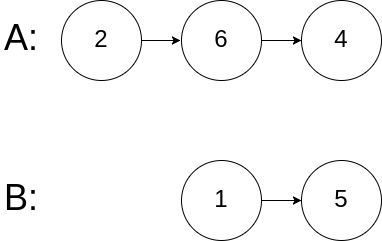
Input: intersectVal = 0, listA = [2,6,4], listB = [1,5], skipA = 3, skipB = 2
Output: No intersection
Explanation: From the head of A, it reads as [2,6,4]. From the head of B, it reads as [1,5]. Since the two lists do not intersect, intersectVal must be 0, while skipA and skipB can be arbitrary values.
Explanation: The two lists do not intersect, so return null.
Constraints:
- The number of nodes of
listAis in them. - The number of nodes of
listBis in then. 1 <= m, n <= 3 * 1041 <= Node.val <= 1050 <= skipA <= m0 <= skipB <= nintersectValis0iflistAandlistBdo not intersect.intersectVal == listA[skipA] == listB[skipB]iflistAandlistBintersect.
Follow up: Could you write a solution that runs in
O(m + n) time and use only O(1) memory?Approach Overview
Problem Overview: You are given the heads of two singly linked lists. The task is to return the node where the two lists intersect. After the intersection point, both lists share the exact same nodes in memory. If the lists never meet, return null. The challenge is detecting the shared node without modifying the lists and while keeping time and space efficient.
Approach 1: Using Length Difference (O(m+n) time, O(1) space)
First compute the length of both lists by iterating through them once. If one list is longer, advance its pointer by the length difference so both pointers are equally far from the tail. Now move both pointers forward together one node at a time. The first node where the pointers are equal is the intersection node. This approach relies on the property that once the lists align at the same remaining distance, the shared portion will be reached simultaneously. This method is straightforward if you are comfortable with linked list traversal.
Approach 2: Two Pointer Technique (O(m+n) time, O(1) space)
Use two pointers starting at the heads of the two lists. When a pointer reaches the end of its list, redirect it to the head of the other list. After at most two passes, both pointers travel the same total distance. If an intersection exists, the pointers meet exactly at the intersection node. If not, they both reach null at the same time. The key insight is distance equalization: each pointer effectively traverses lenA + lenB. This elegant trick is a classic application of the two pointers pattern and avoids explicitly computing lengths.
Recommended for interviews: The two pointer switching technique is what most interviewers expect. It demonstrates a deeper understanding of pointer traversal and avoids extra preprocessing. The length difference method still shows solid reasoning and is often the first solution candidates derive. Both run in O(m+n) time with O(1) extra space, which is optimal for this linked list problem.
Complexity Analysis
| Approach | Time | Space | When to Use |
|---|---|---|---|
| Length Difference Alignment | O(m+n) | O(1) | When you want a straightforward approach by aligning list lengths before traversal |
| Two Pointer Switching Technique | O(m+n) | O(1) | Best general solution; commonly expected in coding interviews |