
Find Common Elements Between Two Arrays - Video Solutions
Leetcode | 2956. Find Common Elements Between Two Arrays | Easy | Java Solution
Find Common Elements Between Two Arrays - Video Solution
Watch 10 video solutions for Find Common Elements Between Two Arrays, a easy level problem involving Array, Hash Table. This walkthrough by Developer Docs has 1,515 views views. Want to try solving it yourself? Practice on FleetCode or read the detailed text solution.
Problem Statement
You are given two integer arrays nums1 and nums2 of sizes n and m, respectively. Calculate the following values:
answer1: the number of indicesisuch thatnums1[i]exists innums2.answer2: the number of indicesisuch thatnums2[i]exists innums1.
Return [answer1,answer2].
Example 1:
Input: nums1 = [2,3,2], nums2 = [1,2]
Output: [2,1]
Explanation:
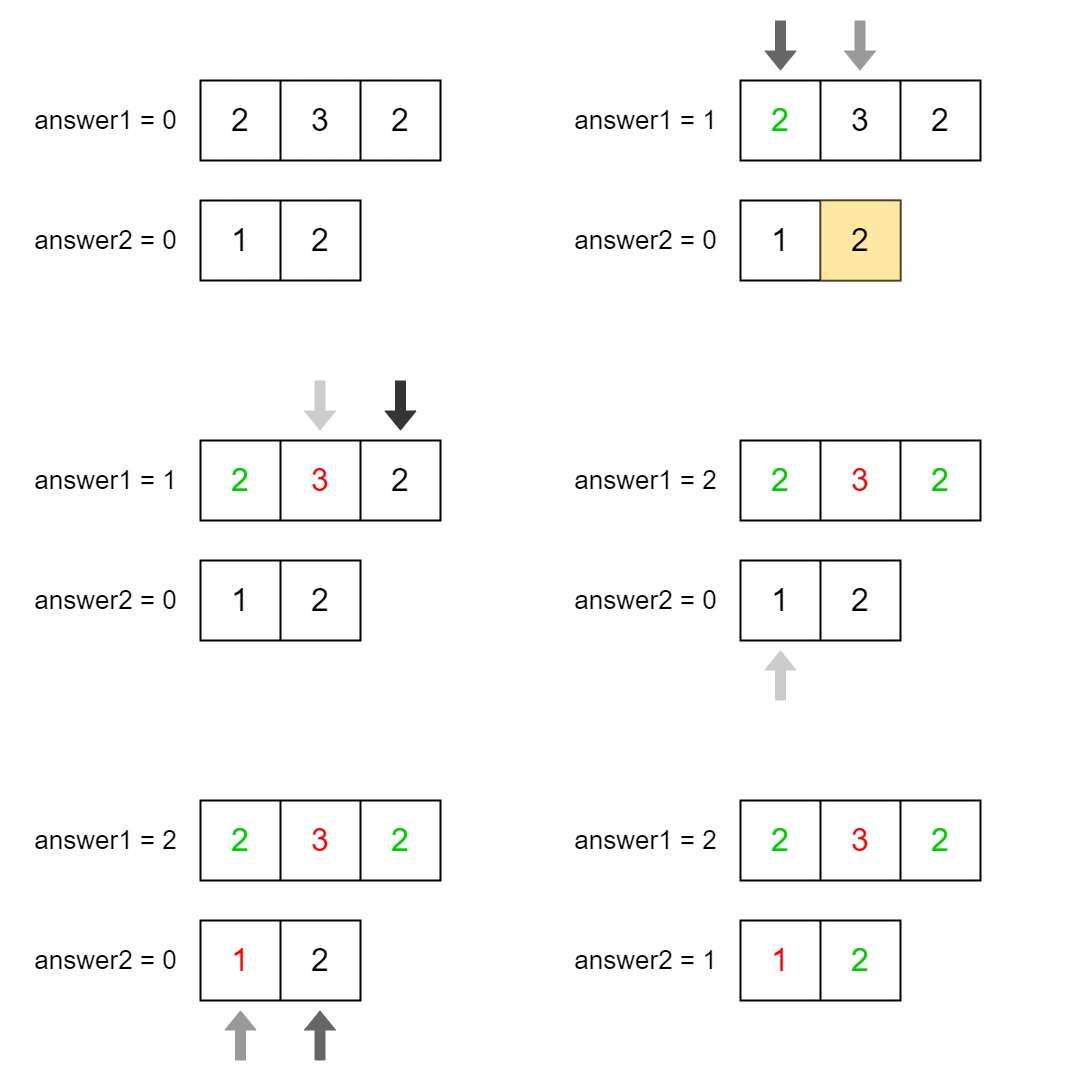
Example 2:
Input: nums1 = [4,3,2,3,1], nums2 = [2,2,5,2,3,6]
Output: [3,4]
Explanation:
The elements at indices 1, 2, and 3 in nums1 exist in nums2 as well. So answer1 is 3.
The elements at indices 0, 1, 3, and 4 in nums2 exist in nums1. So answer2 is 4.
Example 3:
Input: nums1 = [3,4,2,3], nums2 = [1,5]
Output: [0,0]
Explanation:
No numbers are common between nums1 and nums2, so answer is [0,0].
Constraints:
n == nums1.lengthm == nums2.length1 <= n, m <= 1001 <= nums1[i], nums2[i] <= 100
Approach Overview
Problem Overview: You get two integer arrays, nums1 and nums2. For each array, count how many elements also appear in the other array. The result is a two‑element array where the first value counts matches from nums1 in nums2, and the second counts matches from nums2 in nums1.
Approach 1: Using Brute Force with Optimizations (O(n * m) time, O(1) space)
The straightforward method checks every element of one array against the other. For each value in nums1, iterate through nums2 and stop once a match is found. Repeat the same process in the opposite direction. Early termination slightly reduces unnecessary comparisons, but the worst‑case still requires scanning the full second array for each element. This approach relies only on nested iteration and basic comparisons, making it easy to implement but inefficient for larger inputs. It’s mainly useful for understanding the baseline before introducing better lookup structures.
Approach 2: Using Set for Efficient Look-Up (O(n + m) time, O(n + m) space)
A more efficient solution uses a set (hash table) for constant‑time membership checks. Convert nums1 and nums2 into sets, then iterate through each original array. For every value in nums1, check if it exists in the set built from nums2. Do the reverse for nums2. Hash lookups run in average O(1), so each array is scanned only once. This reduces the total complexity to O(n + m) while using extra memory for the sets. This pattern appears frequently in array problems that require fast membership checks and is a common use case for a hash table.
Recommended for interviews: The hash set approach is the expected solution. It demonstrates that you recognize when repeated membership checks can be optimized with a set. Showing the brute force approach first confirms you understand the baseline complexity, while moving to the O(n + m) hash‑based solution shows strong problem‑solving skills with hash table techniques.
Complexity Analysis
| Approach | Time | Space | When to Use |
|---|---|---|---|
| Brute Force with Nested Loops | O(n * m) | O(1) | Useful for small arrays or when minimizing extra memory is required |
| Hash Set Look-Up | O(n + m) | O(n + m) | Best general solution when fast membership checks are needed |