
Copy List with Random Pointer - Video Solutions
Copy List with Random Pointer - Linked List - Leetcode 138
Copy List with Random Pointer - Video Solution
Watch 10 video solutions for Copy List with Random Pointer, a medium level problem involving Hash Table, Linked List. This walkthrough by NeetCode has 218,113 views views. Want to try solving it yourself? Practice on FleetCode or read the detailed text solution.
Problem Statement
A linked list of length n is given such that each node contains an additional random pointer, which could point to any node in the list, or null.
Construct a deep copy of the list. The deep copy should consist of exactly n brand new nodes, where each new node has its value set to the value of its corresponding original node. Both the next and random pointer of the new nodes should point to new nodes in the copied list such that the pointers in the original list and copied list represent the same list state. None of the pointers in the new list should point to nodes in the original list.
For example, if there are two nodes X and Y in the original list, where X.random --> Y, then for the corresponding two nodes x and y in the copied list, x.random --> y.
Return the head of the copied linked list.
The linked list is represented in the input/output as a list of n nodes. Each node is represented as a pair of [val, random_index] where:
val: an integer representingNode.valrandom_index: the index of the node (range from0ton-1) that therandompointer points to, ornullif it does not point to any node.
Your code will only be given the head of the original linked list.
Example 1:
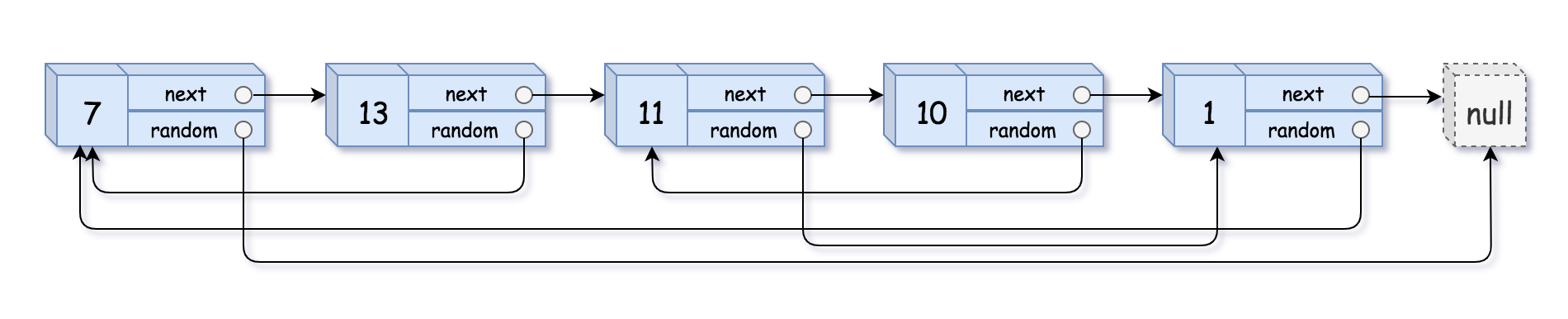
Input: head = [[7,null],[13,0],[11,4],[10,2],[1,0]]
Output: [[7,null],[13,0],[11,4],[10,2],[1,0]]
Example 2:

Input: head = [[1,1],[2,1]]
Output: [[1,1],[2,1]]
Example 3:

Input: head = [[3,null],[3,0],[3,null]]
Output: [[3,null],[3,0],[3,null]]
Constraints:
0 <= n <= 1000-104 <= Node.val <= 104Node.randomisnullor is pointing to some node in the linked list.
Approach Overview
Problem Overview: You are given a linked list where each node has two pointers: next and random. The random pointer can point to any node in the list or null. The task is to create a deep copy of this list so that the new list has entirely new nodes but preserves both pointer relationships.
Approach 1: Using Hash Map (O(n) time, O(n) space)
This method builds the cloned list in two passes using a hash table. First, iterate through the original list and create a copy node for each original node. Store the mapping originalNode → clonedNode in the map. In the second pass, assign next and random pointers by performing constant-time lookups in the map. This works because every original node already has its clone stored in the dictionary.
The key insight is that pointer relationships can be reconstructed by translating original references through the map. If node.random points to some node R, then the cloned node’s random pointer simply becomes map[R]. This approach is straightforward, easy to implement, and commonly used in interviews when clarity matters more than space optimization.
Approach 2: Interleaving Nodes (O(n) time, O(1) space)
This approach avoids extra memory by weaving copied nodes directly into the original linked list. During the first pass, insert each cloned node immediately after its original node. The list transforms from A → B → C into A → A' → B → B' → C → C'.
In the second pass, set the random pointers for cloned nodes. Because each copy sits right after its original, the correct target becomes node.random.next. This allows constant-time pointer assignment without a hash table. Finally, perform a third pass to separate the interleaved list into two independent lists: the original and the deep copy.
The main insight is that adjacency between original and cloned nodes eliminates the need for external mapping. Every reference can be resolved using local pointer relationships created during the interleaving step.
Recommended for interviews: Both solutions run in O(n) time. The hash map approach demonstrates clear reasoning about pointer mapping and is often the easiest way to reach a correct solution quickly. The interleaving technique is the optimal solution because it reduces extra memory to O(1). Interviewers frequently expect candidates to start with the hash map idea and then optimize using pointer manipulation within the linked list.
Complexity Analysis
| Approach | Time | Space | When to Use |
|---|---|---|---|
| Hash Map Mapping | O(n) | O(n) | Best for clarity and quick implementation. Easy to reason about using node-to-node mapping. |
| Interleaving Nodes | O(n) | O(1) | Optimal when minimizing memory usage. Common interview follow-up after the hash map approach. |