Watch 10 video solutions for Convert Sorted List to Binary Search Tree, a medium level problem involving Linked List, Divide and Conquer, Tree. This walkthrough by codestorywithMIK has 18,406 views views. Want to try solving it yourself? Practice on FleetCode or read the detailed text solution.
Given the head of a singly linked list where elements are sorted in ascending order, convert it to a height-balanced binary search tree.
Example 1:
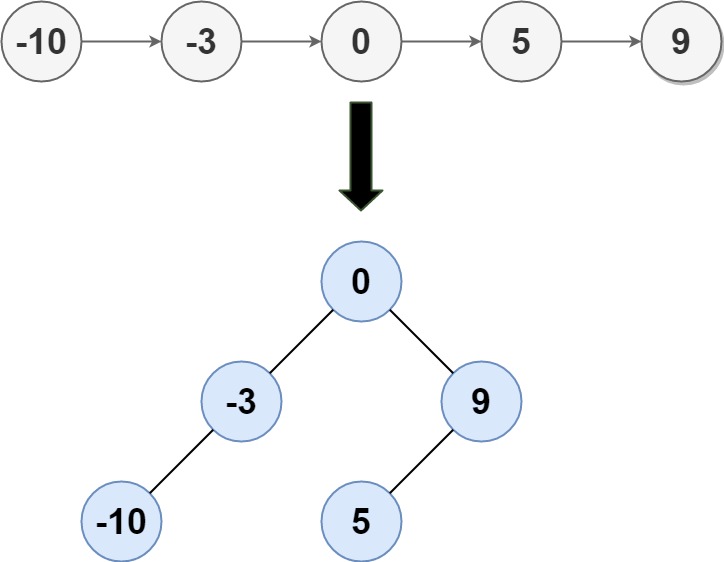
Input: head = [-10,-3,0,5,9]
Output: [0,-3,9,-10,null,5]
Explanation: One possible answer is [0,-3,9,-10,null,5], which represents the shown height balanced BST.
Example 2:
Input: head = []
Output: []
Constraints:
head is in the range [0, 2 * 104].-105 <= Node.val <= 105Problem Overview: You receive the head of a sorted singly linked list and must convert it into a height-balanced binary search tree. The BST property must hold (left < root < right) while keeping the tree balanced so operations remain efficient.
Approach 1: Convert Linked List to Array (O(n) time, O(n) space)
The simplest strategy is to copy the linked list values into an array. Once stored in an array, the problem becomes identical to building a balanced BST from a sorted array. Recursively choose the middle index as the root, build the left subtree from the left half, and the right subtree from the right half. Array indexing gives constant-time access to the middle element, so the recursion runs in O(n) time with O(n) extra space for the array. This approach is easy to reason about and often preferred when clarity matters more than strict memory usage.
Approach 2: Fast and Slow Pointer (O(n log n) time, O(log n) space)
This approach avoids converting the list into an array. Use the classic fast and slow pointer technique to locate the middle node of the linked list, which becomes the root of the BST. Recursively apply the same logic to the left portion of the list (before the middle) and the right portion (after the middle). Finding the middle node takes linear time each recursion level, and the recursion depth is O(log n), producing a total time complexity of O(n log n). Only recursion stack space is used, so extra space is O(log n). This method demonstrates deeper understanding of linked list traversal and divide and conquer.
Recommended for interviews: Interviewers typically expect the fast–slow pointer solution because it shows you understand how to manipulate a linked list without converting it to another structure. Starting with the array approach is still valuable—it proves you recognize the relationship between a sorted sequence and a balanced binary search tree. Then improving it to the in-place divide-and-conquer version demonstrates stronger problem-solving skills.
| Approach | Time | Space | When to Use |
|---|---|---|---|
| Convert Linked List to Array | O(n) | O(n) | When simplicity matters and extra memory is acceptable |
| Fast and Slow Pointer (Divide and Conquer) | O(n log n) | O(log n) | When you want an in-place linked list solution with minimal extra memory |
