
Check If Two Expression Trees are Equivalent - Video Solutions
1612. Check If Two Expression Trees are Equivalent (Leetcode Medium)
Check If Two Expression Trees are Equivalent - Video Solution
Watch 3 video solutions for Check If Two Expression Trees are Equivalent, a medium level problem involving Hash Table, Tree, Depth-First Search. This walkthrough by Programming Live with Larry has 166 views views. Want to try solving it yourself? Practice on FleetCode or read the detailed text solution.
Problem Statement
A binary expression tree is a kind of binary tree used to represent arithmetic expressions. Each node of a binary expression tree has either zero or two children. Leaf nodes (nodes with 0 children) correspond to operands (variables), and internal nodes (nodes with two children) correspond to the operators. In this problem, we only consider the '+' operator (i.e. addition).
You are given the roots of two binary expression trees, root1 and root2. Return true if the two binary expression trees are equivalent. Otherwise, return false.
Two binary expression trees are equivalent if they evaluate to the same value regardless of what the variables are set to.
Example 1:
Input: root1 = [x], root2 = [x]
Output: true
Example 2:
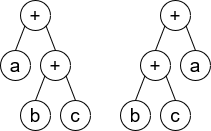
Input: root1 = [+,a,+,null,null,b,c], root2 = [+,+,a,b,c]
Output: true
Explanation: a + (b + c) == (b + c) + a
Example 3:
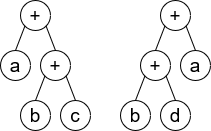
Input: root1 = [+,a,+,null,null,b,c], root2 = [+,+,a,b,d]
Output: false
Explanation: a + (b + c) != (b + d) + a
Constraints:
- The number of nodes in both trees are equal, odd and, in the range
[1, 4999]. Node.valis'+'or a lower-case English letter.- It's guaranteed that the tree given is a valid binary expression tree.
Follow up: What will you change in your solution if the tree also supports the '-' operator (i.e. subtraction)?
Approach Overview
Problem Overview: You receive two binary expression trees. Leaf nodes contain variables (like a, b, c) and internal nodes contain the '+' operator. Because addition is commutative, the structure of the tree may differ while still representing the same expression. The task is to check whether both trees evaluate to the same expression.
Approach 1: Canonical Serialization of Expression Trees (O(n log n) time, O(n) space)
One way to compare expressions is to convert each tree into a canonical form. Traverse the tree using Depth-First Search and serialize each subtree into a string. For operator nodes, recursively serialize left and right children, then sort the two results before concatenation because a + b equals b + a. This normalization ensures equivalent expressions produce identical serialized strings. Finally, compare the two strings. Sorting child expressions introduces extra overhead, giving roughly O(n log n) time in the worst case and O(n) space for recursion and serialization.
Approach 2: Variable Frequency Counting with DFS (O(n) time, O(k) space)
The key observation: since the only operator is '+', the final expression is simply the sum of all variables in the tree. The tree structure does not matter. Traverse each tree using DFS and count how many times each variable appears. Use a hash table to maintain frequencies. For the first tree, increment counts for each variable. For the second tree, decrement counts. If both trees represent the same expression, all counts end at zero.
This approach works because addition is associative and commutative, meaning order and grouping do not affect the result. The traversal touches each node exactly once, giving O(n) time. Space complexity is O(k), where k is the number of unique variables. Implementation is straightforward using recursion over the binary tree.
Recommended for interviews: The DFS frequency counting approach. It demonstrates the key insight that tree structure is irrelevant when the operator is commutative. Interviewers expect candidates to recognize this simplification and reduce the problem to counting variables with a hash map. Mentioning the serialization approach first shows you considered structural comparison, but identifying the O(n) counting solution demonstrates stronger problem-solving skills.
Complexity Analysis
| Approach | Time | Space | When to Use |
|---|---|---|---|
| Canonical Serialization with Sorted Subtrees | O(n log n) | O(n) | Useful when comparing full expression structure or when multiple operators exist |
| DFS Variable Frequency Counting (Hash Map) | O(n) | O(k) | Best approach when operator is '+' and order does not matter |