
Check If It Is a Straight Line - Video Solutions
Check If It Is a Straight Line | Leetcode #1232 | Find if all coordinate points form a straight line
Check If It Is a Straight Line - Video Solution
Watch 10 video solutions for Check If It Is a Straight Line, a easy level problem involving Array, Math, Geometry. This walkthrough by Techdose has 21,067 views views. Want to try solving it yourself? Practice on FleetCode or read the detailed text solution.
Problem Statement
You are given an array coordinates, coordinates[i] = [x, y], where [x, y] represents the coordinate of a point. Check if these points make a straight line in the XY plane.
Example 1:
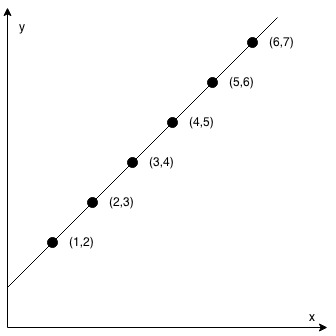
Input: coordinates = [[1,2],[2,3],[3,4],[4,5],[5,6],[6,7]]
Output: true
Example 2:
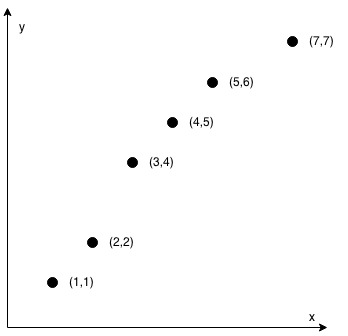
Input: coordinates = [[1,1],[2,2],[3,4],[4,5],[5,6],[7,7]]
Output: false
Constraints:
2 <= coordinates.length <= 1000coordinates[i].length == 2-10^4 <= coordinates[i][0], coordinates[i][1] <= 10^4coordinatescontains no duplicate point.
Approach Overview
Problem Overview: You receive a list of 2D coordinates. The task is to determine whether every point lies on the same straight line. If the slope between every pair of consecutive points is identical, the points form a single line.
Approach 1: Using Slope Comparison (Time: O(n), Space: O(1))
This approach compares slopes between the first two points and every other pair of points. Compute the slope using (y2 - y1) / (x2 - x1). Instead of division, compare cross-multiplied values (y2 - y1) * (x - x1) and (y - y1) * (x2 - x1) to avoid floating point precision errors and division by zero. Iterate through the remaining coordinates and verify the slope consistency with the first segment. If any slope differs, the points do not form a straight line.
This method works well for problems involving coordinate relationships in geometry. It performs a single pass through the coordinates, so runtime is linear. Space remains constant since only a few variables store slope components.
Approach 2: Vector Cross Product (Time: O(n), Space: O(1))
A more geometric solution uses vector cross products. Form a base vector from the first two points: v = (x2 - x1, y2 - y1). For every other point, construct another vector from the first point: w = (xi - x1, yi - y1). If the cross product v.x * w.y - v.y * w.x equals zero, the vectors are collinear. Non-zero means the point deviates from the line.
This technique directly checks collinearity and avoids slope calculations entirely. It is common in computational geometry and works reliably even for vertical lines. Implementation requires only arithmetic operations while iterating once through the coordinate array. Time complexity remains O(n) with constant memory.
Recommended for interviews: Both solutions run in O(n) time and O(1) space, which is optimal because you must inspect every point. The vector cross product approach is often preferred in interviews since it avoids division and handles vertical lines naturally. Implementing slope comparison still demonstrates a strong understanding of coordinate geometry, while the cross product version signals deeper familiarity with geometric vector operations.
Complexity Analysis
| Approach | Time | Space | When to Use |
|---|---|---|---|
| Slope Comparison | O(n) | O(1) | Simple implementation when checking slope equality across coordinates |
| Vector Cross Product | O(n) | O(1) | Preferred geometric method that avoids division and handles vertical lines safely |