
All Possible Full Binary Trees - Video Solutions
All Possible Full Binary Trees - Memoization - Leetcode 894 - Python
All Possible Full Binary Trees - Video Solution
Watch 10 video solutions for All Possible Full Binary Trees, a medium level problem involving Dynamic Programming, Tree, Recursion. This walkthrough by NeetCode has 41,351 views views. Want to try solving it yourself? Practice on FleetCode or read the detailed text solution.
Problem Statement
Given an integer n, return a list of all possible full binary trees with n nodes. Each node of each tree in the answer must have Node.val == 0.
Each element of the answer is the root node of one possible tree. You may return the final list of trees in any order.
A full binary tree is a binary tree where each node has exactly 0 or 2 children.
Example 1:
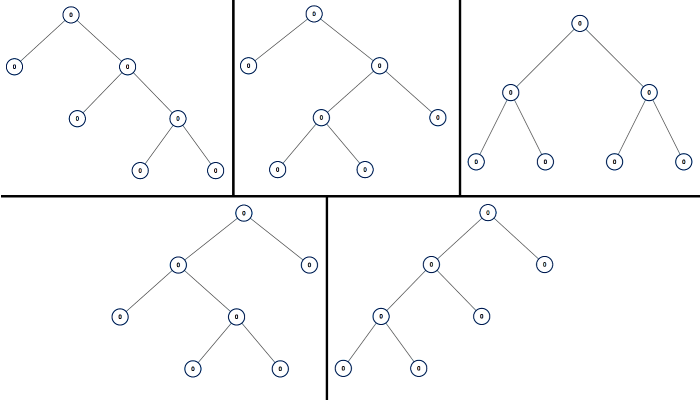
Input: n = 7
Output: [[0,0,0,null,null,0,0,null,null,0,0],[0,0,0,null,null,0,0,0,0],[0,0,0,0,0,0,0],[0,0,0,0,0,null,null,null,null,0,0],[0,0,0,0,0,null,null,0,0]]
Example 2:
Input: n = 3
Output: [[0,0,0]]
Constraints:
1 <= n <= 20
Approach Overview
Problem Overview: You are given an odd integer n. Build and return every possible full binary tree with exactly n nodes. A full binary tree means every node has either 0 or 2 children. The result is a list of root nodes representing all valid structures.
Approach 1: Recursive Construction with Memoization (Time: ~O(n * F(n)), Space: ~O(n * F(n)))
The key observation: a full binary tree always contains an odd number of nodes. If the root uses one node, the remaining n-1 nodes must be split between the left and right subtrees, and both subtree sizes must also be odd. Recursively generate all left subtrees of size i and all right subtrees of size n-1-i, then attach each combination to a new root. This naturally forms a Cartesian product of left and right subtree possibilities.
Naive recursion recomputes the same subtree sizes many times. Add caching (memoization) keyed by n. When the function needs trees with k nodes, it first checks the cache and reuses previously generated lists. This drastically reduces recomputation and is the most common interview solution using recursion with memoization.
Approach 2: Dynamic Programming (Iterative Build) (Time: ~O(n * F(n)), Space: ~O(n * F(n)))
The recursive idea can be converted into bottom‑up dynamic programming. Maintain a DP array where dp[i] stores all full binary trees with i nodes. Start with the base case dp[1] containing a single node tree. Then iterate through odd sizes from 3 to n.
For each size i, try every odd split left and right = i - 1 - left. Combine each tree from dp[left] with each tree from dp[right] under a new root node. Append the constructed trees into dp[i]. This approach avoids recursion and makes the dependency structure explicit while still generating every valid binary tree configuration.
Recommended for interviews: Recursive generation with memoization is the expected approach. It directly models the recursive structure of full binary trees and demonstrates understanding of subtree decomposition and caching. Mention the odd-node constraint first, then describe splitting n-1 nodes across left and right subtrees. The iterative DP version shows deeper understanding but usually comes after explaining the recursive insight.
Complexity Analysis
| Approach | Time | Space | When to Use |
|---|---|---|---|
| Recursive with Memoization | ~O(n * F(n)) | ~O(n * F(n)) | Most intuitive solution. Preferred in interviews when explaining recursive tree construction. |
| Dynamic Programming (Iterative) | ~O(n * F(n)) | ~O(n * F(n)) | When avoiding recursion or demonstrating bottom-up DP construction of tree structures. |