
Smallest Rectangle Enclosing Black Pixels - Solution & Explanation
Problem Statement
You are given an m x n binary matrix image where 0 represents a white pixel and 1 represents a black pixel.
The black pixels are connected (i.e., there is only one black region). Pixels are connected horizontally and vertically.
Given two integers x and y that represents the location of one of the black pixels, return the area of the smallest (axis-aligned) rectangle that encloses all black pixels.
You must write an algorithm with less than O(mn) runtime complexity
Example 1:
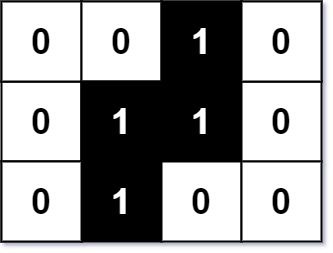
Input: image = [["0","0","1","0"],["0","1","1","0"],["0","1","0","0"]], x = 0, y = 2
Output: 6
Example 2:
Input: image = [["1"]], x = 0, y = 0
Output: 1
Constraints:
m == image.lengthn == image[i].length1 <= m, n <= 100image[i][j]is either'0'or'1'.0 <= x < m0 <= y < nimage[x][y] == '1'.- The black pixels in the
imageonly form one component.
Approach Overview
Problem Overview: You get a binary matrix where '1' represents a black pixel and '0' represents white. One black pixel location (x, y) is given. The task is to compute the area of the smallest axis-aligned rectangle that contains every black pixel in the image.
Approach 1: Full Grid Scan (Brute Force) (Time: O(m*n), Space: O(1))
The simplest strategy is scanning the entire grid. Track four boundaries while iterating: minRow, maxRow, minCol, and maxCol. Every time you encounter a '1', update these limits. After the scan, compute the rectangle area using (maxRow - minRow + 1) * (maxCol - minCol + 1). This approach uses only constant space and works for any matrix, but it ignores the fact that one black pixel location is already known, so it wastes time checking every cell.
Approach 2: BFS/DFS Expansion (Time: O(m*n), Space: O(m*n))
Start traversal from the known black pixel and explore all connected black pixels using breadth-first search or depth-first search. Maintain the same boundary variables while visiting each pixel. Each step checks four directions and continues only if the neighbor is also black and not yet visited. Because every black pixel is visited once, the algorithm runs in O(m*n) in the worst case. This approach leverages connectivity and avoids scanning unrelated white areas, but still degrades to full-grid exploration if most cells are black.
Approach 3: Binary Search on Boundaries (Optimal) (Time: O(m log n + n log m), Space: O(1))
The key observation: all black pixels form a connected region, so the rows and columns containing black pixels are contiguous. Instead of exploring every cell, perform binary search to locate each boundary. Search the top boundary between rows 0 and x, the bottom between x and m-1, the left between 0 and y, and the right between y and n-1. For each midpoint row or column, scan across it to check if at least one black pixel exists. Binary search narrows the first and last rows/columns containing '1'. Once boundaries are found, compute the rectangle area. This approach dramatically reduces search space compared with full traversal.
Recommended for interviews: The binary search boundary approach is usually what interviewers expect. It shows you recognized the monotonic property of rows and columns containing black pixels. Mentioning the brute force or BFS/DFS first demonstrates understanding of the grid traversal baseline, but implementing the binary search version proves stronger algorithmic insight with better asymptotic performance.
Solution
Try this approach in the editor →Detailed Complexity Analysis
| Approach | Time | Space | When to Use |
|---|---|---|---|
| Full Grid Scan | O(m*n) | O(1) | Simple baseline when matrix size is small or when no starting pixel is provided |
| BFS/DFS Traversal | O(m*n) | O(m*n) | When exploring connected components or when you want to visit only reachable black pixels |
| Binary Search Boundaries | O(m log n + n log m) | O(1) | Optimal choice when a starting black pixel is known and rows/columns of black pixels are contiguous |
Video Solution
LeetCode 302 | Smallest Rectangle Enclosing Black Pixels | BFS | Functional Programming | Java • Sleepy Cracker • 562 views views
Watch 4 more video solutions →Frequently Asked Questions
Is Smallest Rectangle Enclosing Black Pixels easy or hard?
Smallest Rectangle Enclosing Black Pixels Python/Java solution
What is the best approach for Smallest Rectangle Enclosing Black Pixels?
Is Smallest Rectangle Enclosing Black Pixels asked at Google/Amazon/Meta?
What data structure is used in Smallest Rectangle Enclosing Black Pixels?
What is the time complexity of Smallest Rectangle Enclosing Black Pixels?
How to solve Smallest Rectangle Enclosing Black Pixels in O(m log n + n log m)?
Ready to solve this problem?
Practice Smallest Rectangle Enclosing Black Pixels with our built-in code editor and test cases.
Practice on FleetCode