
Pascal's Triangle - Solution & Explanation
Problem Statement
Given an integer numRows, return the first numRows of Pascal's triangle.
In Pascal's triangle, each number is the sum of the two numbers directly above it as shown:
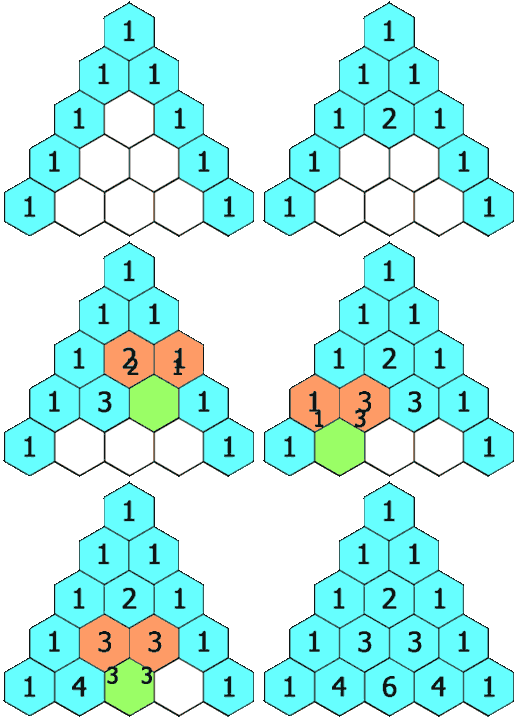
Example 1:
Input: numRows = 5
Output: [[1],[1,1],[1,2,1],[1,3,3,1],[1,4,6,4,1]]
Example 2:
Input: numRows = 1
Output: [[1]]
Constraints:
1 <= numRows <= 30
Approach Overview
Problem Overview: Generate the first numRows of Pascal's Triangle. Each number in the triangle equals the sum of the two numbers directly above it. The first and last value of every row is always 1. The output is a 2D array where each inner array represents a row.
Approach 1: Iterative Construction (O(n²) time, O(n²) space)
This method builds the triangle row by row using a dynamic programming idea. Start with the first row [1]. For every new row i, create an array of size i + 1. Set the first and last elements to 1. For the inner elements, compute values using the previous row: row[j] = prevRow[j-1] + prevRow[j]. Continue this process until numRows rows are generated. The algorithm touches each element once, so the total time complexity is O(n²). The triangle itself stores n(n+1)/2 numbers, giving O(n²) space complexity. This approach is straightforward, avoids recursion overhead, and is the most common solution used in production code. It relies heavily on array indexing and sequential iteration, making it a good example of problems involving the Array pattern combined with simple Dynamic Programming.
Approach 2: Recursive Pascal's Triangle Construction (O(n²) time, O(n²) space)
The recursive strategy mirrors the mathematical definition of Pascal's Triangle. Define a function that generates the triangle up to row n. The base case returns [[1]]. For each recursive call, first compute the triangle up to n-1, then construct the new row using the last row of the previously generated triangle. The first and last elements remain 1, while middle elements are computed using adjacent pairs from the previous row. Although recursion makes the logic elegant, the triangle still requires visiting every element, resulting in O(n²) time complexity. The space complexity is also O(n²) for storing the triangle, plus O(n) recursion stack depth. Recursive implementations are useful when practicing recursion patterns or understanding the mathematical structure of Pascal's Triangle, but iterative construction is usually preferred in interviews.
Recommended for interviews: Interviewers typically expect the iterative construction approach. It demonstrates that you understand the relationship between rows and can translate that rule into array operations. Writing the brute recursive version shows conceptual understanding of the triangle's definition, but the iterative Dynamic Programming build is cleaner, avoids stack overhead, and is the solution most candidates present during coding interviews.
Approach 1: Iterative Construction Approach
This approach involves generating Pascal's Triangle row by row using an iterative method. The first row is initialized with [1], and for each subsequent row, the first and last element are always 1. The intermediate elements are calculated as sums of appropriate elements from the previous row.
In this C implementation, we allocate a 2D array to hold the triangle's content. We initialize the first and last entries of each row to 1. For each intermediate row entry, we compute its value as the sum of the two appropriate values from the preceding row, incrementally building each row from top to bottom.
Complexity
Time Complexity: O(numRows^2) due to the nested loop structure.
Space Complexity: O(numRows^2) as we store all elements of the triangle.
Approach 2: Recursive Pascal's Triangle Construction
This approach constructs Pascal's Triangle using recursion by calculating each value based on the combination formula. The values on the edges are always 1, and other values are calculated as combinatorial numbers derived recursively.
In this C recursive implementation, Pascal's Triangle values are computed using the combination formula. Recursive calls determine each value's placement using typical combinatorial calculations, recursively reducing the problem until base conditions are met.
Complexity
Time Complexity: O(numRows^3) due to recursive calls, not optimal.
Space Complexity: O(numRows^2) for storing the triangle.
Approach 3: Simulation
We first create an answer array f, then set the first row of f to [1]. Next, starting from the second row, the first and last elements of each row are 1, and for other elements f[i][j] = f[i - 1][j - 1] + f[i - 1][j].
The time complexity is O(n^2), where n is the given number of rows. Ignoring the space consumption of the answer, the space complexity is O(1).
Code
Python
Java
C++
Go
TypeScript
Rust
JavaScript
C#
Complexity Comparison
| Approach | Complexity |
|---|---|
| Iterative Construction Approach | Time Complexity: O(numRows^2) due to the nested loop structure. |
| Recursive Pascal's Triangle Construction | Time Complexity: O(numRows^3) due to recursive calls, not optimal. |
| Simulation | — |
Detailed Complexity Analysis
| Approach | Time | Space | When to Use |
|---|---|---|---|
| Iterative Construction (Dynamic Programming) | O(n²) | O(n²) | Best general solution. Simple loops, no recursion overhead, commonly expected in interviews. |
| Recursive Pascal Construction | O(n²) | O(n²) + O(n) stack | Useful for understanding the mathematical recurrence or practicing recursion patterns. |
Video Solution
LeetCode Pascal's Triangle Solution Explained - Java • Nick White • 165,185 views views
Watch 9 more video solutions →Frequently Asked Questions
Is Pascal's Triangle easy or hard?
How to solve Pascal's Triangle in O(n)?
What is the best approach for Pascal's Triangle?
What data structure is used in Pascal's Triangle?
What is the time complexity of Pascal's Triangle?
Pascal's Triangle Python or Java solution approach?
Is Pascal's Triangle asked at Google, Amazon, or Meta interviews?
Ready to solve this problem?
Practice Pascal's Triangle with our built-in code editor and test cases.
Practice on FleetCodeProblem Info
Table of Contents
Practice this problem
Open in Editor