
Number of Distinct Islands - Solution & Explanation
Problem Statement
You are given an m x n binary matrix grid. An island is a group of 1's (representing land) connected 4-directionally (horizontal or vertical.) You may assume all four edges of the grid are surrounded by water.
An island is considered to be the same as another if and only if one island can be translated (and not rotated or reflected) to equal the other.
Return the number of distinct islands.
Example 1:
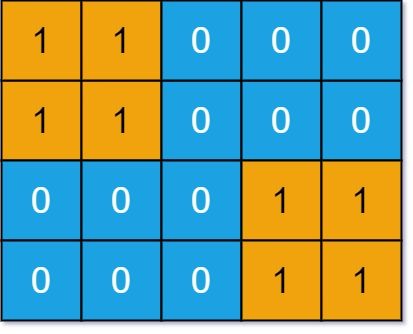
Input: grid = [[1,1,0,0,0],[1,1,0,0,0],[0,0,0,1,1],[0,0,0,1,1]]
Output: 1
Example 2:
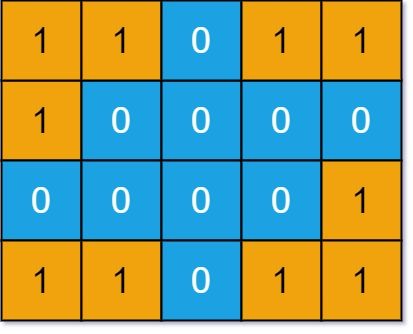
Input: grid = [[1,1,0,1,1],[1,0,0,0,0],[0,0,0,0,1],[1,1,0,1,1]]
Output: 3
Constraints:
m == grid.lengthn == grid[i].length1 <= m, n <= 50grid[i][j]is either0or1.
Approach Overview
Problem Overview: You receive a binary grid where 1 represents land and 0 represents water. Islands are groups of horizontally or vertically connected land cells. The task is to count how many distinct shapes of islands exist in the grid. Two islands are considered the same if their shapes match after translation (shifting position), regardless of where they appear in the grid.
Approach 1: Brute Force Shape Comparison (O((m*n)^2) time, O(m*n) space)
Traverse the grid and collect all cells belonging to each island using a traversal such as Depth-First Search or Breadth-First Search. Store the absolute coordinates of each island's cells. After discovering every island, compare each island's coordinate set against all previously found islands to determine if the shape matches after translation. Normalizing coordinates requires shifting them relative to a base cell before comparison. This works but becomes expensive because every new island may need comparison with many existing shapes.
Approach 2: Relative Coordinate Hashing (O(m*n) time, O(m*n) space)
Instead of storing absolute positions, record each island's cells relative to the first discovered land cell of that island. During a DFS traversal, compute offsets like (row - baseRow, col - baseCol). This converts every island into a normalized shape representation independent of location. Store the sequence of relative coordinates in a set using a Hash Table. If another island produces the same normalized coordinate list, it represents the same shape and will not increase the count. Each cell is visited once, so the traversal runs in linear time.
Approach 3: DFS Path Signature Encoding (O(m*n) time, O(m*n) space)
Another common technique records the traversal path itself. While performing DFS, append characters representing movement directions (for example U, D, L, R) and a marker when backtracking. The resulting traversal string uniquely describes the island's structure. Two islands with identical shapes generate the same traversal signature. Store these signatures in a hash set to count distinct patterns. This avoids storing full coordinate lists and works well with recursive DFS.
Recommended for interviews: DFS with relative coordinate hashing or path signature encoding. Both achieve O(m*n) time by visiting each cell once and storing normalized island shapes in a set. Interviewers expect you to recognize that island position is irrelevant and that the shape must be normalized before hashing. Starting with a brute-force comparison shows understanding, but moving to a hashing-based solution demonstrates strong problem-solving and familiarity with graph traversal.
Solution
Code
Python
Java
C++
Go
TypeScript
Detailed Complexity Analysis
| Approach | Time | Space | When to Use |
|---|---|---|---|
| Brute Force Shape Comparison | O((m*n)^2) | O(m*n) | Conceptual baseline when learning island problems or validating shape normalization logic |
| Relative Coordinate Hashing (DFS/BFS) | O(m*n) | O(m*n) | General optimal solution; simple to implement and easy to reason about in interviews |
| DFS Path Signature Encoding | O(m*n) | O(m*n) | Useful when you prefer storing traversal strings instead of coordinate sets |
Video Solution
Amazon Coding Interview Question - Number of Distinct Islands • AlgosWithMichael • 31,850 views views
Watch 9 more video solutions →Frequently Asked Questions
Is Number of Distinct Islands easy or hard?
Number of Distinct Islands Python/Java solution
How to solve Number of Distinct Islands in O(n)?
What is the best approach for Number of Distinct Islands?
Is Number of Distinct Islands asked at Google/Amazon/Meta?
What data structure is used in Number of Distinct Islands?
What is the time complexity of Number of Distinct Islands?
Ready to solve this problem?
Practice Number of Distinct Islands with our built-in code editor and test cases.
Practice on FleetCodeProblem Info
Table of Contents
Practice this problem
Open in Editor