
Node With Highest Edge Score - Solution & Explanation
Problem Statement
You are given a directed graph with n nodes labeled from 0 to n - 1, where each node has exactly one outgoing edge.
The graph is represented by a given 0-indexed integer array edges of length n, where edges[i] indicates that there is a directed edge from node i to node edges[i].
The edge score of a node i is defined as the sum of the labels of all the nodes that have an edge pointing to i.
Return the node with the highest edge score. If multiple nodes have the same edge score, return the node with the smallest index.
Example 1:
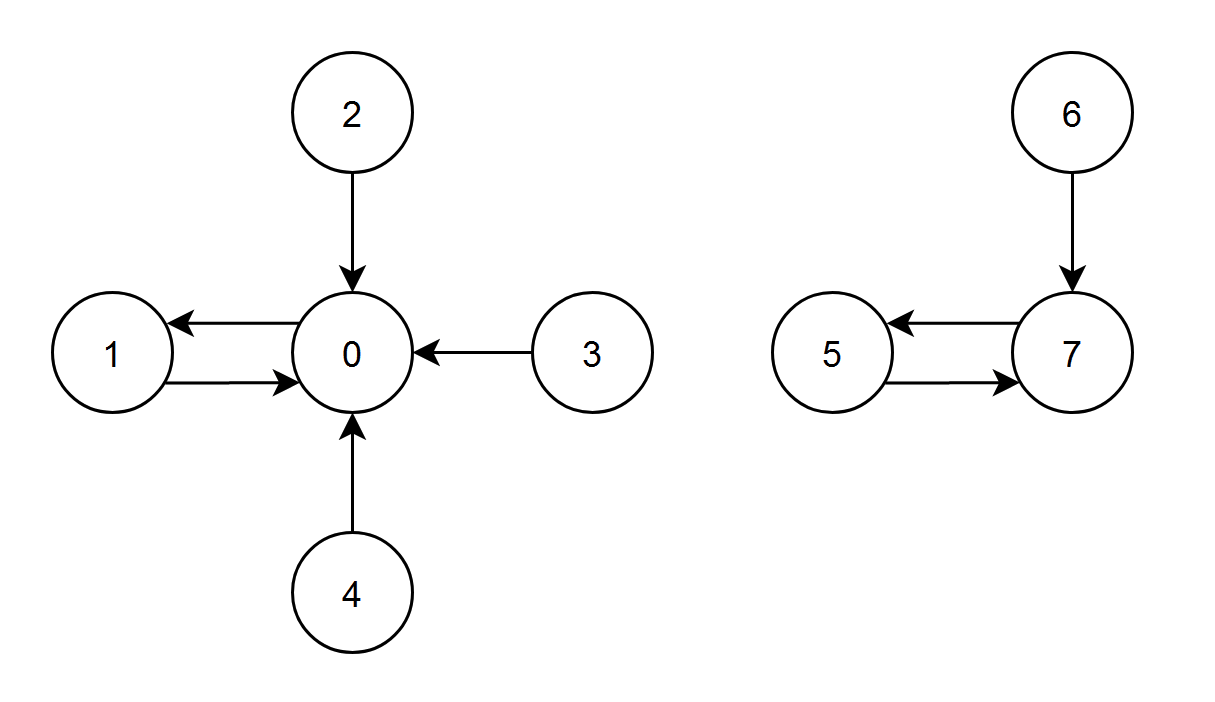
Input: edges = [1,0,0,0,0,7,7,5]
Output: 7
Explanation:
- The nodes 1, 2, 3 and 4 have an edge pointing to node 0. The edge score of node 0 is 1 + 2 + 3 + 4 = 10.
- The node 0 has an edge pointing to node 1. The edge score of node 1 is 0.
- The node 7 has an edge pointing to node 5. The edge score of node 5 is 7.
- The nodes 5 and 6 have an edge pointing to node 7. The edge score of node 7 is 5 + 6 = 11.
Node 7 has the highest edge score so return 7.
Example 2:
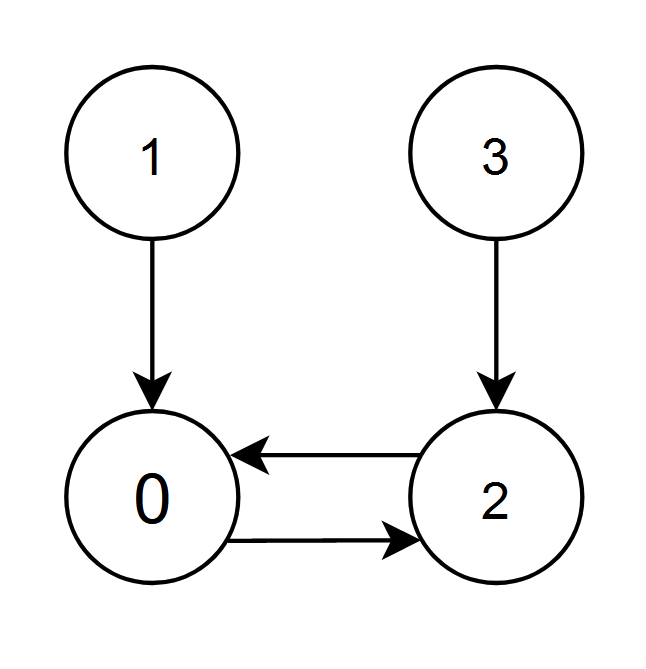
Input: edges = [2,0,0,2]
Output: 0
Explanation:
- The nodes 1 and 2 have an edge pointing to node 0. The edge score of node 0 is 1 + 2 = 3.
- The nodes 0 and 3 have an edge pointing to node 2. The edge score of node 2 is 0 + 3 = 3.
Nodes 0 and 2 both have an edge score of 3. Since node 0 has a smaller index, we return 0.
Constraints:
n == edges.length2 <= n <= 1050 <= edges[i] < nedges[i] != i
Approach Overview
Problem Overview: You are given an array edges where index i has a directed edge to edges[i]. The edge score of a node is the sum of indices of nodes pointing to it. Your task is to compute the score for every node and return the node with the highest score (smallest index if there is a tie).
Approach 1: Brute Force Score Calculation (O(n²) time, O(1) space)
The straightforward idea is to compute the score of each node by scanning the entire edges array and summing all indices i where edges[i] == node. This means for every node j, you iterate through all n elements to check incoming edges. While the implementation is simple and uses constant extra space, it performs redundant scans and becomes inefficient for large inputs. This approach mainly helps you reason about how scores are defined before optimizing the solution.
Approach 2: Using an Array to Keep Score (O(n) time, O(n) space)
A more efficient approach accumulates scores in a dedicated array. Create a score array of size n, initialized to zero. Iterate once through the edges array. For each index i, add i to score[edges[i]]. This directly builds the total edge score for every node in a single pass. After filling the score array, scan it once more to find the node with the maximum score, resolving ties by selecting the smallest index. This method runs in linear time and works well because node IDs are already within the range [0, n-1]. Conceptually, the structure behaves like an adjacency accumulation in a graph.
Approach 3: Using a Hash Map for Flexibility (O(n) time, O(n) space)
If node identifiers were sparse or outside a predictable range, a hash map would be more flexible than a fixed array. Iterate through edges and update a map where the key is the destination node and the value stores the running score. Each iteration performs a constant-time hash lookup and addition. After building the map, iterate through the keys to determine the node with the maximum score. This approach uses the same accumulation idea as the array method but relies on a hash table for dynamic storage. It’s slightly heavier in memory and constant factors but easier to adapt when node IDs are not bounded.
Recommended for interviews: The array accumulation approach is the expected solution. It demonstrates that you recognize the fixed node range and can compute scores in one linear pass. Mentioning the brute force method first shows understanding of the scoring definition, while transitioning to the O(n) array solution shows optimization skills. The hash map version is useful to discuss when the problem generalizes beyond a fixed-size node set.
Approach 1: Using an array to keep score
This approach involves creating an array to store the scores of each node. We iterate through the given edges, and for each edge from node i to edges[i], we add i to the score of edges[i]. After populating the scores, we find the node with the highest score. In case of tie, we choose the smallest index.
This C solution initializes a score array of a sufficiently large size to accommodate all possible nodes. When iterating over the given edges array, we increment the score for the destination node by its source node index. Finally, we find the node with the highest score while handling ties by choosing the smallest index.
Complexity
Time complexity: O(n), where n is the number of nodes.
Space complexity: O(n), for storing the scores.
Approach 2: Using a hash map for flexibility
This approach uses a hash map (or dictionary) to keep track of the scores of nodes. We traverse the edges and for each connection from node i to node edges[i], we update the score for edges[i] by adding i. After computing the scores for all nodes, we find the node with the highest score. If multiple nodes have the same score, choose the node with the smallest index.
This Python solution leverages a defaultdict for storing scores. As we iterate, the score of the destination node is increased by the source node index. After iterating through all nodes, we determine the node with the highest score, with ties resolved by index order.
Code
Python
JavaScript
Java
Complexity
Time complexity: O(n), where n is the number of nodes.
Space complexity: O(n), due to storing scores in the dictionary.
Approach 3: Single Traversal
We define an array cnt of length n, where cnt[i] represents the edge score of node i. Initially, all elements are 0. We also define an answer variable ans, initially set to 0.
Next, we traverse the array edges. For each node i and its outgoing edge node j, we update cnt[j] to cnt[j] + i. If cnt[ans] < cnt[j] or cnt[ans] = cnt[j] and j < ans, we update ans to j.
Finally, return ans.
The time complexity is O(n), and the space complexity is O(n). Here, n is the length of the array edges.
Complexity Comparison
| Approach | Complexity |
|---|---|
| Using an array to keep score | Time complexity: O(n), where n is the number of nodes. |
| Using a hash map for flexibility | Time complexity: O(n), where n is the number of nodes. |
| Single Traversal | — |
Detailed Complexity Analysis
| Approach | Time | Space | When to Use |
|---|---|---|---|
| Brute Force Score Calculation | O(n²) | O(1) | Useful for understanding the definition of edge score or when constraints are extremely small |
| Array Score Accumulation | O(n) | O(n) | Best choice when node IDs are within 0..n-1 and you want the fastest solution |
| Hash Map Accumulation | O(n) | O(n) | Preferred when node identifiers are sparse or not limited to a fixed range |
Video Solution
Leetcode 2374 Node With Highest Edge Score | Graph Basics | Coding Decoded SDE Sheet • Coding Decoded • 847 views views
Watch 9 more video solutions →Frequently Asked Questions
Is Node With Highest Edge Score easy or hard?
Node With Highest Edge Score Python/Java solution
How to solve Node With Highest Edge Score in O(n)?
What is the best approach for Node With Highest Edge Score?
Is Node With Highest Edge Score asked at Google/Amazon/Meta?
What data structure is used in Node With Highest Edge Score?
What is the time complexity of Node With Highest Edge Score?
Ready to solve this problem?
Practice Node With Highest Edge Score with our built-in code editor and test cases.
Practice on FleetCode