
Network Recovery Pathways - Solution & Explanation
Problem Statement
You are given a directed acyclic graph of n nodes numbered from 0 to n − 1. This is represented by a 2D array edges of length m, where edges[i] = [ui, vi, costi] indicates a one‑way communication from node ui to node vi with a recovery cost of costi.
Some nodes may be offline. You are given a boolean array online where online[i] = true means node i is online. Nodes 0 and n − 1 are always online.
A path from 0 to n − 1 is valid if:
- All intermediate nodes on the path are online.
- The total recovery cost of all edges on the path does not exceed
k.
For each valid path, define its score as the minimum edge‑cost along that path.
Return the maximum path score (i.e., the largest minimum-edge cost) among all valid paths. If no valid path exists, return -1.
Example 1:
Input: edges = [[0,1,5],[1,3,10],[0,2,3],[2,3,4]], online = [true,true,true,true], k = 10
Output: 3
Explanation:
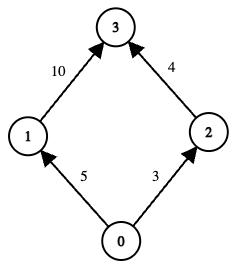
-
The graph has two possible routes from node 0 to node 3:
-
Path
0 → 1 → 3-
Total cost =
5 + 10 = 15, which exceeds k (15 > 10), so this path is invalid.
-
-
Path
0 → 2 → 3-
Total cost =
3 + 4 = 7 <= k, so this path is valid. -
The minimum edge‐cost along this path is
min(3, 4) = 3.
-
-
-
There are no other valid paths. Hence, the maximum among all valid path‐scores is 3.
Example 2:
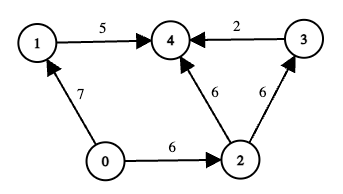
Input: edges = [[0,1,7],[1,4,5],[0,2,6],[2,3,6],[3,4,2],[2,4,6]], online = [true,true,true,false,true], k = 12
Output: 6
Explanation:
-
Node 3 is offline, so any path passing through 3 is invalid.
-
Consider the remaining routes from 0 to 4:
-
Path
0 → 1 → 4-
Total cost =
7 + 5 = 12 <= k, so this path is valid. -
The minimum edge‐cost along this path is
min(7, 5) = 5.
-
-
Path
0 → 2 → 3 → 4-
Node 3 is offline, so this path is invalid regardless of cost.
-
-
Path
0 → 2 → 4-
Total cost =
6 + 6 = 12 <= k, so this path is valid. -
The minimum edge‐cost along this path is
min(6, 6) = 6.
-
-
-
Among the two valid paths, their scores are 5 and 6. Therefore, the answer is 6.
Constraints:
n == online.length2 <= n <= 5 * 1040 <= m == edges.length <=min(105, n * (n - 1) / 2)edges[i] = [ui, vi, costi]0 <= ui, vi < nui != vi0 <= costi <= 1090 <= k <= 5 * 1013online[i]is eithertrueorfalse, and bothonline[0]andonline[n − 1]aretrue.- The given graph is a directed acyclic graph.
Approach Overview
Problem Overview: You are given a network of nodes and connections representing recovery routes after failures. The task is to determine valid recovery pathways that satisfy shortest-path constraints while respecting dependency order between nodes.
Approach 1: Brute Force Graph Traversal (Exponential time, O(V) space)
The most direct idea is to enumerate every possible path from the source to the destination using DFS. For each path, compute the total cost and verify whether it satisfies the recovery constraints. This approach repeatedly explores the same subpaths and becomes infeasible once the graph grows beyond small sizes. Time complexity grows exponentially with the number of nodes because the algorithm explores all combinations of routes, while recursion depth requires O(V) stack space.
Approach 2: Dijkstra + Shortest Path DAG + Dynamic Programming (O(E log V) time, O(V + E) space)
The optimal strategy first computes the shortest distance from the source to every node using Dijkstra's algorithm with a min heap. After distances are known, keep only edges that maintain the shortest path condition dist[u] + w = dist[v]. These edges form a Directed Acyclic Graph (shortest-path DAG). Once this DAG is built, process nodes in topological order and use dynamic programming to count or evaluate valid recovery pathways. Each node aggregates results from its predecessors, avoiding recomputation. This approach leverages shortest path algorithms and efficient heap operations, giving O(E log V) time and linear graph storage.
Approach 3: Binary Search on Constraint + Shortest Path Check (O(log C * (E log V)) time)
If the problem introduces a constraint such as maximum delay or recovery threshold, you can binary search on the allowed value. For each candidate threshold, run a constrained shortest-path or feasibility check that ignores edges violating the constraint. This pattern combines binary search with graph traversal. It works well when the answer lies within a numeric range and feasibility is monotonic.
Recommended for interviews: Interviewers expect the Dijkstra + shortest-path DAG + DP approach. Brute force shows understanding of graph traversal, but the optimal solution demonstrates control over priority queues, shortest path properties, and DP on DAGs using topological ordering.
Solution
The path score is defined as the minimum edge cost along the path. We seek the maximum score among all valid paths.
For a candidate minimum edge weight mid, we only keep edges with cost at least mid, then check whether there exists a path from node 0 to node n - 1 with total cost at most k. This reduces to running heap-optimized Dijkstra on the filtered graph.
As mid increases, fewer edges remain and feasibility becomes harder to satisfy, so we can binary search on mid. We preprocess by removing edges incident to offline nodes, and set l and r to the minimum and maximum edge costs. If check(l) is true, return l; otherwise return -1.
The time complexity is O((n + m) log n log W), and the space complexity is O(n + m), where n and m are the numbers of nodes and edges, and W is the maximum edge cost.
Code
Python
Java
C++
Go
TypeScript
Detailed Complexity Analysis
| Approach | Time | Space | When to Use |
|---|---|---|---|
| Brute Force DFS Path Enumeration | O(2^V) | O(V) | Useful only for very small graphs or understanding the search space |
| Dijkstra + Shortest Path DAG + DP | O(E log V) | O(V + E) | General case; optimal solution for large graphs with weighted edges |
| Binary Search + Shortest Path Feasibility | O(log C * (E log V)) | O(V + E) | When the answer depends on a monotonic threshold such as time, delay, or capacity |
Video Solution
Network Recovery Pathways | Detailed Explanation | Simplified | Leetcode 3620 | codestorywithMIK • codestorywithMIK • 8,717 views views
Watch 9 more video solutions →Frequently Asked Questions
Is Network Recovery Pathways easy or hard?
Network Recovery Pathways Python/Java solution
How to solve Network Recovery Pathways in O(E log V)?
What is the best approach for Network Recovery Pathways?
Is Network Recovery Pathways asked at Google/Amazon/Meta?
What data structure is used in Network Recovery Pathways?
What is the time complexity of Network Recovery Pathways?
Ready to solve this problem?
Practice Network Recovery Pathways with our built-in code editor and test cases.
Practice on FleetCodeTable of Contents
Practice this problem
Open in Editor