
Minimum Time to Make Rope Colorful - Solution & Explanation
Problem Statement
Alice has n balloons arranged on a rope. You are given a 0-indexed string colors where colors[i] is the color of the ith balloon.
Alice wants the rope to be colorful. She does not want two consecutive balloons to be of the same color, so she asks Bob for help. Bob can remove some balloons from the rope to make it colorful. You are given a 0-indexed integer array neededTime where neededTime[i] is the time (in seconds) that Bob needs to remove the ith balloon from the rope.
Return the minimum time Bob needs to make the rope colorful.
Example 1:
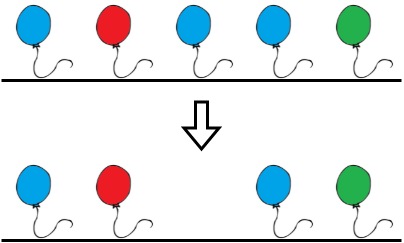
Input: colors = "abaac", neededTime = [1,2,3,4,5]
Output: 3
Explanation: In the above image, 'a' is blue, 'b' is red, and 'c' is green.
Bob can remove the blue balloon at index 2. This takes 3 seconds.
There are no longer two consecutive balloons of the same color. Total time = 3.
Example 2:
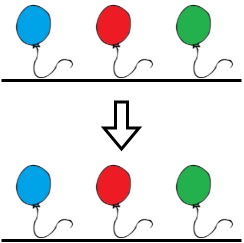
Input: colors = "abc", neededTime = [1,2,3]
Output: 0
Explanation: The rope is already colorful. Bob does not need to remove any balloons from the rope.
Example 3:
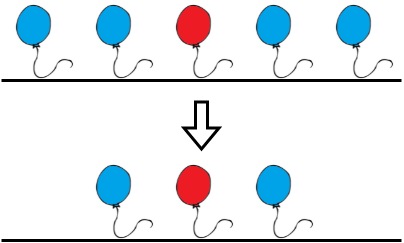
Input: colors = "aabaa", neededTime = [1,2,3,4,1]
Output: 2
Explanation: Bob will remove the balloons at indices 0 and 4. Each balloons takes 1 second to remove.
There are no longer two consecutive balloons of the same color. Total time = 1 + 1 = 2.
Constraints:
n == colors.length == neededTime.length1 <= n <= 1051 <= neededTime[i] <= 104colorscontains only lowercase English letters.
Approach Overview
Problem Overview: You receive a string colors where each character represents a balloon color and an array neededTime where neededTime[i] is the time required to remove the i-th balloon. Adjacent balloons cannot share the same color in the final rope. Remove balloons with minimum total time so that no two neighbors have identical colors.
Approach 1: Two Pointer Greedy (O(n) time, O(1) space)
This problem becomes simple once you notice that conflicts only occur inside groups of consecutive identical colors. For every such group, you must remove all balloons except the one with the highest removal time. Use two pointers (or a running group tracker) to iterate through the string and detect segments where colors[i] == colors[i-1]. Within each segment, accumulate the total removal time while keeping track of the maximum cost balloon to keep. The minimum removal time for the group equals sum - max. This greedy decision works because keeping the most expensive balloon minimizes the total cost of removals. The algorithm scans the array once, making it O(n) time and O(1) extra space. This technique is common in greedy problems on arrays and strings where local optimal choices lead to a global optimum.
Approach 2: Dynamic Programming with State Compression (O(n) time, O(1) space)
The same logic can also be expressed with dynamic programming. Define a state that tracks the maximum removal cost balloon kept in the current color segment and the minimum cost accumulated so far. When the current balloon has a different color from the previous one, the state resets because no conflict exists. When the colors match, a decision is required: remove the current balloon or remove the previously kept balloon. The cheaper option is added to the total cost while the state keeps the balloon with the larger removal time for future comparisons. State compression reduces the DP storage to a few variables since each step depends only on the previous state. The resulting algorithm still runs in O(n) time with O(1) space but frames the solution as a decision process, which some candidates find easier when reasoning about transitions.
Recommended for interviews: The greedy two-pointer approach is what interviewers typically expect. It demonstrates the ability to recognize that each same-color segment can be solved independently and that keeping the maximum-cost balloon minimizes removals. Explaining the segment insight clearly usually matters more than the code itself. Mentioning the dynamic programming interpretation shows deeper understanding of state transitions and optimization.
Approach 1: Two Pointer Approach
This is a greedy technique using two pointers. Iterate over the string of balloon colors. For each sequence of consecutive balloons of the same color, use one pointer to find the maximum time required to remove a balloon (among those consecutive balloons). Accumulate the total removal time by subtracting this maximum time from the sum of all removal times for the sequence.
Complexity
Time Complexity: O(n), where n is the number of balloons. We iterate through the array once.
Space Complexity: O(1), no additional space is used other than a few variables.
Approach 2: Dynamic Programming with State Compression
This approach uses dynamic programming (DP) with state compression to minimize the time required to make all the balloons non-consecutive in terms of color. The solution leverages optimization by compressing the state to monitor the necessary reduction within nested loops over sequences of consecutive duplicates.
This C solution utilizes a dynamic programming array to store minimum times dynamically adjusted as pairs of consecutive balloons come into play. It keeps track of multiple states based on whether the current or previous balloons of the same color should be retained.
Complexity
Time Complexity: O(n), for looping through the list.
Space Complexity: O(1), only using a couple of elements for the DP state transitions.
Approach 3: Two Pointers + Greedy
We can use two pointers to point to the beginning and end of the current consecutive balloons with the same color, then calculate the total time s of these consecutive balloons with the same color, as well as the maximum time mx. If the number of consecutive balloons with the same color is greater than 1, we can greedily choose to keep the balloon with the maximum time and remove the other balloons with the same color, which takes time s - mx, and add it to the answer. Then we continue to traverse until all balloons are traversed.
The time complexity is O(n) and the space complexity is O(1), where n is the number of balloons.
Complexity Comparison
| Approach | Complexity |
|---|---|
| Two Pointer Approach | Time Complexity: O(n), where n is the number of balloons. We iterate through the array once. |
| Dynamic Programming with State Compression | Time Complexity: O(n), for looping through the list. |
| Two Pointers + Greedy | — |
Detailed Complexity Analysis
| Approach | Time | Space | When to Use |
|---|---|---|---|
| Two Pointer Greedy | O(n) | O(1) | Best general solution. Detect consecutive color groups and keep the maximum cost balloon. |
| Dynamic Programming (State Compression) | O(n) | O(1) | Useful when reasoning about decision transitions between removing current vs previous balloon. |
Video Solution
Minimum Time To Make Rope Colorful - Leetcode 1578 - Python • NeetCodeIO • 18,837 views views
Watch 9 more video solutions →Frequently Asked Questions
Is Minimum Time to Make Rope Colorful easy or hard?
Minimum Time to Make Rope Colorful Python/Java solution
How to solve Minimum Time to Make Rope Colorful in O(n)?
What is the best approach for Minimum Time to Make Rope Colorful?
Is Minimum Time to Make Rope Colorful asked at Google/Amazon/Meta?
What data structure is used in Minimum Time to Make Rope Colorful?
What is the time complexity of Minimum Time to Make Rope Colorful?
Ready to solve this problem?
Practice Minimum Time to Make Rope Colorful with our built-in code editor and test cases.
Practice on FleetCode