
Minimum Garden Perimeter to Collect Enough Apples - Solution & Explanation
Problem Statement
In a garden represented as an infinite 2D grid, there is an apple tree planted at every integer coordinate. The apple tree planted at an integer coordinate (i, j) has |i| + |j| apples growing on it.
You will buy an axis-aligned square plot of land that is centered at (0, 0).
Given an integer neededApples, return the minimum perimeter of a plot such that at least neededApples apples are inside or on the perimeter of that plot.
The value of |x| is defined as:
xifx >= 0-xifx < 0
Example 1:
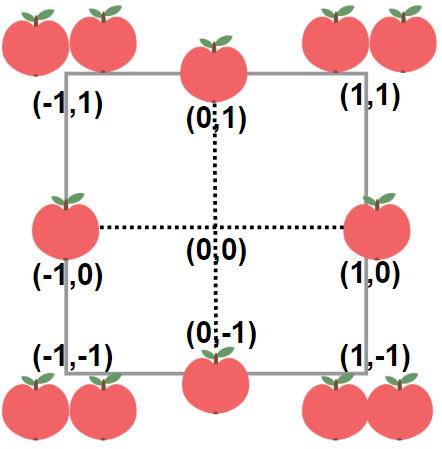
Input: neededApples = 1
Output: 8
Explanation: A square plot of side length 1 does not contain any apples.
However, a square plot of side length 2 has 12 apples inside (as depicted in the image above).
The perimeter is 2 * 4 = 8.
Example 2:
Input: neededApples = 13
Output: 16
Example 3:
Input: neededApples = 1000000000
Output: 5040
Constraints:
1 <= neededApples <= 1015
Approach Overview
Problem Overview: You are given neededApples. Apples grow on an infinite grid where the number of apples increases as you expand a square garden centered at the origin. The task is to find the minimum perimeter of a square garden that collects at least neededApples.
The garden expands in square layers. If the side length reaches distance k from the center, the garden perimeter becomes 8 * k. The key observation is that apples accumulate in predictable mathematical patterns as layers expand.
Approach 1: Iterative Expansion Approach (O(sqrt(n)) time, O(1) space)
Expand the garden one square layer at a time. Let k represent the current layer distance from the center. Each new layer contributes 12 * k^2 apples to the total. Start from k = 1, add apples layer by layer, and stop when the cumulative count reaches or exceeds neededApples. Once the correct layer is found, compute the perimeter as 8 * k. This approach works because the apple pattern follows a deterministic formula, so you only simulate layer growth instead of scanning grid cells. Time complexity is O(sqrt(n)) since the required layer grows roughly with the cube root/square-root scale of the target apples, and space usage remains O(1).
Approach 2: Mathematical Calculation with Binary Search (O(log n) time, O(1) space)
The cumulative number of apples within k layers follows the closed-form formula total = 2 * k * (k + 1) * (2 * k + 1). Instead of expanding sequentially, treat the problem as finding the smallest k such that this formula is at least neededApples. Because the function is strictly increasing, you can apply binary search on the value of k. For each midpoint, compute the apple total using the formula and adjust the search bounds accordingly. Once the minimal valid k is found, return 8 * k. This approach leverages mathematical pattern recognition and avoids iterative accumulation, making it significantly faster for very large inputs.
Recommended for interviews: Interviewers usually expect you to first recognize the layer pattern and derive the formula for total apples. A simple iterative expansion demonstrates understanding of the pattern. The stronger solution uses the mathematical formula with binary search to reduce the search space to O(log n), which shows comfort with monotonic functions and optimization techniques.
Approach 1: Iterative Expansion Approach
In this approach, you simulate expanding squares centered at (0, 0) incrementally and calculate the apples contained within each square until the apple count meets or exceeds the `neededApples`.
In the C solution, we iterate through square layers, where each square layer contributes 12 * k * k apples (considering all contributions on each segment). We keep track of the total apples accumulated and stop when it exceeds `neededApples`. The perimeter is simply the side k multiplied by 8.
Complexity
Time Complexity: O(sqrt(n)) where `n` is the number of needed apples, since we incrementally check squares.
Space Complexity: O(1) as we use only a fixed number of variables.
Approach 2: Mathematical Calculation Approach
This approach formulates a mathematical solution to avoid iterative calculations by directly finding the k such that the sum of apples within the square is equal to or greater than the neededApples.
The C solution calculates an approximation for 'k' directly and adjusts iteratively to the needed apple count precision. This leverages mathematical summation of the series formed by square dimensions.
Complexity
Time Complexity: O(1) for initial approximation and O(sqrt(k)) for convergence to precise 'k'.
Space Complexity: O(1).
Approach 3: Default Approach
Code
Python
Java
C++
Go
TypeScript
Complexity Comparison
| Approach | Complexity |
|---|---|
| Iterative Expansion Approach | Time Complexity: O(sqrt(n)) where `n` is the number of needed apples, since we incrementally check squares. |
| Mathematical Calculation Approach | Time Complexity: O(1) for initial approximation and O(sqrt(k)) for convergence to precise 'k'. |
| Default Approach | — |
Detailed Complexity Analysis
| Approach | Time | Space | When to Use |
|---|---|---|---|
| Iterative Expansion | O(sqrt(n)) | O(1) | Good for quickly implementing the idea once the layer pattern is known |
| Mathematical Formula + Binary Search | O(log n) | O(1) | Best for very large inputs where iterative expansion may take many steps |
Video Solution
Leetcode: Minimum Garden Perimeter • Coding For Dummies • 2,438 views views
Watch 5 more video solutions →Frequently Asked Questions
Is Minimum Garden Perimeter to Collect Enough Apples easy or hard?
Minimum Garden Perimeter to Collect Enough Apples Python/Java solution
How to solve Minimum Garden Perimeter to Collect Enough Apples in O(log n)?
What is the best approach for Minimum Garden Perimeter to Collect Enough Apples?
Is Minimum Garden Perimeter to Collect Enough Apples asked at Google/Amazon/Meta?
What data structure is used in Minimum Garden Perimeter to Collect Enough Apples?
What is the time complexity of Minimum Garden Perimeter to Collect Enough Apples?
Ready to solve this problem?
Practice Minimum Garden Perimeter to Collect Enough Apples with our built-in code editor and test cases.
Practice on FleetCode