
Minimum Cuts to Divide a Circle - Solution & Explanation
Problem Statement
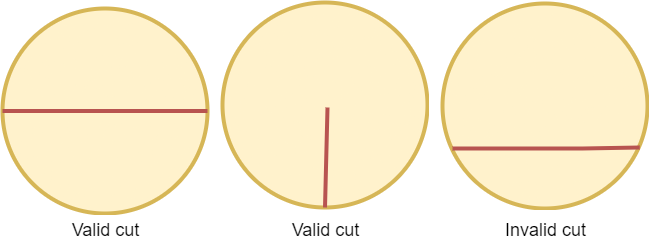
A valid cut in a circle can be:
- A cut that is represented by a straight line that touches two points on the edge of the circle and passes through its center, or
- A cut that is represented by a straight line that touches one point on the edge of the circle and its center.
Some valid and invalid cuts are shown in the figures below.
Given the integer n, return the minimum number of cuts needed to divide a circle into n equal slices.
Example 1:
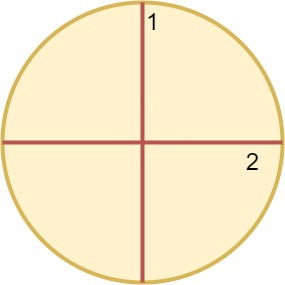
Input: n = 4
Output: 2
Explanation:
The above figure shows how cutting the circle twice through the middle divides it into 4 equal slices.
Example 2:
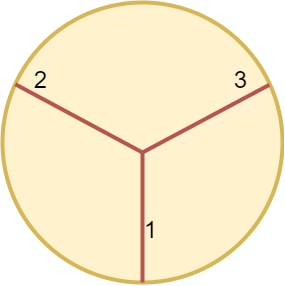
Input: n = 3
Output: 3
Explanation:
At least 3 cuts are needed to divide the circle into 3 equal slices.
It can be shown that less than 3 cuts cannot result in 3 slices of equal size and shape.
Also note that the first cut will not divide the circle into distinct parts.
Constraints:
1 <= n <= 100
Approach Overview
Problem Overview: Given an integer n, determine the minimum number of straight cuts required to divide a circle into exactly n equal slices. Each cut is a straight line across the circle and can intersect previous cuts.
Approach 1: Iterative Simulation of Cuts (O(n) time, O(1) space)
This approach simulates the cutting process conceptually. Start from a single whole circle and reason about how many additional slices each new cut can produce. If you keep adding cuts one by one, you track the total pieces formed until reaching n. The logic relies on recognizing how a cut across the circle can create new regions depending on where it passes relative to previous cuts. While simple to reason about, this method still performs repeated checks or iterations up to n, making it less efficient than a direct formula.
The approach is useful for understanding the geometry behind the problem. It helps you visualize how slices increase as you add diameters or chords. However, since the relationship between cuts and slices follows a predictable pattern, simulation becomes unnecessary once the pattern is recognized.
Approach 2: Mathematical Calculation for Minimum Cuts (O(1) time, O(1) space)
The optimal solution comes from a simple geometric observation. If n == 1, no cuts are needed. When n is even, each cut can pass through the center (a diameter) and create two equal slices. With n/2 diameters, you get exactly n equal pieces. When n is odd, diameters alone cannot produce the required symmetry, so each slice requires its own cut, resulting in n cuts.
This reduces the problem to a constant-time formula: return 0 if n == 1, return n / 2 if n is even, otherwise return n. No loops, no data structures, and no geometric construction are required. The entire solution relies on recognizing the symmetry properties of circles and diameters.
The reasoning falls under basic Math and Geometry concepts, especially symmetry and equal partitioning of circular regions.
Recommended for interviews: The mathematical observation is what interviewers expect. It shows you can move from brute reasoning to pattern recognition and reduce the problem to an O(1) formula. Mentioning the simulation idea briefly demonstrates understanding of the geometry, but implementing the constant-time solution shows stronger problem-solving skill.
Approach 1: Mathematical Calculation for Minimum Cuts
When you have a circle, dividing it into n equal parts can be achieved depending on whether n is even or odd.
- Even: When n is even, you can achieve this with n/2 cuts through the center because each cut through the center divides the circle into two equal parts.
- Odd: When n is odd, each cut after the first one can pass through the center, adding one more section than the previous even count, so you must use n cuts.
In this Python solution, the key logic is whether n is even or odd. If n is even, dividing n by 2 gives the number of cuts needed. If n is odd, n cuts are required.
Complexity
The time complexity is O(1) since the calculations involved are basic arithmetic operations. The space complexity is also O(1) because no additional data structures are used.
Approach 2: Iterative Simulation of Cuts
This approach involves simulating the division by using iterations and manually counting the number of cuts. It covers each scenario by first considering it as a line that does not pass through the center of the circle, but subsequently confirms the equal division of the circle.
Start with 1 cut and multiply by 2 each time after incrementing. Repeat until the number of distinct segments is no less than n.
Complexity
The while loop ensures that the computation quickly reaches a point , O(log n) time complexity and O(1) space complexity.
Approach 3: Case Discussion
- When
n=1, no cutting is needed, so the number of cuts is0; - When
nis odd, there is no collinear situation, and at leastncuts are needed; - When
nis even, they can be collinear in pairs, and at least\frac{n}{2}cuts are needed.
In summary, we can get:
$
ans = \begin{cases}
n, & n \gt 1  and  n  is odd \
\frac{n}{2}, & n  is even \
\end{cases}
The time complexity is O(1), and the space complexity is O(1)$.
Complexity Comparison
| Approach | Complexity |
|---|---|
| Mathematical Calculation for Minimum Cuts | The time complexity is O(1) since the calculations involved are basic arithmetic operations. The space complexity is also O(1) because no additional data structures are used. |
| Iterative Simulation of Cuts | The while loop ensures that the computation quickly reaches a point , O(log n) time complexity and O(1) space complexity. |
| Case Discussion | — |
Detailed Complexity Analysis
| Approach | Time | Space | When to Use |
|---|---|---|---|
| Iterative Simulation of Cuts | O(n) | O(1) | Useful for understanding how slices grow with each cut or when deriving the mathematical pattern |
| Mathematical Calculation | O(1) | O(1) | Best choice for interviews and production solutions due to constant-time computation |
Video Solution
2481. Minimum Cuts to Divide a Circle (Leetcode Easy) • Programming Live with Larry • 393 views views
Watch 9 more video solutions →Frequently Asked Questions
Is Minimum Cuts to Divide a Circle easy or hard?
Minimum Cuts to Divide a Circle Python/Java solution
How to solve Minimum Cuts to Divide a Circle in O(1)?
What is the best approach for Minimum Cuts to Divide a Circle?
Is Minimum Cuts to Divide a Circle asked at Google/Amazon/Meta?
What data structure is used in Minimum Cuts to Divide a Circle?
What is the time complexity of Minimum Cuts to Divide a Circle?
Ready to solve this problem?
Practice Minimum Cuts to Divide a Circle with our built-in code editor and test cases.
Practice on FleetCode