
Lonely Pixel I - Solution & Explanation
Problem Statement
Given an m x n picture consisting of black 'B' and white 'W' pixels, return the number of black lonely pixels.
A black lonely pixel is a character 'B' that located at a specific position where the same row and same column don't have any other black pixels.
Example 1:
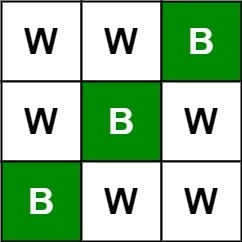
Input: picture = [["W","W","B"],["W","B","W"],["B","W","W"]]
Output: 3
Explanation: All the three 'B's are black lonely pixels.
Example 2:
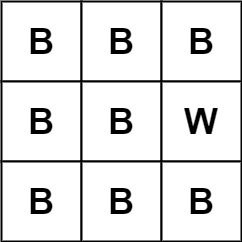
Input: picture = [["B","B","B"],["B","B","W"],["B","B","B"]]
Output: 0
Constraints:
m == picture.lengthn == picture[i].length1 <= m, n <= 500picture[i][j]is'W'or'B'.
Approach Overview
Problem Overview: You are given a 2D picture containing characters 'B' (black) and 'W' (white). A black pixel is considered lonely if it is the only black pixel in its row and its column. The task is to count how many such pixels exist in the matrix.
Approach 1: Brute Force Row and Column Scan (O(mn(m+n)) time, O(1) space)
Iterate through every cell in the matrix. When you encounter a 'B', scan the entire row and entire column to check if any other 'B' exists. If both the row and column contain exactly one black pixel, increment the result. This approach performs repeated row and column scans for each candidate pixel, which increases the total work significantly. It is straightforward and useful for validating correctness but inefficient for larger matrices.
Approach 2: Counting + Enumeration (O(mn) time, O(m+n) space)
Precompute the number of black pixels in each row and each column. Create two arrays: rowCount[m] and colCount[n]. First pass: iterate through the matrix and increment the corresponding row and column counters whenever you see 'B'. Second pass: iterate again and check each 'B'. If rowCount[i] == 1 and colCount[j] == 1, that pixel is lonely and contributes to the answer.
The key insight is that loneliness depends only on counts, not positions of other pixels. Precomputing these counts avoids repeated scans and reduces the complexity to a single linear pass over the grid plus a verification pass. This pattern appears frequently in matrix problems where row and column statistics are reused.
The implementation uses simple arrays or hash maps depending on the language. In most cases arrays are enough because indices correspond directly to rows and columns. The logic is deterministic: count first, then enumerate candidates. This is a common counting trick used in problems involving grids, frequency tracking, or uniqueness checks in array and hash table style problems.
Recommended for interviews: Counting + Enumeration. Interviewers expect you to avoid repeated row/column scans and instead store counts. The brute force approach demonstrates understanding of the condition, but the optimized counting method shows you can reduce redundant work and reach the optimal O(mn) solution.
Solution
According to the problem description, we need to count the number of black pixels in each row and column, which are recorded in the arrays rows and cols respectively. Then we traverse each black pixel, check whether there is only one black pixel in its row and column. If so, we increment the answer by one.
The time complexity is O(m times n), and the space complexity is O(m + n), where m and n are the number of rows and columns in the matrix respectively.
Code
Python
Java
C++
Go
TypeScript
Detailed Complexity Analysis
| Approach | Time | Space | When to Use |
|---|---|---|---|
| Brute Force Row & Column Scan | O(mn(m+n)) | O(1) | When first reasoning about the problem or validating correctness on small grids |
| Counting + Enumeration | O(mn) | O(m+n) | General optimal solution for interview and production scenarios |
Video Solution
531 - Lonely Pixel I (LeetCode) • Programmer Fellas • 230 views views
Watch 2 more video solutions →Frequently Asked Questions
Is Lonely Pixel I easy or hard?
Lonely Pixel I Python/Java solution
How to solve Lonely Pixel I in O(n)?
What is the best approach for Lonely Pixel I?
Is Lonely Pixel I asked at Google/Amazon/Meta?
What data structure is used in Lonely Pixel I?
What is the time complexity of Lonely Pixel I?
Ready to solve this problem?
Practice Lonely Pixel I with our built-in code editor and test cases.
Practice on FleetCode