
Largest Local Values in a Matrix - Solution & Explanation
Problem Statement
You are given an n x n integer matrix grid.
Generate an integer matrix maxLocal of size (n - 2) x (n - 2) such that:
maxLocal[i][j]is equal to the largest value of the3 x 3matrix ingridcentered around rowi + 1and columnj + 1.
In other words, we want to find the largest value in every contiguous 3 x 3 matrix in grid.
Return the generated matrix.
Example 1:
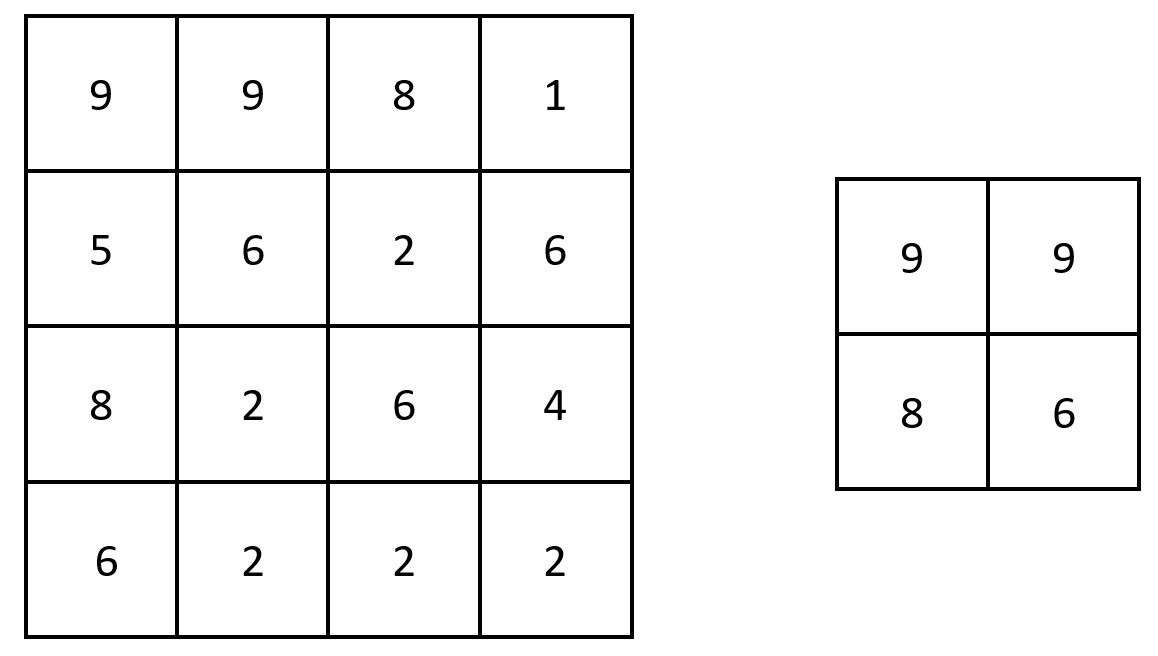
Input: grid = [[9,9,8,1],[5,6,2,6],[8,2,6,4],[6,2,2,2]]
Output: [[9,9],[8,6]]
Explanation: The diagram above shows the original matrix and the generated matrix.
Notice that each value in the generated matrix corresponds to the largest value of a contiguous 3 x 3 matrix in grid.
Example 2:
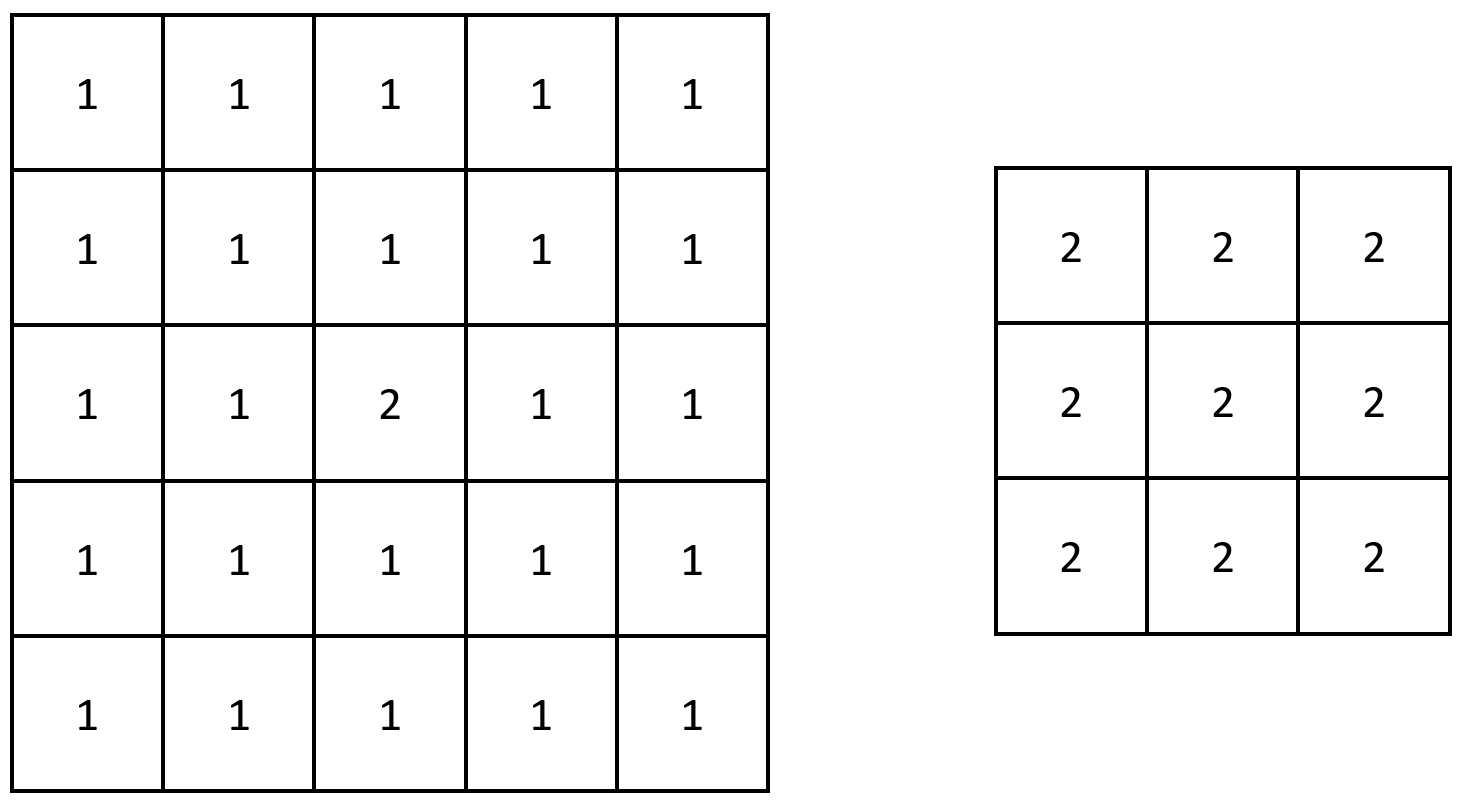
Input: grid = [[1,1,1,1,1],[1,1,1,1,1],[1,1,2,1,1],[1,1,1,1,1],[1,1,1,1,1]]
Output: [[2,2,2],[2,2,2],[2,2,2]]
Explanation: Notice that the 2 is contained within every contiguous 3 x 3 matrix in grid.
Constraints:
n == grid.length == grid[i].length3 <= n <= 1001 <= grid[i][j] <= 100
Approach Overview
Problem Overview: Given an n x n integer grid, compute a new matrix where each cell contains the maximum value inside the corresponding 3 x 3 submatrix of the original grid. The resulting matrix has size (n-2) x (n-2) because each result cell represents the largest element in a local window.
Approach 1: Greedy 3x3 Window Scan (O(n²) time, O(1) space)
The direct approach iterates over every possible 3 x 3 window in the grid. For each top-left position (i, j), scan the nine elements from grid[i..i+2][j..j+2] and track the maximum value. Store that value in the output matrix at position (i, j). Since each window checks exactly nine elements, the constant factor is small and the overall complexity becomes O(n²). This works well because the problem size is limited and no extra data structures are required.
The key idea is that each local region is independent. You simply iterate through the matrix using nested loops and compute the maximum within each small window. This approach relies only on basic iteration over an array and works naturally for problems involving fixed-size neighborhoods in a matrix.
Approach 2: Dynamic Programming / Precomputed Maximums (O(n²) time, O(n²) space)
Another strategy reduces repeated comparisons by precomputing maximum values. First compute horizontal maximums for every group of three consecutive elements in each row. Store these in an auxiliary matrix. Then compute vertical maximums across three consecutive rows using the intermediate results. Each step reuses previously computed maximums, avoiding repeated scans of the same cells.
This dynamic programming style approach transforms the problem into two passes: row preprocessing and column aggregation. The time complexity remains O(n²), but the number of repeated comparisons drops because each element contributes to multiple windows through cached results. The tradeoff is additional O(n²) memory for intermediate storage.
Recommended for interviews: The greedy window scan is what most interviewers expect. It is simple, readable, and clearly demonstrates how to iterate through a matrix while evaluating local neighborhoods. The dynamic programming version shows optimization thinking, but the brute window scan already achieves optimal asymptotic complexity for this problem.
Approach 1: Dynamic Programming Approach
This approach leverages dynamic programming techniques to break down the problem into overlapping subproblems and solve them using a bottom-up manner. The core idea is to store the results of subproblems to avoid redundant computations, therefore optimizing the solution.
In the C solution, we initialize an array to store the results of subproblems. We iterate through possible states and fill this array based on previous computations, adhering to the defined recurrence relation relevant for the problem.
Complexity
Time Complexity: O(n)
Space Complexity: O(n)
Approach 2: Greedy Approach
The greedy approach aims to find a solution by making the most favorable choice at every stage, intending to reach an overall optimal solution. This approach might not always work for all types of problems but can provide simpler solutions where applicable.
In the C implementation, we iterate through each element, making what seems to be the optimal choice without revisiting previous choices. The greedy selection criteria are based on current state conditions.
Complexity
Time Complexity: O(n)
Space Complexity: O(1)
Approach 3: Default Approach
Code
Python
Java
C++
Go
TypeScript
Complexity Comparison
| Approach | Complexity |
|---|---|
| Dynamic Programming Approach | Time Complexity: O(n) |
| Greedy Approach | Time Complexity: O(n) |
| Default Approach | — |
Detailed Complexity Analysis
| Approach | Time | Space | When to Use |
|---|---|---|---|
| Greedy 3x3 Window Scan | O(n²) | O(1) | Best general solution. Simple nested loops scanning each 3x3 region. |
| Dynamic Programming (Precomputed Maximums) | O(n²) | O(n²) | Useful when reducing repeated comparisons or demonstrating preprocessing techniques. |
Video Solution
Largest Local Values in a Matrix - Leetcode 2373 - Python • NeetCodeIO • 11,420 views views
Watch 9 more video solutions →Frequently Asked Questions
Is Largest Local Values in a Matrix easy or hard?
Largest Local Values in a Matrix Python/Java solution
How to solve Largest Local Values in a Matrix in O(n²)?
What is the best approach for Largest Local Values in a Matrix?
Is Largest Local Values in a Matrix asked at Google/Amazon/Meta?
What data structure is used in Largest Local Values in a Matrix?
What is the time complexity of Largest Local Values in a Matrix?
Ready to solve this problem?
Practice Largest Local Values in a Matrix with our built-in code editor and test cases.
Practice on FleetCode