
Find the Degree of Each Vertex - Solution & Explanation
Practice this problemProblem Statement
You are given a 2D integer array matrix of size n x n representing the adjacency matrix of an undirected graph with n vertices labeled from 0 to n - 1.
matrix[i][j] = 1indicates that there is an edge between verticesiandj.matrix[i][j] = 0indicates that there is no edge between verticesiandj.
The degree of a vertex is the number of edges connected to it.
Return an integer array ans of size n where ans[i] represents the degree of vertex i.
Example 1:
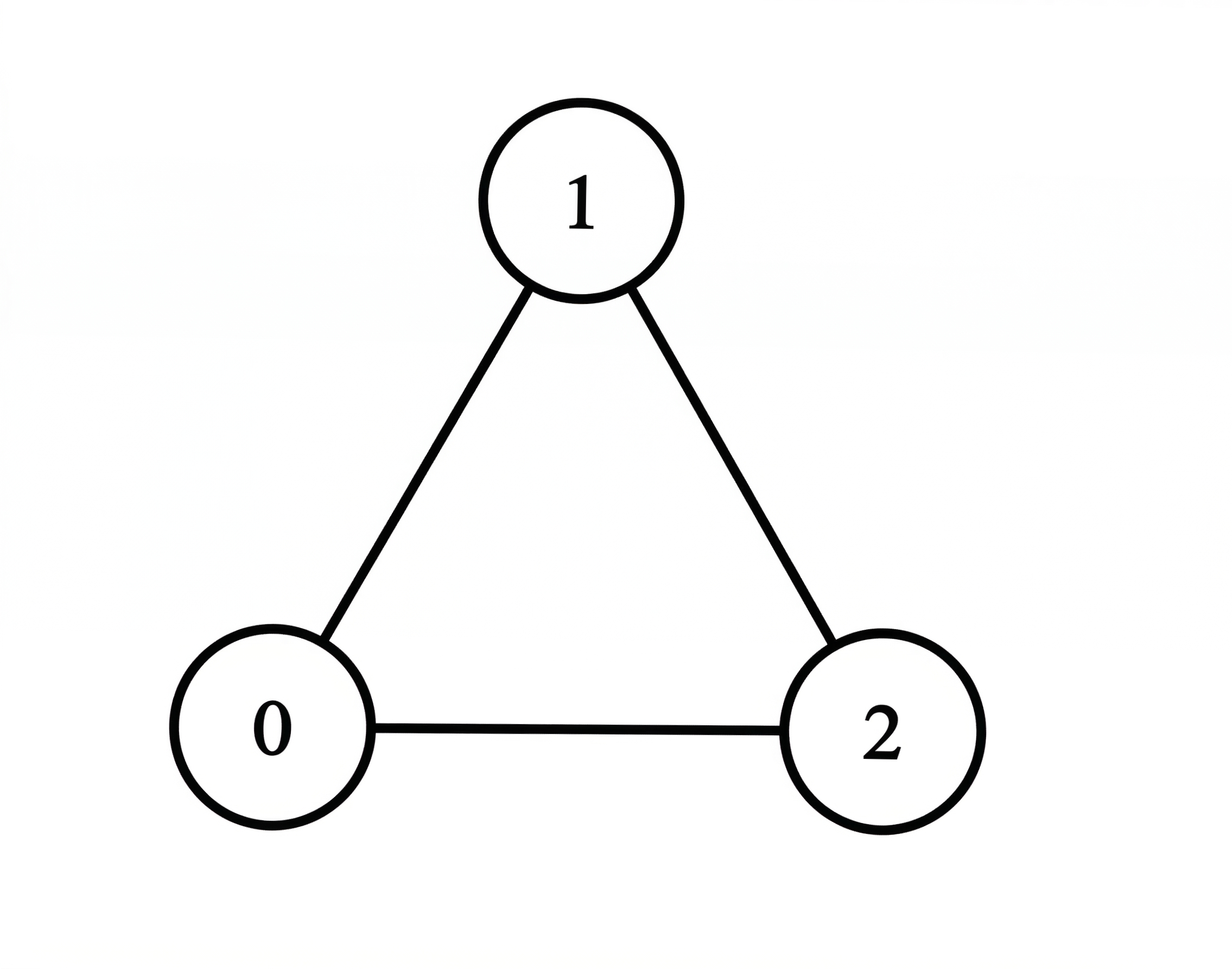
Input: matrix = [[0,1,1],[1,0,1],[1,1,0]]
Output: [2,2,2]
Explanation:
- Vertex 0 is connected to vertices 1 and 2, so its degree is 2.
- Vertex 1 is connected to vertices 0 and 2, so its degree is 2.
- Vertex 2 is connected to vertices 0 and 1, so its degree is 2.
Thus, the answer is [2, 2, 2].
Example 2:
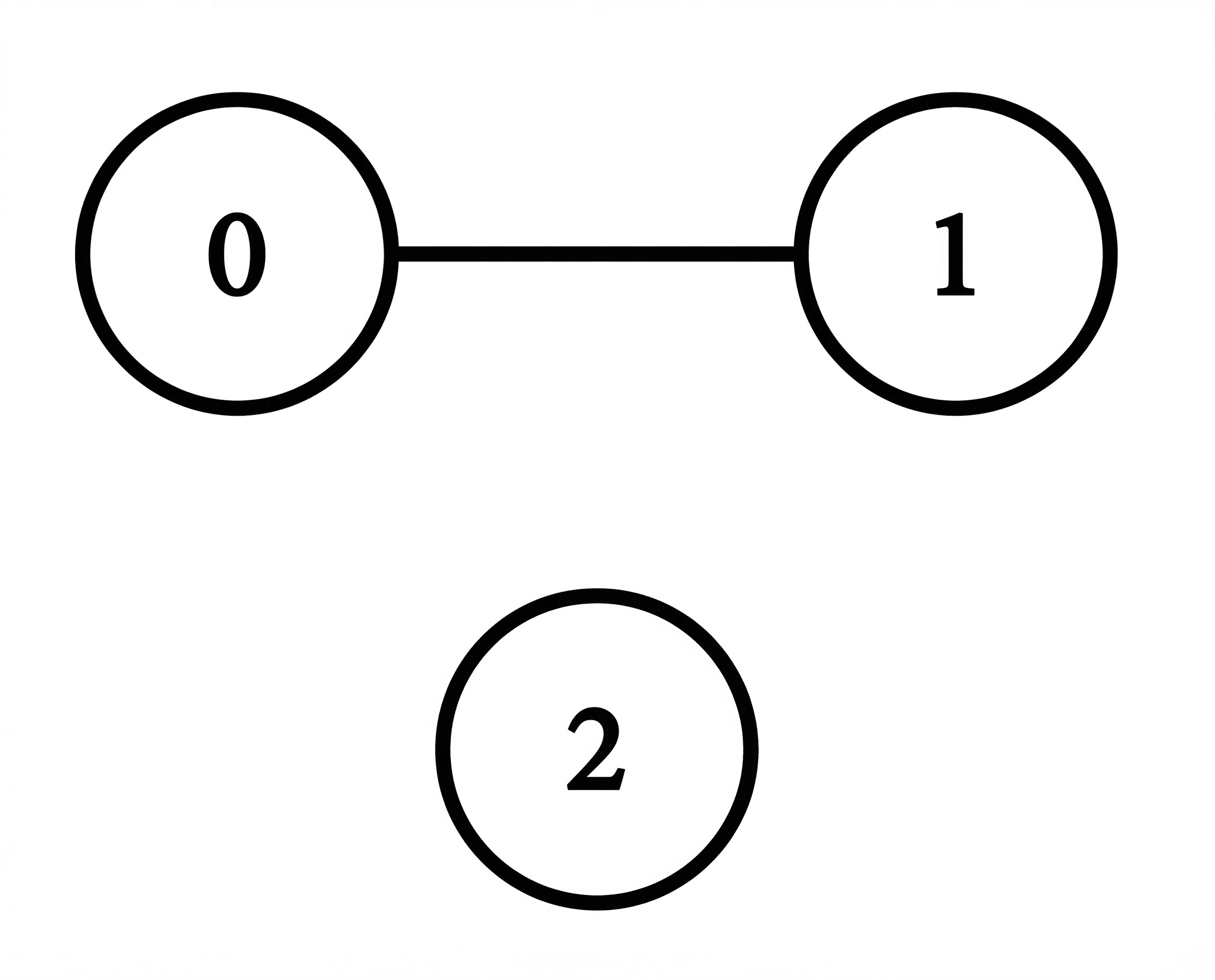
Input: matrix = [[0,1,0],[1,0,0],[0,0,0]]
Output: [1,1,0]
Explanation:
- Vertex 0 is connected to vertex 1, so its degree is 1.
- Vertex 1 is connected to vertex 0, so its degree is 1.
- Vertex 2 is not connected to any vertex, so its degree is 0.
Thus, the answer is [1, 1, 0].
Example 3:
Input: matrix = [[0]]
Output: [0]
Explanation:
There is only one vertex and it has no edges connected to it. Thus, the answer is [0].
Constraints:
1 <= n == matrix.length == matrix[i].length <= 100matrix[i][i] == 0matrix[i][j]is either 0 or 1matrix[i][j] == matrix[j][i]
Approach Overview
Problem Overview: You are given a graph and need to compute the degree of every vertex. The degree of a vertex is the number of edges connected to it. For an undirected graph, each edge contributes +1 to the degree of both endpoints.
Approach 1: Adjacency Matrix Scan (O(V²) time, O(V²) space)
If the graph is represented as an adjacency matrix, you can compute the degree of a vertex by summing all values in its row. Iterate through every column of the row and count how many edges exist. This approach works directly with matrix representations but scales poorly because you must scan V entries for each vertex. Prefer this only when the graph is already stored as a matrix or when the graph is dense.
Approach 2: Edge List Counting (O(E) time, O(V) space)
Most problems provide the graph as a list of edges. Initialize an array degree[V] with zeros. Iterate through each edge (u, v). Increment degree[u] and degree[v]. Each edge contributes to exactly two vertices in an undirected graph. The key insight: you never need to explicitly build the full structure of the graph—just count how many times each vertex appears in the edge list. This avoids unnecessary storage and runs in linear time relative to the number of edges.
Approach 3: Adjacency List Construction (O(V + E) time, O(V + E) space)
Another common solution builds an adjacency list first. Use an array of lists where each index represents a vertex. While iterating through edges, append neighbors to both vertices. Once the adjacency list is built, the degree of a vertex equals the length of its neighbor list. This representation is standard for many graph algorithms and becomes useful if additional traversal such as DFS or BFS is required later.
For simple counting tasks, Approach 2 is usually the cleanest. It relies only on an array and a single pass through the edges, making it both memory‑efficient and fast. The adjacency list method is slightly heavier but integrates naturally with other graph operations like traversal. Both rely on straightforward array indexing and sequential iteration.
Recommended for interviews: The edge list counting approach. Start by explaining the definition of vertex degree, then show that every edge increments two counters. The interviewer sees that you understand graph fundamentals and can reduce the problem to a simple linear pass. Mentioning the adjacency list alternative shows awareness of standard graph representations used in broader graph problems.
Solution
We can directly simulate the process of computing the degree of each vertex.
For each vertex i, we traverse its corresponding row matrix[i] and count the number of elements equal to 1, which is exactly the degree of vertex i.
The time complexity is O(n^2), where n is the number of vertices in the graph. Ignoring the space consumed by the answer array, the space complexity is O(1).
Code
Python
Java
C++
Go
TypeScript
Detailed Complexity Analysis
| Approach | Time | Space | When to Use |
|---|---|---|---|
| Adjacency Matrix Scan | O(V²) | O(V²) | When the graph is already stored as an adjacency matrix or when the graph is dense |
| Edge List Counting | O(E) | O(V) | Best general solution when edges are provided directly |
| Adjacency List Construction | O(V + E) | O(V + E) | Useful when you also need BFS/DFS or other graph traversals |
Video Solutions (5)
Find the Degree of Each Vertex | LeetCode XXXX | Weekly Contest 497 | Java Code | Developer Coder
Frequently Asked Questions
Is Find the Degree of Each Vertex easy or hard?
Find the Degree of Each Vertex Python/Java solution
How to solve Find the Degree of Each Vertex in O(n)?
What is the best approach for Find the Degree of Each Vertex?
Is Find the Degree of Each Vertex asked at Google/Amazon/Meta?
What data structure is used in Find the Degree of Each Vertex?
What is the time complexity of Find the Degree of Each Vertex?
Ready to solve this problem?
Practice Find the Degree of Each Vertex with our built-in code editor and test cases.
Practice on FleetCodeProblem Info
Table of Contents
Practice this problem
Open in Editor