
Extract Kth Character From The Rope Tree - Solution & Explanation
Problem Statement
You are given the root of a binary tree and an integer k. Besides the left and right children, every node of this tree has two other properties, a string node.val containing only lowercase English letters (possibly empty) and a non-negative integer node.len. There are two types of nodes in this tree:
- Leaf: These nodes have no children,
node.len = 0, andnode.valis some non-empty string. - Internal: These nodes have at least one child (also at most two children),
node.len > 0, andnode.valis an empty string.
The tree described above is called a Rope binary tree. Now we define S[node] recursively as follows:
- If
nodeis some leaf node,S[node] = node.val, - Otherwise if
nodeis some internal node,S[node] = concat(S[node.left], S[node.right])andS[node].length = node.len.
Return k-th character of the string S[root].
Note: If s and p are two strings, concat(s, p) is a string obtained by concatenating p to s. For example, concat("ab", "zz") = "abzz".
Example 1:
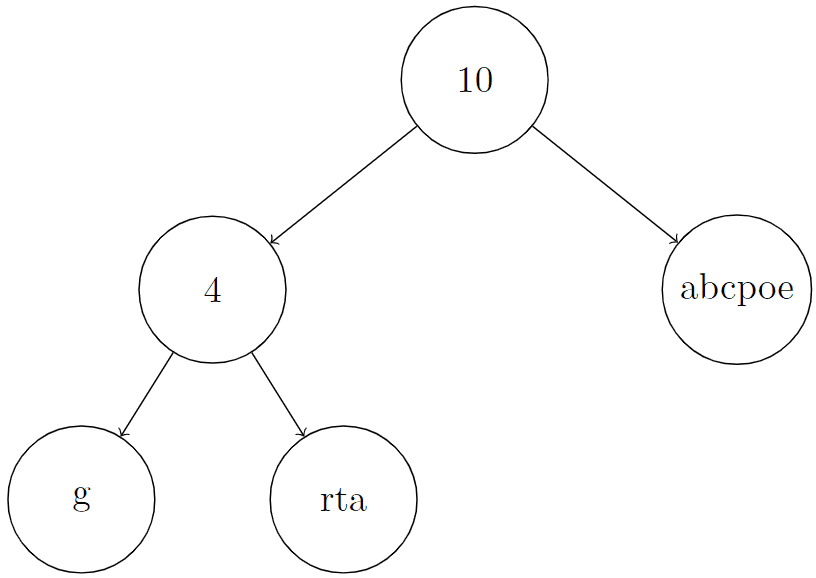
Input: root = [10,4,"abcpoe","g","rta"], k = 6
Output: "b"
Explanation: In the picture below, we put an integer on internal nodes that represents node.len, and a string on leaf nodes that represents node.val.
You can see that S[root] = concat(concat("g", "rta"), "abcpoe") = "grtaabcpoe". So S[root][5], which represents 6th character of it, is equal to "b".
Example 2:
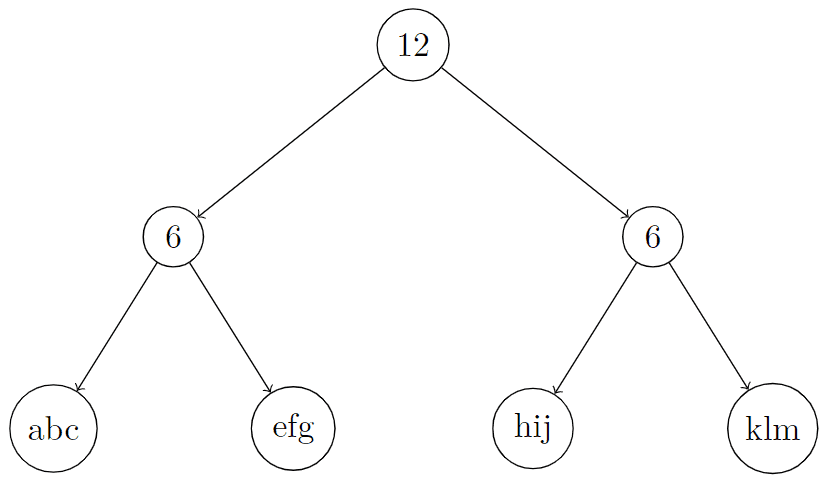
Input: root = [12,6,6,"abc","efg","hij","klm"], k = 3
Output: "c"
Explanation: In the picture below, we put an integer on internal nodes that represents node.len, and a string on leaf nodes that represents node.val.
You can see that S[root] = concat(concat("abc", "efg"), concat("hij", "klm")) = "abcefghijklm". So S[root][2], which represents the 3rd character of it, is equal to "c".
Example 3:
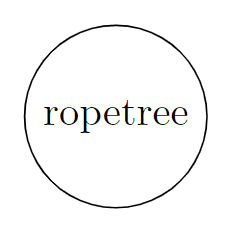
Input: root = ["ropetree"], k = 8
Output: "e"
Explanation: In the picture below, we put an integer on internal nodes that represents node.len, and a string on leaf nodes that represents node.val.
You can see that S[root] = "ropetree". So S[root][7], which represents 8th character of it, is equal to "e".
Constraints:
- The number of nodes in the tree is in the range
[1, 103] node.valcontains only lowercase English letters0 <= node.val.length <= 500 <= node.len <= 104- for leaf nodes,
node.len = 0andnode.valis non-empty - for internal nodes,
node.len > 0andnode.valis empty 1 <= k <= S[root].length
Approach Overview
Problem Overview: A rope tree stores a long string across multiple nodes. Leaf nodes contain actual string fragments, while internal nodes store the length of the left subtree. The task is to return the k-th character of the full concatenated string without building the entire string explicitly.
Approach 1: Build Full String with DFS (O(n) time, O(n) space)
The straightforward approach performs a depth‑first traversal and concatenates all leaf strings in order. Traverse the tree using DFS, append each leaf node's val to a result buffer, then return the character at index k. This approach treats the rope like a normal binary tree and ignores the optimization provided by the rope structure.
While simple, this method defeats the purpose of a rope. Constructing the full string costs O(n) time and space where n is the total number of characters. It works for small inputs or when you already need the entire string, but it is inefficient when only a single character is required.
Approach 2: Navigate Using Rope Length Metadata (O(h) time, O(1) space)
The rope structure is designed to support efficient indexing. Each internal node stores len, representing the total length of the left subtree. This value tells you exactly where the split occurs in the logical string.
Start at the root and compare k with len. If k < len, the target character lies in the left subtree, so move left. Otherwise, move to the right subtree and update the index to k - len. Continue this process until reaching a leaf node. At that point, simply return node.val[k].
This method works like binary search over the concatenated string. Instead of scanning characters, you skip entire substrings using the stored lengths. The traversal depth is bounded by the tree height h, so the runtime is O(h) with constant extra space. The algorithm naturally follows the structure of a tree and can be implemented using either iteration or depth‑first search.
Recommended for interviews: The length‑guided traversal is the approach interviewers expect. It demonstrates that you understand how rope data structures enable fast indexing without reconstructing the entire string. Mentioning the brute‑force DFS solution shows baseline understanding, but the optimized navigation using len proves you recognize how the rope structure is intended to be used.
Solution
Try this approach in the editor →Detailed Complexity Analysis
| Approach | Time | Space | When to Use |
|---|---|---|---|
| DFS Build Full String | O(n) | O(n) | Simple implementation or when the full concatenated string is required |
| Length-Guided Rope Traversal | O(h) | O(1) | Best approach for indexing a rope tree without constructing the entire string |
Video Solution
leetcode 2689. Extract Kth Character From The Rope Tree - recursion and comments on problem • Code-Yao • 165 views views
Frequently Asked Questions
Is Extract Kth Character From The Rope Tree easy or hard?
Extract Kth Character From The Rope Tree Python/Java solution
How to solve Extract Kth Character From The Rope Tree in O(h)?
What is the best approach for Extract Kth Character From The Rope Tree?
Is Extract Kth Character From The Rope Tree asked at Google/Amazon/Meta?
What data structure is used in Extract Kth Character From The Rope Tree?
What is the time complexity of Extract Kth Character From The Rope Tree?
Ready to solve this problem?
Practice Extract Kth Character From The Rope Tree with our built-in code editor and test cases.
Practice on FleetCode