
Delete Node in a Linked List - Solution & Explanation
Problem Statement
There is a singly-linked list head and we want to delete a node node in it.
You are given the node to be deleted node. You will not be given access to the first node of head.
All the values of the linked list are unique, and it is guaranteed that the given node node is not the last node in the linked list.
Delete the given node. Note that by deleting the node, we do not mean removing it from memory. We mean:
- The value of the given node should not exist in the linked list.
- The number of nodes in the linked list should decrease by one.
- All the values before
nodeshould be in the same order. - All the values after
nodeshould be in the same order.
Custom testing:
- For the input, you should provide the entire linked list
headand the node to be givennode.nodeshould not be the last node of the list and should be an actual node in the list. - We will build the linked list and pass the node to your function.
- The output will be the entire list after calling your function.
Example 1:
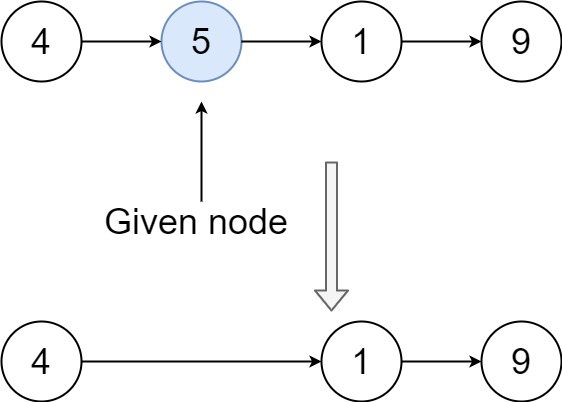
Input: head = [4,5,1,9], node = 5
Output: [4,1,9]
Explanation: You are given the second node with value 5, the linked list should become 4 -> 1 -> 9 after calling your function.
Example 2:
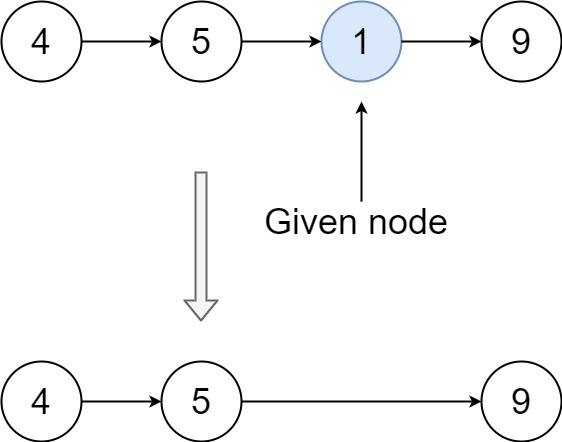
Input: head = [4,5,1,9], node = 1
Output: [4,5,9]
Explanation: You are given the third node with value 1, the linked list should become 4 -> 5 -> 9 after calling your function.
Constraints:
- The number of the nodes in the given list is in the range
[2, 1000]. -1000 <= Node.val <= 1000- The value of each node in the list is unique.
- The
nodeto be deleted is in the list and is not a tail node.
Approach Overview
Problem Overview: You’re given a reference to a node inside a singly linked list, not the head. The task is to delete that node from the list while keeping the rest of the list intact. The constraint is the key challenge: without access to the previous node, you can’t perform the usual pointer update.
Approach 1: Copy and Bypass (O(1) time, O(1) space)
This trick avoids needing the previous node. Copy the value from the next node into the current node using node.val = node.next.val. Then bypass the next node by updating the pointer: node.next = node.next.next. The original "next" node effectively disappears from the list. This works because the node to delete is guaranteed not to be the tail, so node.next always exists. The structure of the linked list remains valid and the deletion appears as if the original node was removed.
Approach 2: Utilize Two Pointers (O(n) time, O(1) space)
If the head of the list is available, you can traverse the list to locate the previous node. Use two pointers: one iterating through the list and another tracking the previous node. When the current pointer matches the node that needs deletion, update prev.next = curr.next to unlink it. This is the standard deletion method in a singly linked list. The traversal introduces linear time complexity, similar to many two pointer scanning patterns where one pointer follows another through the structure.
Recommended for interviews: The expected solution is the Copy and Bypass approach. Interviewers want to see whether you recognize the constraint that the previous node is unavailable. Copying the next node’s value and skipping it demonstrates a deep understanding of pointer manipulation in linked lists. The traversal approach shows baseline knowledge, but the O(1) trick is the real signal of problem-solving skill.
Approach 1: Copy and Bypass
This approach leverages the fact that we have access to the node to be deleted and that deletion does not mean removing from memory but rather bypassing this node.
By copying the value from the next node to the node to be deleted and rearranging the pointers, we can effectively 'delete' the node without needing access to the head of the list.
In C, we access the next node, copy its value into the current node, and link to its next pointer. Finally, we free the memory of the next node to clean up.
Complexity
Time Complexity: O(1) since we're performing constant-time operations.
Space Complexity: O(1) because we aren't using any auxiliary data structures.
Approach 2: Utilize Two Pointers
This approach uses two pointers to manage nodes, allowing for a genuine swap and linkage manipulation. It reinforces the conceptual understanding of linked list pointer adjustments.
Note: The fundamentals are the same as we still replace and link to carry out the 'deletion'.
In C, we manage two pointers internally to achieve the same result, illustrating the necessity to understand pointer accessibility and connectivity.
Complexity
Time Complexity: O(1), never fluctuating beyond direct node handling.
Space Complexity: O(1), not utilizing external structures.
Approach 3: Node assignment
We can replace the value of the current node with the value of the next node, and then delete the next node. This can achieve the purpose of deleting the current node.
Time complexity O(1), space complexity O(1).
Code
Python
Java
C++
Go
TypeScript
JavaScript
C#
C
Complexity Comparison
| Approach | Complexity |
|---|---|
| Copy and Bypass | Time Complexity: O(1) since we're performing constant-time operations. Space Complexity: O(1) because we aren't using any auxiliary data structures. |
| Utilize Two Pointers | Time Complexity: O(1), never fluctuating beyond direct node handling. Space Complexity: O(1), not utilizing external structures. |
| Node assignment | — |
Detailed Complexity Analysis
| Approach | Time | Space | When to Use |
|---|---|---|---|
| Copy and Bypass | O(1) | O(1) | When only the target node is given and it is guaranteed not to be the tail |
| Two Pointers Traversal | O(n) | O(1) | When the head pointer is available and you want the standard deletion logic |
Video Solution
Delete Node in a Linked List | Can you solve it ? • take U forward • 132,816 views views
Watch 9 more video solutions →Frequently Asked Questions
Is Delete Node in a Linked List easy or hard?
Delete Node in a Linked List Python/Java solution
How to solve Delete Node in a Linked List in O(1)?
What is the best approach for Delete Node in a Linked List?
Is Delete Node in a Linked List asked at Google/Amazon/Meta?
What data structure is used in Delete Node in a Linked List?
What is the time complexity of Delete Node in a Linked List?
Ready to solve this problem?
Practice Delete Node in a Linked List with our built-in code editor and test cases.
Practice on FleetCode