
Count Connected Components in LCM Graph - Solution & Explanation
Problem Statement
You are given an array of integers nums of size n and a positive integer threshold.
There is a graph consisting of n nodes with the ith node having a value of nums[i]. Two nodes i and j in the graph are connected via an undirected edge if lcm(nums[i], nums[j]) <= threshold.
Return the number of connected components in this graph.
A connected component is a subgraph of a graph in which there exists a path between any two vertices, and no vertex of the subgraph shares an edge with a vertex outside of the subgraph.
The term lcm(a, b) denotes the least common multiple of a and b.
Example 1:
Input: nums = [2,4,8,3,9], threshold = 5
Output: 4
Explanation:
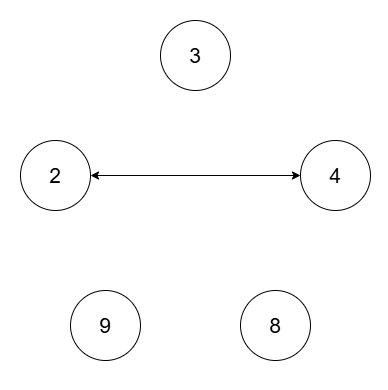
The four connected components are (2, 4), (3), (8), (9).
Example 2:
Input: nums = [2,4,8,3,9,12], threshold = 10
Output: 2
Explanation:
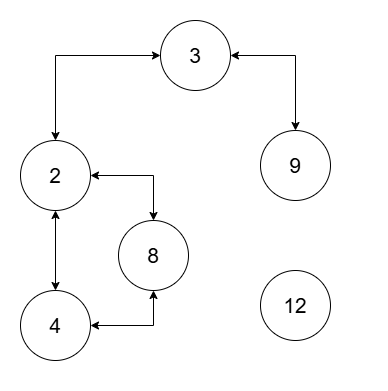
The two connected components are (2, 3, 4, 8, 9), and (12).
Constraints:
1 <= nums.length <= 1051 <= nums[i] <= 109- All elements of
numsare unique. 1 <= threshold <= 2 * 105
Approach Overview
Problem Overview: You are given an array of integers and a threshold. Treat each value as a node. Two nodes are connected if the lcm(a, b) of their values is less than or equal to the threshold. The task is to determine how many connected components exist in this implicit graph.
Approach 1: Union Find with Multiples (≈ O(T log T) time, O(T) space)
The key observation is that if lcm(a, b) ≤ threshold, both numbers must divide some common multiple that is also ≤ threshold. Instead of checking every pair (which would be too slow), iterate through values up to the threshold and connect numbers through their multiples. Use a Union Find structure to merge indices whose values share a valid LCM relationship. For each number x, iterate through multiples k * x that do not exceed the threshold and union the nodes containing those values. Numbers greater than the threshold cannot form valid LCM edges with others and remain isolated components. Path compression and union-by-rank keep operations nearly constant time.
Approach 2: Graph Construction + DFS (O(n² log(max)) time, O(n²) space)
A direct approach constructs the graph explicitly. For every pair of numbers, compute lcm(a, b) = a * b / gcd(a, b). If the result is ≤ threshold, add an undirected edge. After building the adjacency list, run DFS or BFS to count connected components. This uses standard graph traversal techniques. The main drawback is the quadratic pair check and repeated gcd calculations, making it impractical for large inputs.
The efficient solution relies heavily on insights from number theory. Instead of evaluating LCM for every pair, it groups numbers through shared multiples that stay within the threshold.
Recommended for interviews: The Union Find approach is what interviewers typically expect. It demonstrates that you can translate a number theory constraint into a connectivity problem and optimize pairwise checks using disjoint sets. Explaining the brute-force pair comparison first shows understanding of the graph definition, while transitioning to Union Find with multiples shows the algorithmic insight needed to scale the solution.
Approach 1: Union Find
Try this approach in the editor →Approach 2: DFS
Try this approach in the editor →Complexity Comparison
| Approach | Complexity |
|---|---|
| Union Find | — |
| DFS | — |
Detailed Complexity Analysis
| Approach | Time | Space | When to Use |
|---|---|---|---|
| Graph Construction + DFS | O(n² log M) | O(n²) | Useful for understanding the definition of the LCM graph or when n is very small |
| Union Find with Multiples | ≈ O(T log T) | O(T) | Optimal approach for large inputs; avoids pairwise LCM checks using number theory |
Video Solution
3378. Count Connected Components in LCM Graph | Factors/Divisors | DSU | Graph + Math | Part-1 • Aryan Mittal • 1,784 views views
Watch 2 more video solutions →Frequently Asked Questions
Is Count Connected Components in LCM Graph easy or hard?
Count Connected Components in LCM Graph Python/Java solution
How to solve Count Connected Components in LCM Graph in O(T log T)?
What is the best approach for Count Connected Components in LCM Graph?
Is Count Connected Components in LCM Graph asked at Google/Amazon/Meta?
What data structure is used in Count Connected Components in LCM Graph?
What is the time complexity of Count Connected Components in LCM Graph?
Ready to solve this problem?
Practice Count Connected Components in LCM Graph with our built-in code editor and test cases.
Practice on FleetCodeProblem Info
Table of Contents
Practice this problem
Open in Editor