
Construct Binary Tree from Preorder and Inorder Traversal - Solution & Explanation
Problem Statement
Given two integer arrays preorder and inorder where preorder is the preorder traversal of a binary tree and inorder is the inorder traversal of the same tree, construct and return the binary tree.
Example 1:
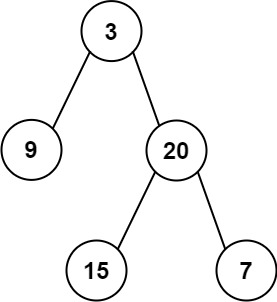
Input: preorder = [3,9,20,15,7], inorder = [9,3,15,20,7]
Output: [3,9,20,null,null,15,7]
Example 2:
Input: preorder = [-1], inorder = [-1]
Output: [-1]
Constraints:
1 <= preorder.length <= 3000inorder.length == preorder.length-3000 <= preorder[i], inorder[i] <= 3000preorderandinorderconsist of unique values.- Each value of
inorderalso appears inpreorder. preorderis guaranteed to be the preorder traversal of the tree.inorderis guaranteed to be the inorder traversal of the tree.
Approach Overview
Problem Overview: You receive two arrays representing the preorder and inorder traversal of a binary tree. Your task is to reconstruct the original binary tree structure. Each value appears exactly once, which guarantees a unique tree.
Approach 1: Recursive Divide and Conquer with Hash Map (O(n) time, O(n) space)
The key observation: preorder traversal always gives you the root first, while inorder traversal tells you how the tree splits into left and right subtrees. Start with the first element in preorder as the root. Use a hash map to store each value's index in the inorder array so you can locate the root position in O(1) time. Everything to the left of that index belongs to the left subtree, and everything to the right belongs to the right subtree.
Recursively repeat the same process for each subtree. Maintain a pointer that advances through the preorder array as you build nodes. This technique works because preorder determines node creation order, while inorder determines subtree boundaries. Building the index map reduces repeated searches and keeps the total runtime at O(n) with O(n) extra space for recursion and the hash map.
This solution combines divide and conquer with a hash table to efficiently rebuild the structure of a binary tree. Most interview solutions use this exact pattern.
Approach 2: Iterative Stack Simulation (O(n) time, O(n) space)
An iterative version simulates the recursive construction using a stack. Start by creating the root from the first preorder value and push it onto the stack. Traverse the preorder array and keep attaching nodes as left children until the current node matches the inorder pointer. Once a match occurs, pop nodes from the stack while values align with inorder, then attach the next node as a right child.
The stack represents the path of ancestors whose right subtree has not yet been constructed. The inorder pointer acts as a signal telling you when a subtree is finished. Each node is pushed and popped at most once, so the algorithm runs in O(n) time and uses O(n) stack space.
Recommended for interviews: The recursive hash map approach is the standard solution interviewers expect. It clearly demonstrates understanding of preorder vs inorder properties and divide-and-conquer reasoning. The iterative stack approach is also strong because it avoids recursion and shows deeper mastery of traversal mechanics.
Approach 1: Recursive Approach
This approach uses recursion to build the tree. We know that the first element of the preorder traversal is the root of the tree. We find that element in the inorder traversal to determine the elements of the left and right subtrees. We then recursively build the left and right subtrees.
Steps:
- Start with the entire range of the inorder traversal.
- The first element of the preorder list is the root; locate it in the inorder list.
- Divide the inorder list into left and right subtrees based on this root.
- Recursively build the left and right subtrees using the remaining elements of the preorder list.
- Use an index map to quickly locate the root in the inorder list, improving the performance to O(n).
This Python solution defines a TreeNode class and constructs the tree using a helper function. The helper function takes indices to track the ranges in the preorder and inorder lists, creating new TreeNode objects as necessary and using an index map for efficient lookups. This approach recursively builds the tree, taking care of each node's left and right subtrees.
Complexity
Time Complexity: O(n), where n is the number of nodes in the tree, because each node is processed once.
Space Complexity: O(n) for the recursion call stack and additional structures.
Approach 2: Iterative Approach
This approach uses an iterative method to build the binary tree using stacks. By leveraging the properties of the preorder and inorder sequences, we can keep track of the tree nodes that are yet to be processed. We utilize a stack data structure to maintain the hierarchy of nodes as they are constructed.
Steps:
- Initialize a stack with the root node derived from the first element of the preorder list.
- Iterate over the preorder traversal and use the stack to construct tree nodes.
- Maintain a pointer to track the current position in the inorder sequence, pushing new nodes onto the stack for left children and popping from the stack for right children.
This C++ solution employs an iterative approach using a stack. By iterating through the preorder list, it constructs the tree and manages left and right children using the stack. This method avoids recursion and utilizes an index map for inorder positions.
Code
C++
JavaScript
Complexity
Time Complexity: O(n), where n is the number of nodes, as each node is visited once.
Space Complexity: O(n) for the stack and additional data structures like the map for indices.
Approach 3: Hash Table + Recursion
The first node preorder[0] in the pre-order sequence is the root node. We find the position k of the root node in the in-order sequence, which can divide the in-order sequence into the left subtree inorder[0..k] and the right subtree inorder[k+1..].
Through the intervals of the left and right subtrees, we can calculate the number of nodes in the left and right subtrees, assumed to be a and b. Then in the pre-order nodes, the a nodes after the root node are the left subtree, and the b nodes after that are the right subtree.
Therefore, we design a function dfs(i, j, n), where i and j represent the starting positions of the pre-order sequence and the in-order sequence, respectively, and n represents the number of nodes. The return value of the function is the binary tree constructed with preorder[i..i+n-1] as the pre-order sequence and inorder[j..j+n-1] as the in-order sequence.
The execution process of the function dfs(i, j, n) is as follows:
- If
n leq 0, it means there are no nodes, return a null node. - Take out the first node
v = preorder[i]of the pre-order sequence as the root node, and then use the hash tabledto find the positionkof the root node in the in-order sequence. Then the number of nodes in the left subtree isk - j, and the number of nodes in the right subtree isn - k + j - 1. - Recursively construct the left subtree
l = dfs(i + 1, j, k - j)and the right subtreer = dfs(i + 1 + k - j, k + 1, n - k + j - 1). - Finally, return the binary tree with
vas the root node andlandras the left and right subtrees, respectively.
The time complexity is O(n), and the space complexity is O(n). Here, n is the number of nodes in the binary tree.
Code
Python
Java
C++
Go
TypeScript
Rust
JavaScript
Complexity Comparison
| Approach | Complexity |
|---|---|
| Recursive Approach | Time Complexity: O(n), where n is the number of nodes in the tree, because each node is processed once. |
| Iterative Approach | Time Complexity: O(n), where n is the number of nodes, as each node is visited once. |
| Hash Table + Recursion | — |
Detailed Complexity Analysis
| Approach | Time | Space | When to Use |
|---|---|---|---|
| Recursive Divide and Conquer with Hash Map | O(n) | O(n) | Most common interview solution. Clear logic using preorder for roots and inorder for subtree boundaries. |
| Iterative Stack Construction | O(n) | O(n) | Useful when avoiding recursion or demonstrating deeper understanding of traversal mechanics. |
Video Solution
L34. Construct a Binary Tree from Preorder and Inorder Traversal | C++ | Java • take U forward • 455,238 views views
Watch 9 more video solutions →Frequently Asked Questions
Is Construct Binary Tree from Preorder and Inorder Traversal easy or hard?
Construct Binary Tree from Preorder and Inorder Traversal Python/Java solution
How to solve Construct Binary Tree from Preorder and Inorder Traversal in O(n)?
What is the best approach for Construct Binary Tree from Preorder and Inorder Traversal?
Is Construct Binary Tree from Preorder and Inorder Traversal asked at Google/Amazon/Meta?
What data structure is used in Construct Binary Tree from Preorder and Inorder Traversal?
What is the time complexity of Construct Binary Tree from Preorder and Inorder Traversal?
Ready to solve this problem?
Practice Construct Binary Tree from Preorder and Inorder Traversal with our built-in code editor and test cases.
Practice on FleetCodeProblem Info
Table of Contents
Practice this problem
Open in Editor